 Published on
09 Jul, 2026
Published on
09 Jul, 2026 Updated on 09 Jul, 2026
 5114
5114We have all experienced that terrifying moment. You are sitting in the living room with your aging parents or grandparents. Then they slowly creep to their favourite chair and gradually begin to push themselves up to head to the kitchen, but then they all stop. They cling to the armrest, make fists with their eyes closed, and wait until the room slows down or stops moving. You run over to check on them, your heart beating, and they say in unison, "I was kind of dizzy for a little bit.
As we grow older, the threat of falling looms large in our senior years, often unnoticed in our daily lives. No longer a nuisance, a single dizzy spell is now a danger. Unfortunately, we simply shrug off these moments. We rationalise feeling dizzy as "just getting older”. We convince ourselves that it is part of "getting older" and we can't avoid it. We give them a glass of water, they sit back down, and we hope it's not a problem again.
But frequent dizziness is never just a random mistake by the body. It is a clear, flashing warning light. Your body is trying to tell you that its internal grounding system is struggling to keep things stable.
To help our elders find their balance again, we need to look past the symptoms and understand what is actually happening inside. In Ayurveda, dizziness is not just one single problem. It happens for entirely different reasons depending on what is going on with the body's internal energies. Let us break down the most common reasons simply.
The Ayurvedic Perspective: The Season of Wind
To understand why dizziness happens so often in older age, we first have to look at how Ayurveda views the human lifespan.
Ayurveda divides our lives into three main stages. Childhood is the heavy, growing stage. Adulthood is the fiery, productive stage. But old age, usually starting around sixty, is the Vata stage of life.
The energy of Vata is air, space, movement, and wind. Dry, light, and delicate skin are common complaints as we age. As we grow older, our skin gets thinner, our joints crack, and we lose muscle weight. This light and airy Vata Dosha energy can become too high and rush into the head. Think about a big wind that blows through an empty bamboo stick. It causes instability, lightness, and dizziness (vertigo) or spinning, as Ayurveda terms it.
Doctor’s Note
While mild lightheadedness can sometimes happen when standing up too quickly, frequent or severe dizziness in older adults should never be dismissed as just a normal part of aging. It can be a vital warning sign of underlying medical conditions, such as cardiac arrhythmias, a transient ischemic attack (TIA) or stroke, severe anemia, or an adverse reaction to blood pressure medications. If a dizzy spell is accompanied by red-flag symptoms like sudden fainting (syncope), chest pain, numbness or weakness on one side of the body, difficulty speaking, or a sudden loss of vision, seek immediate emergency medical evaluation.

What Are The Triggers?
The internal imbalances and doshas get triggered in a few different ways, affecting the stability and balance of elderly people:
The Sudden Blackout: Vata Depletion
- How it feels: Your grandparent has been sitting or lying down for a period of time. When they get up, they see black around their eyes. They are extremely tired, weak, and may faint. As soon as you stand still, the feeling goes away altogether within one minute.
- What is actually happening: Modern medicine often calls this "postural hypotension", a sudden drop in blood pressure when changing positions. In Ayurveda, this is a classic sign of Vata drying out the body's vital fluids (Rasa dhatu). Because the elderly naturally have less internal moisture and weaker circulation, gravity pulls their blood down when they stand up, and their weakened system simply cannot pump it back up to the brain fast enough. It is a problem of sheer depletion and dryness.
The Spinning Room: Vata-Pitta Imbalance
- How it feels: This is much more violent and unsettling. They might just be turning their head on the pillow in bed, and suddenly the entire room starts spinning like a merry-go-round. They might feel intensely nauseous, sweaty, and have to lie perfectly still in the dark to make it stop.
- What is actually happening: This is often linked to inner ear problems (like vertigo). In Ayurvedic terms, this happens when the hot, sharp energy of Pitta mixes with the erratic wind of Vata. The heat creates inflammation deep inside the delicate channels of the inner ear, throwing off the body's internal spirit level. It feels sharp, overwhelming, and highly disorienting.
The Heavy Fog: Weak Digestion and Ama
- How it feels: This does not feel like a sudden spin. Instead, it is a constant, lingering wooziness. Your loved one might say their head feels incredibly heavy, foggy, or like it is stuffed with cotton. They feel lethargic, slightly dizzy all day long, and have no appetite.
- What is actually happening: Believe it or not, this type of dizziness starts in the stomach. As we age, our digestive fire (Agni) naturally weakens. If an elderly person is eating heavy, hard-to-digest foods, their stomach cannot process it. This creates a sticky, toxic waste called Ama. This heavy sludge travels up and literally blocks the energetic channels to the mind, starving the brain of fresh oxygen and clear energy.
Simple Daily Habits to Anchor the Body
If you've eliminated a medical emergency and your doctor assures you that all looks well on paper, it's time for the wisdom of ancient Ayurvedic medicine. There is no need to treat the raging current of this inner wind in a complex manner. All they need is to add some weight, warmth, and moisture to their daily routine.
Here are a few traditional practices to help keep your elders steady on their feet:
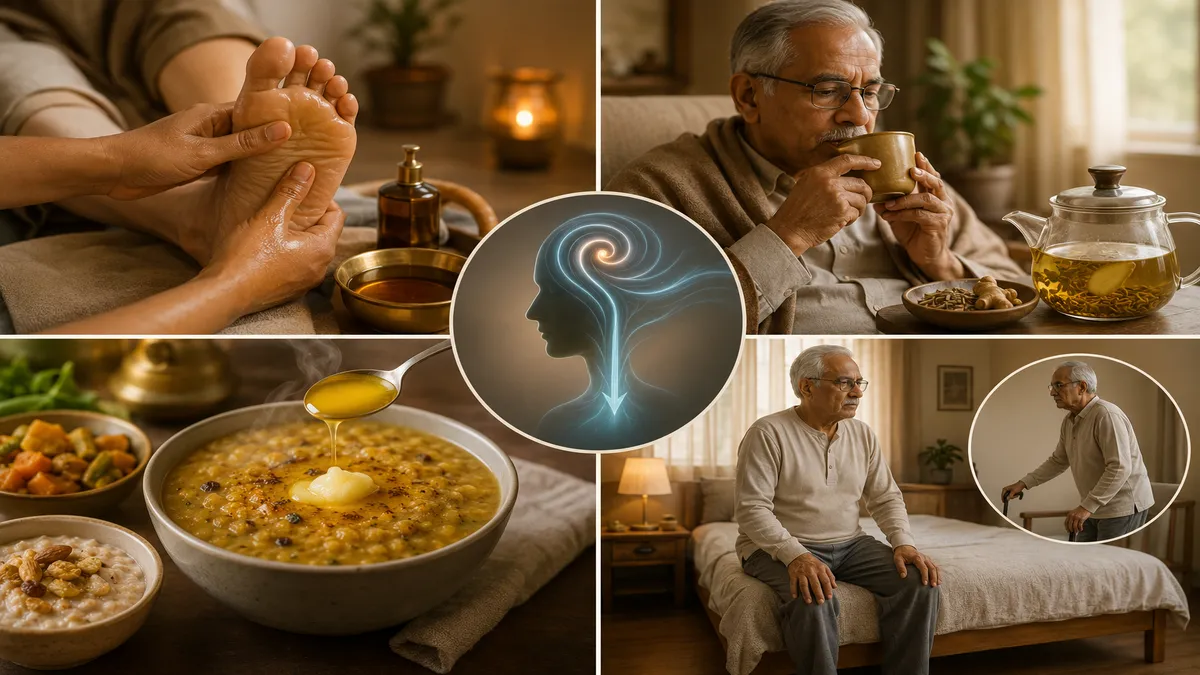
- The Magic of Foot Massage (Pada Abhyanga): If Vata is a light wind blowing up into the head, we need to pull that energy back down to the earth. Every night before bed, gently massage the soles of their feet with warm sesame oil. Sesame oil is heavy, warming, and deeply grounding. This simple, five-minute act dramatically calms the nervous system, pulls erratic energy downward, and helps them sleep deeply.
- Warm, Spiced Hydration: Elderly people often forget to drink water because their thirst cues fade. But dehydration makes dizziness instantly worse. Skip the plain, cold water. Instead, give them warm water boiled with a little bit of dry ginger or cumin. This not only hydrates their dried-out tissues but also keeps their weak digestive fire burning smoothly without chilling their stomach.
- Grounding, Nourishing Meals: Avoid giving them cold, raw salads, dry crackers, or cold milk straight from the fridge. These foods shoot Vata energy through the roof. Instead, their diet should look like a warm hug. Think of well-cooked dals, soft vegetable stews, and warm oatmeal. Always add a small spoonful of pure cow's ghee to their meals. Ghee is the ultimate brain tonic in Ayurveda; it lubricates dry channels and deeply nourishes the nervous system.
- The Two-Minute Rule: This is a simple lifestyle tweak, but it saves lives. Teach your loved ones never to jump straight out of bed or stand up from a chair quickly. Have them sit on the edge of the bed for two full minutes, take a few deep breaths, and let their blood pressure adjust to gravity before they try to walk.
Conclusion
We don't always need to panic when our aging loved ones feel a little unsteady, but we absolutely must pay attention. Our grandmothers understood that as the body ages, it requires a softer, gentler, and more grounded approach to everyday life.
Dizziness is simply the body's way of asking for more stability. By understanding the root cause, whether it is simple dryness, blocked digestion, or a sudden drop in energy, you can make beautiful, simple changes at home. Rub some warm oil on their feet, cook their meals with a little extra ghee, ensure their doctor has checked their daily pills, and help them move through their days with the safety, comfort, and steady grace they deserve.
References:
Dizziness and Imbalance in the Elderly: Age-related Decline in the Vestibular System - PMC
Dizziness Causes in the Elderly and Treatment Options
Dizziness in older adults - ScienceDirect
The Aging Vestibular System: Dizziness and Imbalance in the Elderly - PubMed
Older Adults and Balance Problems | National Institute on Aging