 Published on
17 Jun, 2026
Published on
17 Jun, 2026 Updated on 17 Jun, 2026
 5117
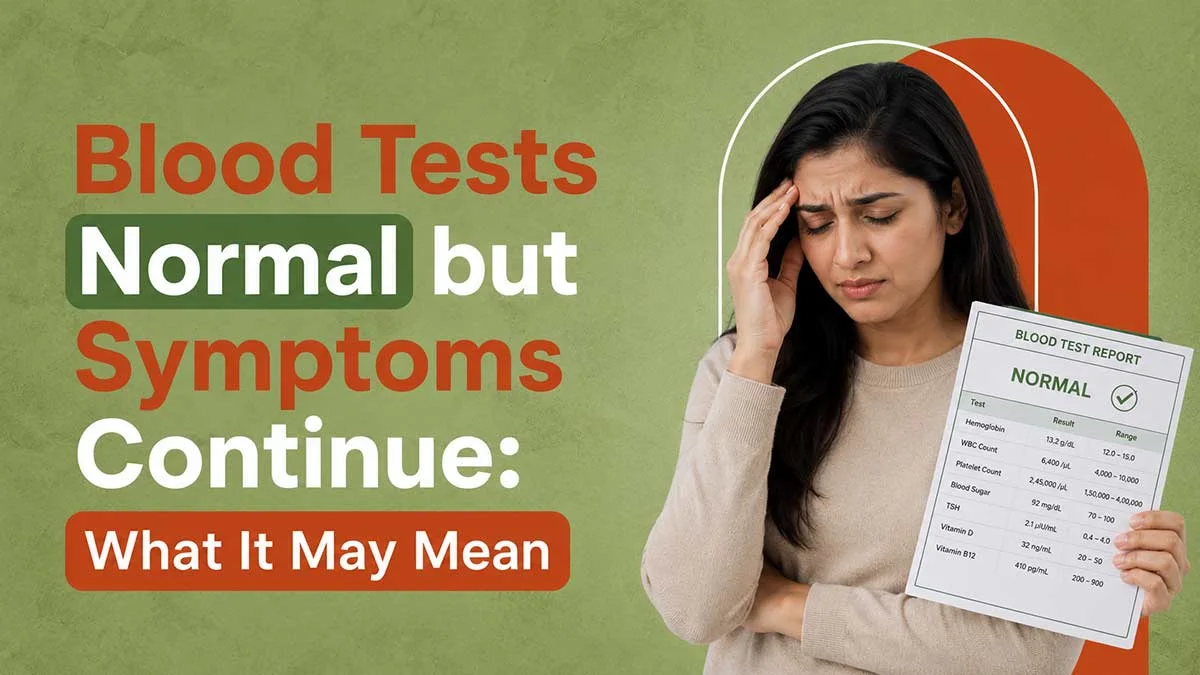
5117You have been feeling off for weeks. Maybe months. Tired in a way that sleep does not fix, a vague heaviness that follows you around, headaches that come and go without explanation, digestion that is never quite right, a brain that feels like it is running on low battery most of the time. So you do the responsible thing. You go to the doctor, get a full set of blood tests done, and wait for answers.
And then the results come back. Everything is completely normal.
The doctor seems reassured. You are supposed to feel reassured. But you do not, because you still feel exactly the same as before and now you have a piece of paper telling you nothing is wrong when your body is very clearly telling you otherwise.
This situation is more common than most people realise and far more valid than it is often made to feel. So let us actually talk about what is going on.
Why Normal Blood Tests Do Not Always Mean Everything Is Fine
Standard blood tests are genuinely useful and important. They check for a specific set of markers within defined reference ranges and when something falls outside those ranges, it flags a problem. But here is the part that does not get explained enough at the doctor's office.
Those reference ranges are based on population averages. They tell you whether your numbers fall within the range seen in most healthy people. What they do not tell you is whether your numbers are optimal for you specifically, whether something is trending in a concerning direction before it crosses a threshold, or whether there are imbalances happening in the body that standard blood panels are simply not designed to detect.
A thyroid result sitting at the very low end of normal and a thyroid result sitting at the very high end of normal are both reported as normal. But for many people, functioning at the low end of the thyroid range produces very real symptoms including fatigue, weight changes, brain fog, and low mood. The test says normal. The body says otherwise. Both are telling the truth.
What Might Actually Be Going On
When symptoms persist despite normal blood work, there are several possibilities worth exploring rather than dismissing:
- Subclinical imbalances that have not yet crossed diagnostic thresholds. Many conditions exist on a spectrum and standard tests only flag them once they cross a specific numerical line. Before that line, the condition is developing, the body is already responding to it, and symptoms are very real even though the numbers look fine on paper.
- Nutrient deficiencies that standard panels do not test for. A routine blood test typically checks haemoglobin, blood sugar, kidney function, liver function, and a few other markers. It does not automatically check Vitamin D, B12, magnesium, ferritin, zinc, or folate unless specifically requested. Deficiencies in any of these can cause significant fatigue, low mood, poor concentration, muscle weakness, and a general feeling of being unwell, all while every standard marker looks perfectly normal.
- Gut health issues that blood tests cannot see. Poor gut microbiome balance, intestinal permeability, low-grade gut inflammation, and digestive enzyme insufficiency do not show up on standard blood panels. Yet the gut is so deeply connected to every other system in the body that when it is struggling, almost everything else feels the effects. Fatigue, brain fog, skin issues, joint discomfort, mood changes, and immune issues can all trace back to a gut that is not functioning optimally even when blood work is unremarkable.
- Hormonal imbalances that standard panels miss. Standard hormonal testing is often limited. Cortisol, which governs the stress response, is rarely tested as part of a routine panel. Insulin sensitivity can be declining significantly before fasting glucose or even HbA1c shows it clearly. Oestrogen and progesterone fluctuations that cause real symptoms in women are often not tested unless specifically requested. The hormonal picture that standard blood work paints is frequently incomplete.
- Chronic low-grade stress and nervous system dysregulation. This one is real and it is underappreciated in conventional medicine. When the nervous system is stuck in a prolonged state of stress response, it produces a wide range of physical symptoms including fatigue, digestive upset, muscle tension, sleep disturbance, heart palpitations, and a general feeling of being unwell. None of this shows up in blood work because it is a functional issue rather than a structural one. The body is working differently, not necessarily breaking down in a way that leaves markers in the blood.
- Autoimmune conditions in their earliest stages. Some autoimmune conditions take years to develop fully and may produce symptoms long before standard antibody tests come back positive. The immune system is already reacting, the body is already producing symptoms, but the disease has not yet progressed to the point where standard markers cross into abnormal range.
What Ayurveda Sees That Blood Tests Cannot
Ayurveda describes six stages of disease development called Shat Kriya Kala. The first two or three stages involve functional imbalances, changes in how the body feels and operates, without any detectable structural change. In modern medicine these stages are essentially invisible because standard diagnostics are designed to detect structural and chemical changes rather than functional ones. In Ayurveda, this is precisely the most important time to intervene.
What does this mean practically? It means that symptoms like persistent fatigue, digestive sluggishness, brain fog, low mood, body heaviness, poor sleep, and a vague feeling of being off are taken completely seriously in Ayurveda as meaningful signs of early imbalance even when every blood test comes back normal. The symptom is considered real information about the body's state, not noise to be dismissed just because a number on a piece of paper looks fine.
Ayurveda assesses the body through different lenses including pulse diagnosis, the state of the digestive fire or Agni, the balance of the three doshas, the condition of the seven dhatus or body tissues, and the presence of Ama, the toxic residue that builds up when digestion is weak. None of these appear in blood work. All of them can explain symptoms that standard medicine cannot account for.
Herbs and Approaches That Help When Standard Medicine Has No Answers
When the blood work is normal but the body is clearly not thriving, Ayurveda offers a genuinely useful framework for support. The approach is not to treat a specific disease but to restore overall balance, strengthen the digestive fire, clear Ama, and nourish depleted tissues and systems.
A few Ayurvedic approaches that are particularly relevant here:
- Ashwagandha is deeply restorative for the nervous system and adrenal function. For people whose symptoms trace back to chronic stress and nervous system depletion, which is very often the case in people with normal blood work and persistent symptoms, Ashwagandha helps the body rebuild its capacity to handle stress and restores energy from a foundational level
- Triphala supports digestive health and gentle detoxification. When Ama is contributing to symptoms, clearing the gut and strengthening Agni often produces noticeable improvement in overall wellbeing even when no specific gut condition has been diagnosed
- Brahmi and Shankhapushpi are particularly useful when brain fog, poor concentration, and mental fatigue are prominent symptoms alongside physical tiredness. They calm the nervous system and support cognitive clarity in ways that address the functional aspect of these symptoms
- Shatavari is especially relevant for women experiencing unexplained fatigue, mood fluctuations, and hormonal symptoms that do not show clearly on standard panels. It supports hormonal balance and nourishes the reproductive and endocrine systems
- Chyawanprash as a daily rasayana or rejuvenating tonic supports immunity, energy, and overall tissue nourishment at a level that addresses the kind of generalised depletion that often underlies persistent unexplained symptoms
Practical Steps Worth Taking
Beyond Ayurvedic support, there are some practical steps that can help when standard blood work has not provided answers:
- Ask your doctor specifically about testing Vitamin D, B12, ferritin, magnesium, fasting insulin, and cortisol if these have not already been checked. These are commonly deficient and commonly missed in routine panels
- Consider seeing a functional medicine doctor or integrative health practitioner who is trained to look at the body as a whole system rather than a collection of individual markers
- Keep a detailed symptom diary that tracks when symptoms are better or worse, what you have eaten, your sleep quality, stress levels, and menstrual cycle, if relevant. Patterns in this diary often reveal triggers and connections that blood tests cannot
- Take gut health seriously even without a diagnosis. An elimination diet, reducing ultra-processed food, adding fermented foods, and supporting digestion with warm meals and adequate hydration can produce significant improvements in overall well-being
- Address sleep and stress as medical priorities rather than lifestyle preferences. Nervous system dysregulation from chronic poor sleep and stress can produce a wide range of physical symptoms that look like disease but respond dramatically to rest and stress management
The Bottom Line
Normal blood tests are a good thing. They genuinely rule out a lot of serious conditions and that matters. But they are not the final word on whether something is wrong with how your body is functioning and they were never designed to be.
If your blood work is normal and you still feel unwell, you are not imagining it. There are layers of assessment that standard blood panels do not cover and there are whole systems of medicine, Ayurveda being one of the most developed, that are specifically designed to work with the subtler functional imbalances that sit beneath the threshold of standard diagnosis.
Your symptoms are real information. Treat them that way. Keep looking for answers, ask for more specific testing, consider an integrative approach, and do not stop until you understand what your body is telling you.
References:
https://www.ncbi.nlm.nih.gov/pmc/articles/PMC1297605