 Published on
26 Jun, 2026
Published on
26 Jun, 2026 Updated on 26 Jun, 2026
 5111
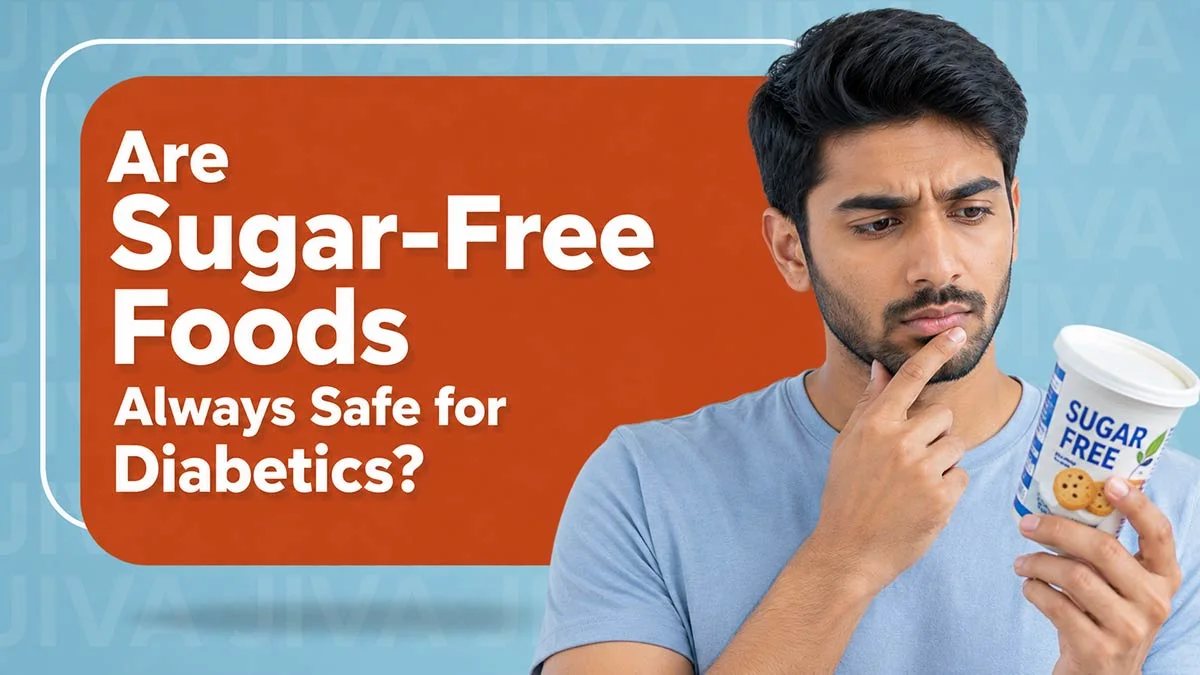
5111Walk into any supermarket in India today and you'll find an entire section dedicated to sugar-free everything. Biscuits, chocolates, juices, sweets, mithai, ice cream. All proudly wearing that "sugar-free" badge like it's some kind of health certificate.
And if you or someone you love has diabetes, you've probably reached for these products thinking you're making the smart choice. The safe choice. The responsible choice.
Here's the uncomfortable truth. Sugar-free does not automatically mean safe for diabetics. Not even close. And the marketing around these products is so convincing that millions of people with diabetes are consuming them daily without realising they might be doing themselves more harm than good.
What Does Sugar-Free Actually Mean
Before anything else, let's get clear on what sugar-free actually means on a food label. It means the product contains no added table sugar, which is sucrose. That's it. That's the entire promise.
It says nothing about:
- Total carbohydrate content
- Artificial sweeteners used
- Overall calorie count
- Effect on blood sugar levels
- Other ingredients that affect insulin response
A product can be completely sugar-free and still spike your blood sugar significantly. A product can be sugar-free and still be loaded with refined flour, unhealthy fats and artificial additives that cause their own problems for diabetics. The label is technically accurate and practically misleading at the same time.
The Artificial Sweetener Problem Nobody Talks About Enough
Most sugar-free products replace sugar with artificial sweeteners or sugar alcohols. These include things like aspartame, saccharin, sucralose, stevia, sorbitol, maltitol and xylitol. Each of these behaves differently in the body and not all of them are as harmless as the packaging suggests.
- Maltitol and sorbitol raise blood sugar too: These are sugar alcohols commonly used in sugar-free chocolates and sweets. They have a lower glycaemic index than sugar but they are not zero. Maltitol in particular raises blood sugar quite meaningfully and large amounts can cause significant spikes. Many diabetics consuming sugar-free chocolates made with maltitol are surprised to find their readings going up afterwards.
- Artificial sweeteners may disrupt gut bacteria: Emerging research suggests that sweeteners like saccharin and sucralose can negatively affect the gut microbiome. Since gut health is deeply connected to insulin sensitivity and blood sugar regulation, this is not a small concern for diabetics. A disrupted gut can actually make blood sugar harder to manage over time.
- Stevia is the safest but still not magic: Stevia is a natural plant-derived sweetener and is currently considered the safest option for diabetics. It does not raise blood sugar on its own. But products containing stevia still often contain other ingredients that affect blood sugar. Always read the full label not just the sweetener type.
The Hidden Carbohydrate Trap
This is probably the biggest issue with sugar-free foods that nobody explains clearly enough.
Carbohydrates convert to glucose in the body. All carbohydrates. Not just sugar. Refined flour, white rice, starch, corn syrup, dextrin, maltodextrin. All of these raise blood sugar. And sugar-free products are frequently made with refined flour and starch as their base because removing sugar from a biscuit or cake still leaves you needing structure and texture from somewhere.
A sugar-free biscuit made primarily with refined flour will raise blood sugar. Maybe slightly less dramatically than a regular biscuit but it will raise it. And people eating three or four of them because they think they're safe are getting a meaningful carbohydrate load without realising it.
Always check the total carbohydrate count on the nutrition label. Not just the sugar line. The total carbohydrates line. That number tells you what's actually going to affect your blood sugar.
Common Sugar-Free Foods and What They Actually Do
- Sugar-free biscuits and cookies: Usually made with refined flour, vegetable oil and artificial sweeteners. The flour alone raises blood sugar. Eating multiple biscuits compounds the effect significantly. These are not a free pass.
- Sugar-free chocolates: Often made with maltitol which does raise blood sugar. They also tend to be high in saturated fat. The "sugar-free" label here is one of the most misleading in the entire category.
- Sugar-free fruit juices: Even without added sugar, fruit juice contains natural fructose which is absorbed quickly and raises blood sugar. Removing added sugar from fruit juice still leaves you with a concentrated source of natural sugars and almost no fibre to slow absorption. Whole fruit is always better than juice for diabetics.
- Sugar-free sweets and mithai: These are often made with sugar substitutes but the base ingredients like khoya, condensed milk, refined flour and ghee in excessive amounts still carry significant carbohydrate and calorie loads. Eating them freely because they say sugar-free is a common and costly mistake.
- Sugar-free soft drinks: Zero sugar sodas contain no glucose but the artificial sweeteners and phosphoric acid in them affect gut health, bone density and potentially insulin response over time. Not the harmless option they're marketed as.
What Ayurveda Says About Sweetness and Diabetes
Ayurveda describes diabetes as Madhumeha, a condition rooted in impaired metabolism of sweetness in the body. Interestingly Ayurveda does not simply say avoid all things sweet. It looks much deeper at why the body is unable to metabolise sweetness properly in the first place.
The root cause in Ayurveda is typically a combination of weak Agni or digestive fire, accumulated Ama or metabolic toxins and an imbalance in Kapha and Vata doshas depending on the type and stage of diabetes. The approach is never just about removing sugar. It's about restoring metabolic function so the body can handle nutrients properly.
Some genuinely supportive Ayurvedic approaches for managing blood sugar:
- Bitter gourd or karela: One of the most well documented natural foods for blood sugar management.
- Fenugreek or methi: Soaking methi seeds overnight and drinking the water in the morning is a classical Ayurvedic practice for blood sugar support.
- Gurmar : The name literally means sugar destroyer in Hindi. A remarkable herb that has been shown to reduce sugar absorption in the intestines and support healthy insulin function.
- Amla: Rich in Vitamin C and antioxidants, Amla helps manage oxidative stress which is a major driver of diabetic complications. It also supports pancreatic function.
Ayurveda also places enormous emphasis on when you eat and how you eat alongside what you eat.
What Diabetics Should Actually Be Looking For
Instead of chasing the sugar-free label, here's what actually matters:
- Low glycaemic index foods: The glycaemic index measures how quickly a food raises blood sugar. Low GI foods like whole grains, legumes, most vegetables and certain fruits raise blood sugar slowly and are far more beneficial for diabetics than sugar-free processed foods.
- High fibre content: Fibre slows glucose absorption and helps maintain stable blood sugar after meals. Look for foods with meaningful fibre content rather than just a sugar-free claim.
- Whole ingredients over processed ones: Whole grains, lentils, vegetables, nuts, seeds and fresh fruits eaten whole are consistently better for blood sugar management than any processed sugar-free alternative. An apple is better than sugar-free apple juice every single time.
- Portion size matters enormously: Even genuinely low glycaemic foods raise blood sugar in large amounts. Portion awareness is one of the most powerful tools a diabetic has and no label claim replaces it.
Final Thoughts
Sugar-free foods are not villains. But they are not heroes either. They occupy a complicated middle ground that gets dramatically oversimplified by marketing.
For diabetics, the question is never just "does this have sugar?" The question is "what does this do to my blood sugar and my overall health?" And the honest answer for most sugar-free processed products is "more than you'd think."
Real food, eaten mindfully, in appropriate portions, supported by Ayurvedic wisdom and medical guidance, will always outperform a shelf full of sugar-free snacks. Your blood sugar readings don't lie. Pay attention to them.
Reference Links
- National Health Portal of India on Diabetes Management https://www.nhp.gov.in/disease/endocrine/diabetes-mellitus
- Ministry of Health and Family Welfare, Government of India on Non Communicable Diseases https://mohfw.gov.in/
- World Health Organization on Diabetes https://www.who.int/news-room/fact-sheets/detail/diabetes