 Published on
08 Oct, 2026
Published on
08 Oct, 2026 Updated on 08 Oct, 2026
 5006
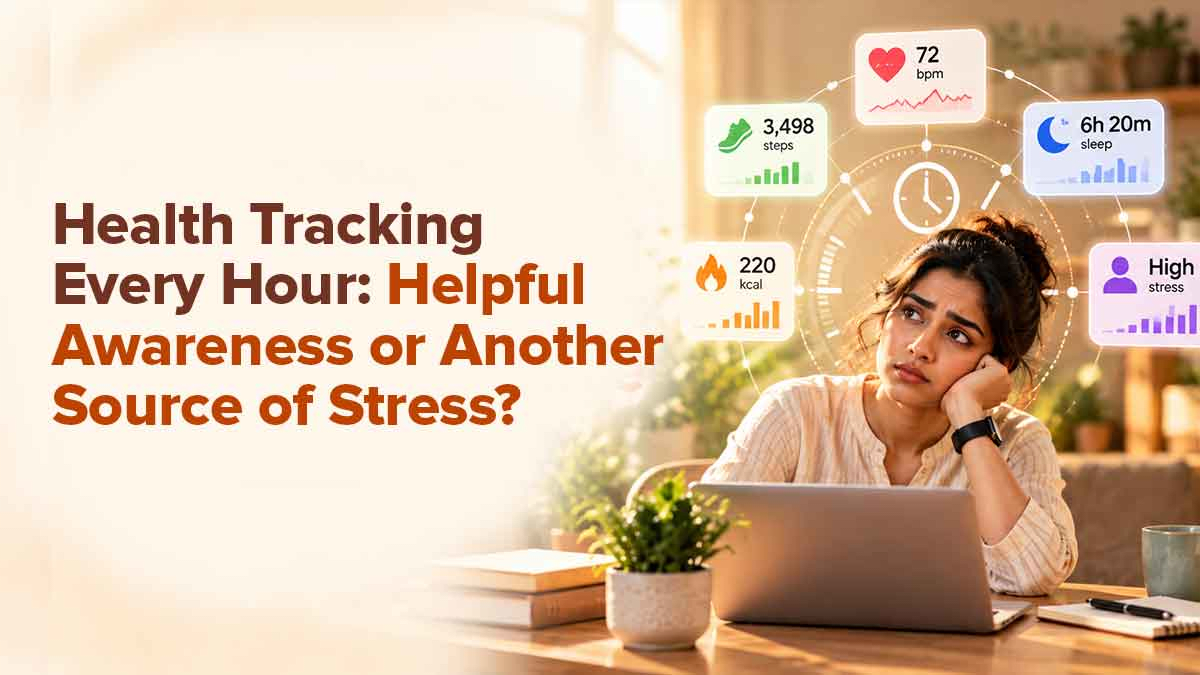
5006You notice that your smartwatch is buzzing, so you go to check your steps, then your heart rate, and then your sleep cycle. You notice that you have been sitting for too long, so you get up and take a few steps around.
A health tracker can be useful for circumstances like these when they remind you to sleep, move, or drink better, or when you simply need attention to how your body is moving. But one thing that can bother or worry is when you check your health again and again and track your steps.
So, what is the boundary between the awareness of health and taking stress around tracking your health?
When Health Tracking Can Actually Help
One of the major advantages of health tracking is that it makes your invisible habits more visible.
You might think that you are fairly active doing all the work until your watch shows that you have comparatively been sitting around. Or you may also realise that the timing of your bedtime is also changing. Seeing these patterns can support realistic changes.
For example, a reminder to stand up after sitting for a long time can be useful if you spend most of your day studying or working at a desk. Tracking activity can also motivate some people to take regular walks or build a more consistent routine.
The key is to use the information as a guide, rather than treating every number as a verdict on your health.
When Numbers Start Taking Over
The problem begins when checking becomes constant.
You might start feeling guilty because you did not reach a particular step count. A slightly different sleep score could make you worry that you slept badly. You may repeatedly check your heart rate even when you feel perfectly fine.
Instead of helping you understand your body, the numbers can make you feel disconnected from it.
There is also a natural tendency to compare today’s data with yesterday’s. Then yesterday’s numbers become the standard you feel you have to beat.
More Tracking Does Not Always Mean More Health
It is easy to assume that more information automatically leads to better decisions. But information is only useful when you know what to do with it.
For instance, seeing that your sleep score was lower than usual does not necessarily tell you why. Maybe you slept later, had a stressful day, exercised differently, or simply had a restless night.
Similarly, wearable devices provide estimates rather than perfect measurements. Their readings can be useful for noticing patterns, but they should not replace how you actually feel or, when necessary, professional medical advice.
Sometimes, constantly checking a number creates more anxiety than the number itself deserves.
Listen To Your Body Too
One simple way to make health tracking healthier is to balance data with body awareness.
Ask yourself:
* How energetic do I feel today?
* Am I genuinely tired or just worried because my sleep score was low?
* Have I been sitting for hours without a break?
* Am I eating because I am hungry, or simply because an app says it is time?
These questions bring the focus back to your actual experience.
Your body does not produce a daily report card. You do not need to “score” perfectly every day to be healthy.
Try Tracking Less, But Tracking Better
If you notice that checking your health data makes you anxious, you do not necessarily have to stop using your device completely.
Instead, consider reducing how often you check it.
Rather than looking at your numbers every hour, review broader patterns once a day or even once a week. Focus on trends instead of individual readings.
For example, instead of worrying about whether you walked exactly 10,000 steps today, you could simply notice whether you are generally moving more throughout your week.
The goal is to make technology support your routine, not control it.
What Does Ayurveda Say?
Ayurveda traditionally places considerable importance on observing the body, daily routines and changes in how you feel. But this kind of awareness is not necessarily about constantly measuring yourself.
Ayurvedic ideas around dinacharya, or daily routine, encourage consistency in areas such as sleep, meals, movement, and rest. The broader idea is to develop awareness of your body’s signals and maintain a balanced routine.
From this perspective, health tracking can be useful if it helps you notice patterns and make sensible adjustments. But if checking numbers creates constant worry or disrupts your natural routine, it may be worth stepping back.
The Bottom Line
Health trackers can be helpful tools, especially when they encourage you to move more, sleep regularly, or notice patterns you might otherwise miss.
But you do not need to monitor yourself every hour to take care of your health.
If your smartwatch reminds you to take a walk and you feel better because of it, great. If checking your watch repeatedly leaves you anxious about whether you are “doing health correctly,” it may be time to put the numbers in the background.
Healthy awareness should make you feel more informed — not constantly judged.
References
STRESS AND HEALTH: Psychological, Behavioral, and Biological Determinants - PMC