 Published on
03 Jul, 2026
Published on
03 Jul, 2026 Updated on 03 Jul, 2026
 5102
5102Curd is practically a food group in India. It sits on the table at almost every meal, gets mixed into rice, spooned alongside parathas and consumed in the form of raita, lassi, chaas and kadhi across every region and season. If there is one food that Indians have collectively decided is universally healthy and digestion friendly, it is curd.
And it is genuinely good. Curd has real nutritional value, contains beneficial bacteria and supports gut health in ways that are well documented. Nobody is here to take your dahi away.
But here is the thing Ayurveda has been saying for a very long time that modern nutrition is only beginning to catch up to. Curd is not always good for digestion. Not for everyone. Not at every time. Not in every season. And consuming it the wrong way or at the wrong time can actually create the exact digestive problems people think it is solving.

What Makes Curd Genuinely Beneficial
Before the caveats, let us give curd its due credit.
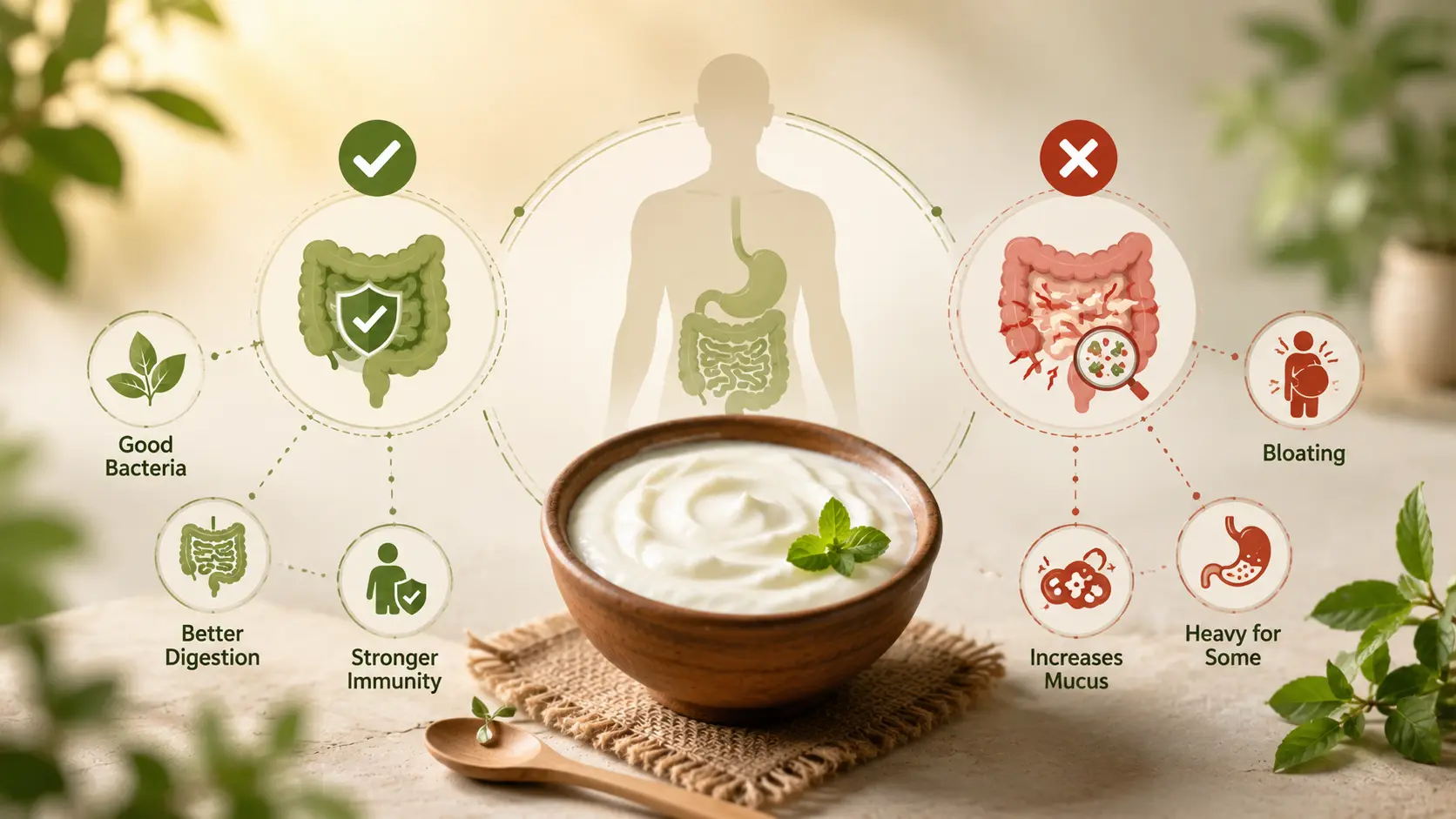
- Probiotic content: Curd contains live bacterial cultures, primarily Lactobacillus, that support the gut microbiome. A healthy gut microbiome is linked to better digestion, stronger immunity and even improved mood. This is real and well supported.
- Protein and calcium: Curd is a good source of easily digestible protein and calcium, making it genuinely nourishing especially for people who do not consume much meat.
- Cooling properties: Curd has a naturally cooling effect which can soothe an irritated digestive tract, reduce acidity and calm inflammation when consumed in the right context.
- Improving nutrient absorption: The fermentation process breaks down some of the harder to digest components of milk, making the nutrients more bioavailable than in plain milk for many people
When Curd Actually Causes Digestive Problems
Here is what Ayurveda figured out a very long time ago and what many people discover through personal experience without quite understanding why.
- Curd eaten at night: This is probably the most widely violated rule around curd consumption. Ayurveda very specifically cautions against eating curd at night and the reasoning is logical. Digestion naturally slows in the evening and further weakens overnight. Curd is heavy, sour and increases Kapha and Pitta simultaneously. Eaten at night it sits in the digestive tract longer, ferments further, produces excess mucus and can contribute to congestion, bloating and sluggish digestion by morning. If you regularly wake up feeling heavy, congested or with a thick feeling in your throat, late night curd is a very likely culprit.
- Curd during winter and monsoon: Ayurveda considers season when making dietary recommendations and curd gets specific seasonal restrictions. In cold and damp weather, which corresponds to Kapha dominant seasons, curd increases heaviness, mucus production and congestion significantly. People prone to respiratory issues, frequent colds and sinus problems are almost always better off reducing or avoiding curd during winter and monsoon months.
- Curd heated or cooked: Here is one that surprises most people. Heating curd kills the beneficial bacteria that make it valuable in the first place. Cooked curd in dishes like kadhi or certain gravies loses its probiotic benefit entirely and according to Ayurveda becomes harder to digest and more likely to produce Ama or metabolic toxins in the process. If you love kadhi, enjoy it. But do not count it as your probiotic fix for the day.
- Curd with incompatible foods: Ayurveda has a detailed framework of food combining and curd appears prominently in the list of foods with specific incompatibilities. Curd with fish is considered one of the most aggravating combinations for the skin and digestive system. Curd with milk is considered too heavy and mucus producing. Curd with sour fruits creates excess acidity. Curd with onion is another combination Ayurveda flags as potentially aggravating. These are not arbitrary rules. They reflect how different foods interact in terms of digestion time, enzyme requirements and the overall effect on gut chemistry.
- Curd for people with existing digestive issues: People with irritable bowel syndrome, chronic bloating, sluggish digestion or Kapha dominant constitutions often find that regular curd consumption worsens rather than helps their symptoms. The assumption that curd is universally good for digestion leads many people to keep eating it despite their gut telling them otherwise.
- Full fat curd in large quantities: The heavier the curd, the more Agni or digestive fire it requires to process. Thick, full fat curd consumed in significant amounts at once can overwhelm a weaker digestive system and lead to heaviness, bloating and sluggishness even in people who generally tolerate curd well.
What Ayurveda Actually Recommends About Curd
Ayurveda does not say never eat curd. It says eat it correctly and the difference matters.
- Eat curd only during the day: Lunch is the ideal time. Digestive fire is strongest at midday and can handle curd much more effectively than the weakened evening and night digestion can.
- Always eat it fresh: Curd that has been sitting for more than a day becomes increasingly sour and more aggravating to Pitta and digestion. Fresh curd made that day is significantly easier on the system than older, very sour curd.
- Add digestive spices: This is the most practical and widely used Ayurvedic approach. Adding a pinch of roasted jeera, a little black pepper, some fresh ginger or a few curry leaves to curd counteracts its heavy and Kapha aggravating qualities. This is why raita with jeera is not just a flavour choice. It is genuinely a digestive upgrade.
- Dilute it into chaas or buttermilk: Ayurveda considers chaas or thin buttermilk made from curd with water added to be far superior to curd itself for digestion. Diluting reduces the heaviness, makes it easier to digest, retains the probiotic benefit and makes it appropriate for more seasons and body types than plain curd is. Chaas with jeera and a pinch of rock salt at lunch is one of Ayurveda's genuinely brilliant digestive recommendations.
- Avoid it if you have respiratory congestion: If you have a cold, cough, sinus issues or chest congestion, curd is the first thing Ayurveda would ask you to put on pause. Its mucus increasing properties genuinely worsen respiratory congestion and most people notice this even without being told the theory behind it.
- Match it to your constitution: Pitta dominant people with strong digestion and good heat tolerance can generally handle curd better than Vata or Kapha dominant types. Vata types benefit from curd eaten warm with spices in small amounts. Kapha types are best keeping curd to a minimum year round and especially in cool, damp weather.
What Modern Nutrition Says
Modern nutrition largely champions curd for its probiotic content, protein and calcium. The nuance around timing, temperature and food combining is not something that features prominently in mainstream nutritional advice.
However there is growing research supporting the idea that not all probiotic foods suit all people equally and that individual gut microbiome composition determines how someone responds to fermented foods including curd. Some people with SIBO or small intestinal bacterial overgrowth actually experience worsening symptoms from probiotic rich foods. People with certain inflammatory gut conditions can find curd aggravating rather than soothing.
The takeaway is that both Ayurveda and emerging modern research point to the same conclusion. Curd is not universally beneficial for everyone in every situation. Individual response, timing, preparation and health context all matter.
Final Thoughts
Curd is a genuinely wonderful food. This is not an anti-curd argument. It is a please-eat-your-curd-more-thoughtfully argument.
Fresh curd at lunch with a pinch of jeera. Chaas instead of plain curd on heavier days. Skipping the raita at dinner. Pausing the curd when you are congested or unwell. These are small adjustments that make a meaningful difference to how your digestion actually feels rather than how it is theoretically supposed to feel.
Your gut will tell you if curd is working for it or against it. The trick is to actually listen rather than assuming the answer is always the same
Reference Links
- National Health Portal of India on Nutrition and Digestive Health https://www.nhp.gov.in/healthlyliving/nutrition
- Ministry of AYUSH, Government of India on Ayurvedic Dietary Principles https://main.ayush.gov.in/
- World Health Organization on Gut Health and Nutrition https://www.who.int/health-topics/nutrition