 Published on
30 Jul, 2026
Published on
30 Jul, 2026 Updated on 30 Jul, 2026
 5067
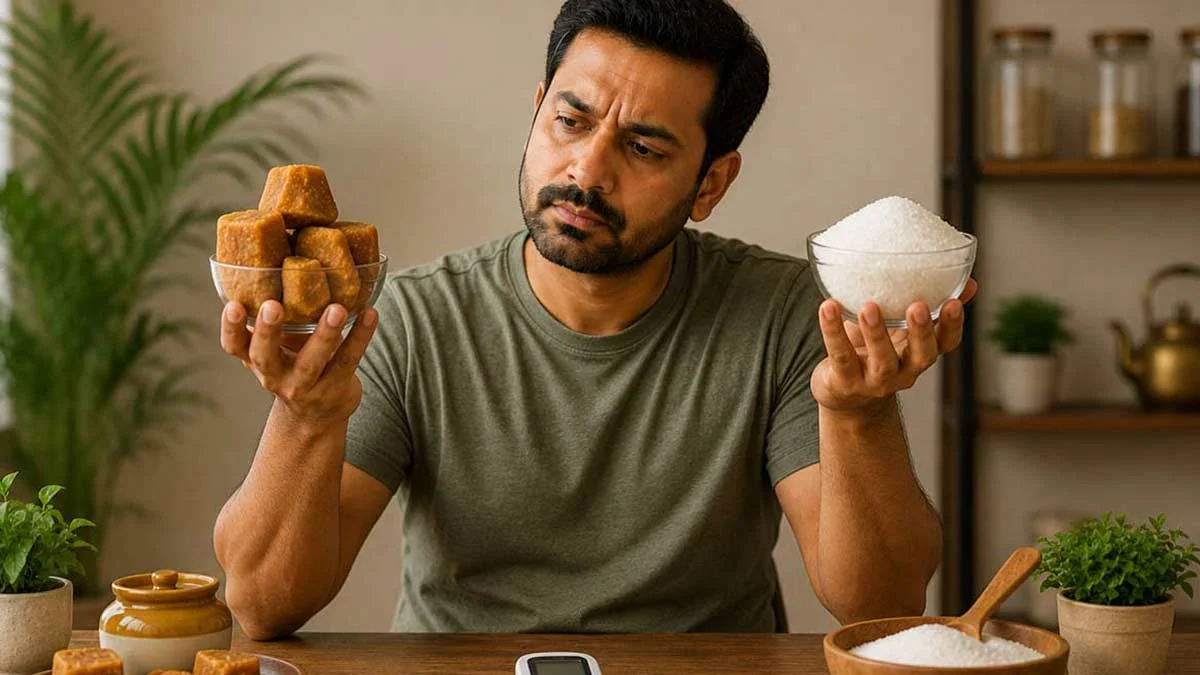
5067It happens in almost every health-conscious household. You make the bold decision to banish white, refined sugar from your pantry forever, proudly replacing it with glowing, earthy blocks of traditional jaggery (Gur). You feel a sense of relief, knowing you are choosing a traditional, unrefined, "healthy" option. But two hours later, you check your glucometer, and the numbers are flashing red, just as high as they were when you were eating white sugar.
You feel completely betrayed by your own kitchen. You followed the advice to eat natural, whole foods, but your body is still struggling with massive blood sugar spikes and metabolic fatigue. If jaggery is considered a traditional superfood, why is it acting like a poison to your blood sugar? Let us break it down simply using the timeless wisdom our grandmothers relied on long before glycemic indexes were measured.
The Mineral Myth And The Metabolic Reality
Before we talk about how to safely sweeten your food, we have to clear up a massive piece of confusion about what jaggery actually is.
Modern diet culture has convinced us that "unrefined" automatically means "diabetic-friendly." We assume that because jaggery contains trace minerals like iron and magnesium, the body treats it differently. But in traditional Indian medicine, the fundamental nature of a food dictates how it acts in the body. Both white sugar and jaggery are intensely sweet (Madhura) and heavy (Guru). They both powerfully build thick, sticky Kapha Dosha energy.
White sugar is essentially 99% pure sucrose. Jaggery is roughly 65% to 85% sucrose, with the remaining percentage being moisture, fiber, and trace minerals. When you eat jaggery, your pancreas does not pause to politely extract the iron; it only sees a massive, overwhelming wave of sucrose that requires an immediate, panicked dump of insulin. The minerals in jaggery make it a fantastic, nourishing food for a healthy, growing child, but for a diabetic body with a broken internal furnace, which is the digestive fire (Agni), it is still just a massive load of heavy, unburnable fuel.
The Weight Gain Trap: How Jaggery Feeds Inflammation
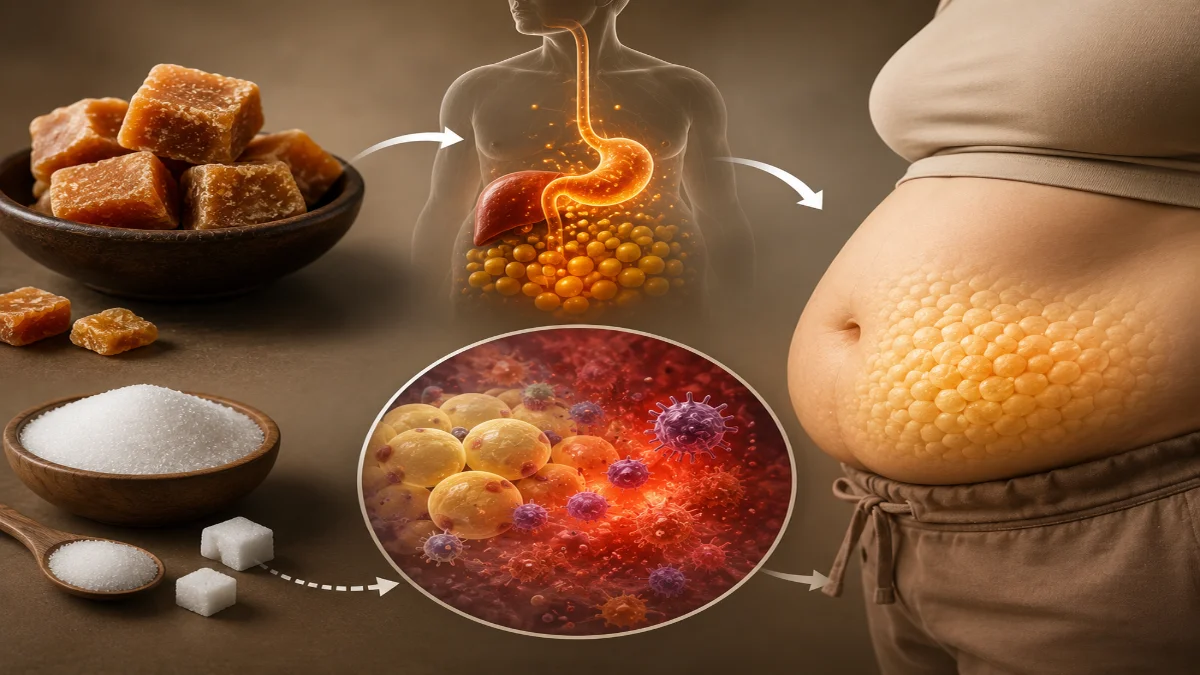
If you have been using jaggery to lose weight or reduce belly fat, you are fighting a losing metabolic battle. Many people believe that because jaggery is unrefined, it does not contribute to weight gain like white sugar does. However, in traditional medicine, jaggery is categorised as highly Prithvi (earth) and Jala (water) heavy, which means its dominant action in the body is that of "building" and "grounding."
While white sugar is "empty" calories, jaggery is incredibly calorie-dense, often containing just as many, if not slightly more, calories per teaspoon. When a diabetic body, already struggling with insulin resistance, processes this heavy sweetness, it does not magically convert it into mineral-rich energy. Instead, it perceives an overload. To protect your vital organs, the body rapidly converts this excess sucrose into fat, depositing it primarily around the midsection. Worse still, this type of dense, sticky buildup contributes heavily to internal inflammation, further blocking the cellular pathways that allow insulin to do its job. Choosing jaggery over sugar to lose weight is simply swapping one high-insulin driver for another.
The Source Secrets: The Reality of Modern Production
It is time for a serious conversation about what is actually in that beautifully convenient cube of jaggery you bought at the supermarket. We imagine that jaggery is produced the ancient, traditional way, pure cane juice boiled down slowly in rustic vats, capturing all the natural goodness.
While some traditional sources still exist, a vast amount of commercial jaggery is produced under the demands of industrial food supply. To achieve that appealing, consistent bright yellow-golden colour that consumers associate with quality, manufacturers often resort to intense chemical refining and bleaching processes. These treatments can involve sulfites, anti-foaming agents, and even phosphoric acid, stripping away the very mineral benefits that made the jaggery seem "healthy" in the first place. You are not buying a holistic remedy; you are purchasing a manufactured, heavily processed sweetener that merely looks natural, while still carrying the massive, destructive metabolic load of the refined cane sugar you were trying to avoid.
The Psychology of Sweet: Escaping the Dopamine Demand
Perhaps the most sinister trick that jaggery plays is not on your pancreas, but on your mind. We spend all this time trying to fight the biological response to sweetness while completely ignoring the mental dependency we have built upon it. Sugar, in all its forms, is addictive. Your brain does not perceive traditional Ayurvedic energy systems; it only perceives a massive dopamine hit.
When you swap white sugar for jaggery, you are not healing the addiction; you are simply changing the colour of your drug. By telling yourself it is "safe" or "mineral-rich," you unconsciously give yourself permission to crave it more often, deepening the psychological pattern of rewarding every moment of stress, fatigue, or sadness with a sweet treat. True metabolic freedom for a diabetic is not found in finding a "healthy" sweetener; it is found in learning to find comfort, warmth, and flavor in savory spices, herbal teas, and a well-regulated nervous system, finally breaking the destructive cycle of the dopamine demand.
Harmful Daily Habits Fueling the Spike

If your blood sugar remains stubbornly high despite "giving up sugar," your perfectly innocent routines around traditional sweeteners are likely keeping your insulin resistance locked in place. Watch out for these subtle traps:
- The "Guilt-Free" Chai Trap: Because jaggery is marketed as healthy, people often use twice as much of it in their tea as they would white sugar. You assume you are just adding flavor and minerals, but you are accidentally drinking a massive, concentrated dose of liquid sucrose first thing in the morning, immediately suppressing your digestive fire.
- The Mineral Justification: Eating a piece of jaggery after dinner because you were told it "aids digestion" or "boosts iron." While it does stimulate digestive enzymes in a healthy person, adding heavy, sticky sweetness on top of a full dinner in a diabetic body simply causes the food to ferment, creating toxic Ama while you sleep. (If you need iron, a bowl of spinach or cooking in a cast-iron pan is a much safer route).
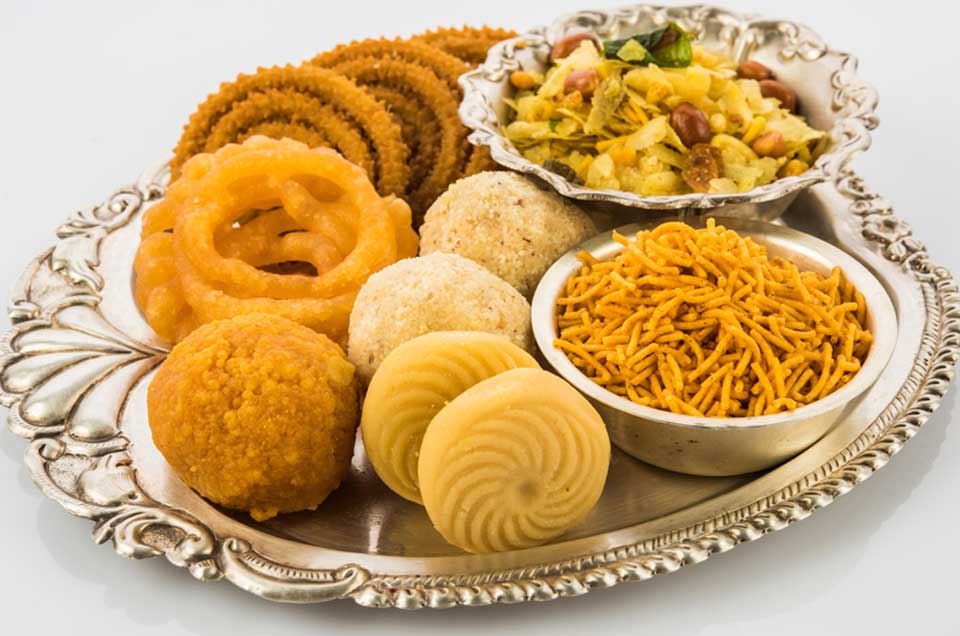
- The Winter Sweet Binge: Loading up on traditional winter sweets like til chikki (sesame brittle) or panjiri because they are made with jaggery instead of sugar. The combination of dense fats, roasted flours, and heavy jaggery is deeply nourishing for someone doing hard physical labor in the cold, but it will violently spike the blood sugar of someone sitting at a desk.
Traditional Solutions for Safe Sweetness
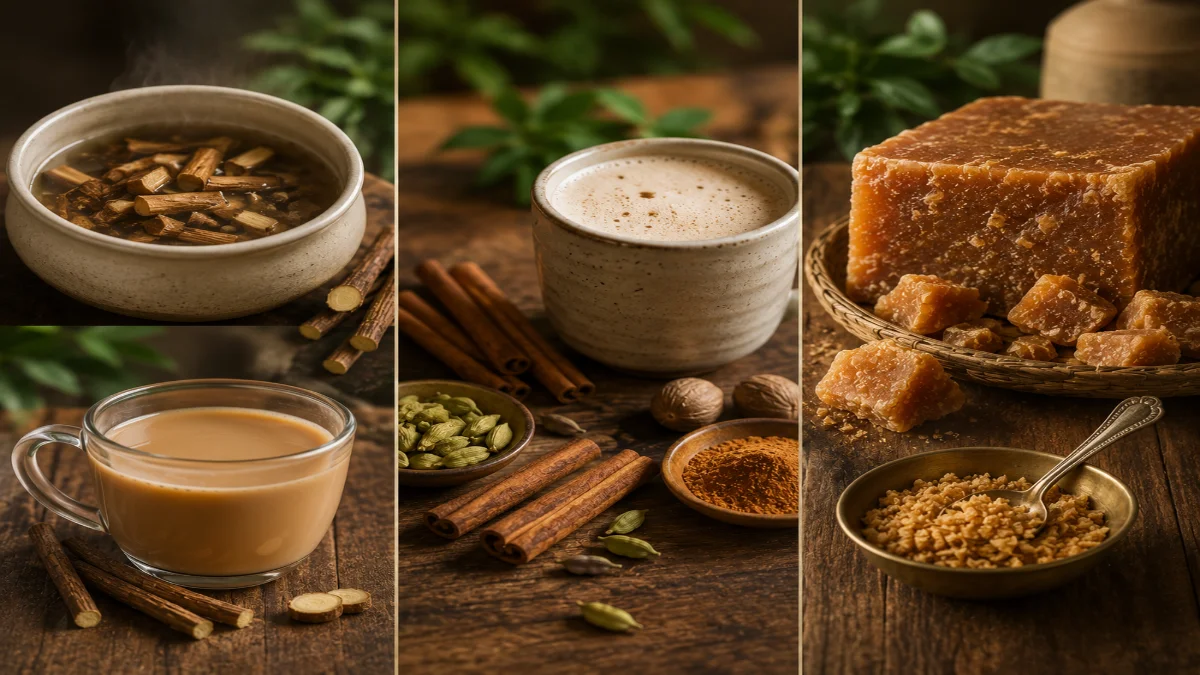
We do not need to banish all joy and flavor from our lives. Our traditional kitchens use specific herbs and spices to satisfy the brain's craving for sweetness without triggering a metabolic crisis in the liver.
- The Mulethi (Licorice) Trick: If you desperately miss the sweet taste in your morning tea, try boiling a small piece of Mulethi (Licorice root) in the water before adding your tea leaves. Mulethi is naturally intensely sweet to the palate, but it is deeply soothing to the stomach lining and does not spike blood glucose at all.
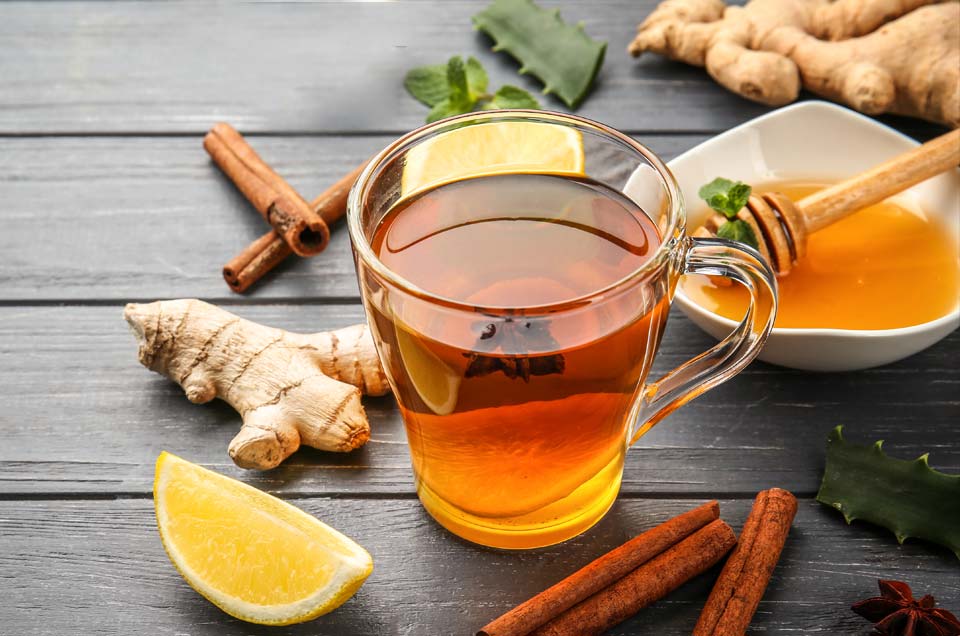
- Tricking the Brain with Warm Spices: Your brain often confuses "sweetness" with "warmth." Heavily spicing your teas, coffees, or oats with true Ceylon cinnamon, green cardamom, and a pinch of nutmeg tricks the palate into perceiving a sweet, comforting flavor, completely bypassing the need for jaggery. Cinnamon also actively helps sensitise your cells to insulin.
- The Rule of "Purana Gur": Ayurveda actually states that fresh jaggery is highly mucus-forming and aggravating to Prameha (diabetes). It recommends using Purana Gur (jaggery that is at least one year old), which becomes lighter, drier, and less sticky over time. However, even this is used as a medicine in tiny, scraped quantities, never as a daily, spoonful-by-spoonful sweetener.
Doctor’s Note
While jaggery is a beautifully traditional food with real nutritional value for healthy individuals, it must be stated clearly: jaggery is not a safe sugar substitute for diabetics.
From an endocrinologist's perspective, your body breaks down jaggery into glucose and fructose just as rapidly as it does a standard sugar cube. If your HbA1c is elevated, you must treat jaggery, honey, maple syrup, and coconut sugar with the exact same strict caution as white table sugar. True holistic health means honoring traditional foods for what they are, without pretending they are magical cures that defy human biology.
Conclusion
We spend so much time looking for loopholes in our diets that we forget to respect the fundamental mechanics of our own bodies. Just because a food is unrefined, wrapped in palm leaves, and sold at a holistic market does not mean your pancreas is equipped to handle it.
Your spiking glucometer readings and afternoon energy crashes are a living, breathing message. They are asking you to stop bargaining with your blood sugar; they are begging you to find comfort in warm spices rather than heavy syrups, and they are reminding you that true sweetness is found in a body that feels light, energetic, and balanced. Listen to your body carefully. Protect your metabolic fire fiercely, let go of the "healthy sugar" myth, and remember that when you clear the heavy congestion, your natural vitality will finally return!
References:
What is Jaggery and What Benefits Does it Have?
Chapter 16 - The benefit of Indian jaggery over sugar on human health