 Published on
07 Apr, 2026
Published on
07 Apr, 2026 Updated on 16 Jun, 2026
 5167
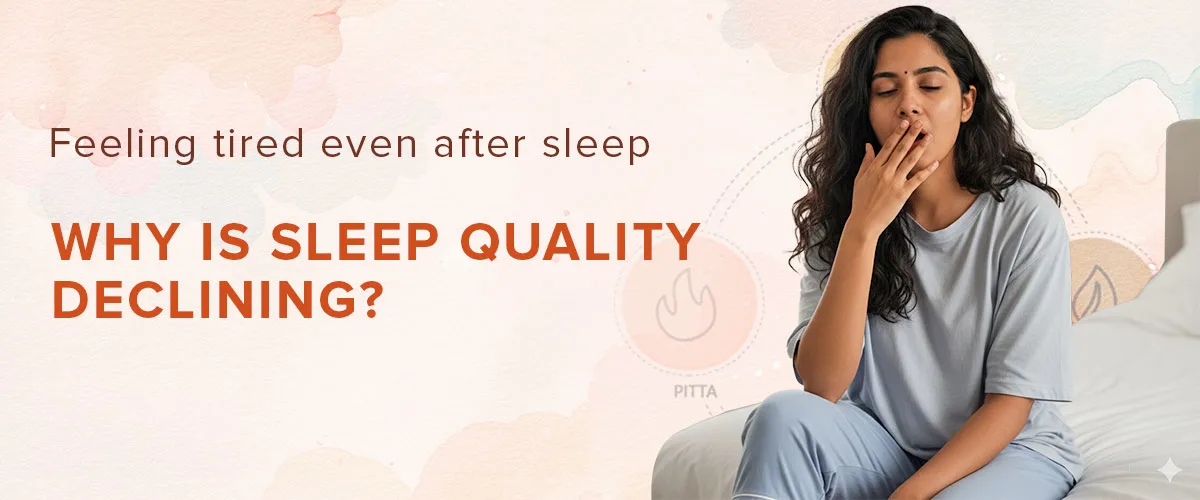
5167Have you ever slept for 7-8 hours and woke up feeling tired, heavy, or unrefreshed? If you have, you are not alone. Many people today face the problem of poor sleep quality despite sleeping “enough.”
However, this is not something you can shrug off as a bad day or a lazy feeling. Poor sleep quality is a sign that something is wrong. If you do not take action at the right time, you could end up facing many problems related to your mood, energy, immunity, and health. Thus, the first step is to understand what Poor Sleep Quality is.
What is Poor Sleep Quality?
When you have poor sleep quality, you are essentially sleeping enough hours, but the quality of the sleep is not deep, peaceful, or refreshing.
What does this mean? In simple words, you are sleeping, but you are not resting. In fact, you could wake up many times during the night. Moreover, you could wake up feeling as though you have not slept at all. In fact, you could wake up feeling tired, heavy, or unrefreshed.
Types of Poor Sleep Quality
Here's the thing bad sleep isn't a one-size-fits-all disaster. It shows up differently for everyone, depending on how stressed you are, how you live, and how your body's doing. Some people crash instantly but sleep like a feather. Others are out for eight hours and still drag themselves out of bed like they've been hit by a truck.
Sound familiar? Here's how it usually plays out:
- Light Sleep: You doze off fine, but the moment your neighbour coughs or a car drives past boom, you're wide awake. Every little noise is basically your alarm clock now.
- Interrupted Sleep: You fall asleep, great. Then you're awake. Then asleep. Then awake again. Your night looks less like rest and more like a bad Netflix buffering session.
- Non-Restorative Sleep: You slept a full eight hours. You have the receipts. And yet somehow you wake up feeling like you didn't sleep at all. Your body clocked in but definitely didn't do the work.
- Delayed Sleep Cycle: A night owl situation you're wide awake at 1am, finally pass out at 3, and then the morning alarm feels genuinely criminal. Your body's clock is just running on a completely different timezone.
- Fragmented Sleep: No long, solid stretch of sleep for you. Instead, it's bits and pieces a nap here, a doze there. Your sleep is basically a highlight reel with no full match.
All these have a different impact on your state of mind and body, which is why you are still feeling tired after sleeping for a long time.
Signs & Symptoms of Poor Sleep Quality
Your body doesn't suffer in silence it'll let you know when your sleep is off, loud and clear. Watch out for these telltale signs:
- Tired after a full night's sleep You slept 8 hours. Still exhausted. Classic.
- Morning headaches or heaviness Waking up with a head that feels like it's full of cement.
- Can't focus to save your life. Brain fog so thick you'd forget your own name mid-sentence.
- Mood swings & irritability Snapping at people for breathing too loud? Yeah, that's the sleep deprivation talking.
- Zero energy, constant fatigue Running on fumes all day, every day.
- Dark circles & dull skin your face is basically a billboard for bad sleep.
- Yawning on repeat If you've yawned three times reading this, well… there's your sign.
- Productivity? What productivity? Tasks that should take 20 minutes suddenly take forever.
Causes of Poor Sleep Quality
Bad sleep rarely just happens out of nowhere. There's usually something behind it. Here are the most common culprits:
- Stress & Overthinking: Your brain decides 11pm is the perfect time to replay every awkward moment from 2014. A busy, anxious mind is enemy number one of good sleep.
- Excess Screen Time: Doom-scrolling right before bed is basically tricking your brain into thinking it's still daytime. Those sleep hormones don't stand a chance.
- Irregular Sleep Schedule: Sleeping at 10pm one night and 2am the next? Your body has absolutely no idea what's going on.
- Poor Diet Habits: A heavy biryani at 10pm or that fifth cup of chai isn't doing your sleep any favours. Your gut will make sure of it.
- Lack of Physical Activity: Sitting all day and expecting deep sleep at night is a bit optimistic. A sedentary lifestyle genuinely affects how well you sleep.
- Hormonal Imbalance: Particularly common in women, hormonal shifts can completely throw off your sleep patterns without warning.
How is Poor Sleep Quality Diagnosed?
When sleep quality is not satisfactory, it is imperative that the condition is diagnosed properly. There are various methods by which doctors diagnose sleep quality. They are:
- Sleep History Assessment: Assessing your routine and sleep habits
- Physical Examination: To check for any underlying conditions
- Sleep Study (Polysomnography): Monitoring the activity in the brain, breathing, and movement while sleeping
- Mental Health Screening: To check for stress levels, anxiety, or depression
- Lifestyle Evaluation: To assess diet and lifestyle habits
Diagnosis of the condition at the right time is crucial in order to avoid any serious health problems in the future.
Ayurvedic Herbs for Poor Sleep Quality
No melatonin gummies, no dependency, no groggy next-day hangover. Ayurveda has been sorting out sleep troubles for thousands of years with herbs that actually work with your body, not against it.
- Ashwagandha: The stress-buster you didn't know you needed. It calms your nervous system down so your brain can actually switch off at night.
- Brahmi: Overthinking at midnight? Brahmi gently quiets the mental chatter and brings some much-needed clarity back to that busy head of yours.
- Jatamansi: Nature's own sedative. It eases you into sleep without knocking you out like a brick wall.
- Tagar (Valerian): The one herb that means business when it comes to deep, sound sleep. No half-measures here.
- Shankhpushpi: Calms a restless mind and sets the stage for genuinely good quality sleep, night after night.
Ayurvedic Therapies
Some Ayurvedic external therapies that help in improving sleep quality are:
- Shirodhara: A continuous flow of warm oil poured over the forehead to calm the mind.
- Abhyanga or Oil Massage: A massage that calms the nervous system and reduces stress.
- Nasya: Oiling the nose to open mental channels.
- Takradhara: A cooling therapy for stress-related sleep disorders.
These not only help in improving sleep quality but also relax the mind.
When Should You Consult a Doctor?
Sometimes bad sleep isn't just a "drink chamomile tea and relax" situation. If your body is consistently struggling, it might be pointing to something deeper. Time to talk to someone if:
- You wake up exhausted every single day despite clocking in a full night
- The sleep issues have been dragging on for more than 2 to 3 weeks
- You're waking up multiple times every night like clockwork
- Anxiety, low mood, or mental exhaustion have become your new normal
- You can't fall asleep without popping a sleeping pill anymore
- Your work, relationships, and daily life are starting to take a hit
Don't brush it off as "just stress." Your body is trying to tell you something.
Conclusion
Your body is pretty good at asking for help. Chronic tiredness, foggy mornings, and restless nights are not just bad luck they're signals worth listening to.
The good news? You don't have to just push through it. Ayurveda takes a root-cause approach, working on your mind, body, and lifestyle together rather than just patching the symptom. Deep, refreshing sleep isn't some distant dream it's genuinely within reach with the right support.
The earlier you start, the easier the reset. Don't wait until you're running on empty to take it seriously.