 Published on
24 Jul, 2026
Published on
24 Jul, 2026 Updated on 24 Jul, 2026
 5081
5081Millions of us perform the exact same ritual every weekday morning. We commute. We grab a coffee. We sit down at a desk. We stay there.
Modern work is a marathon of immobility. We traded factory floors and active trades for ergonomic swivel chairs and glowing monitors. On the surface, it feels safe. It looks comfortable. But beneath the surface, prolonged sitting is quietly dismantling your health.
The human body was engineered for movement. It thrives on walking, lifting, stretching, and bending. When you force it into a static, seated position for eight to ten hours a day, things start to break down. You might not notice it at first. A little tightness in the shoulders. A sluggish feeling after lunch. A waistband that feels just a bit too snug by Friday.
These aren't just the inevitable signs of aging. They are your body’s dashboard warning lights. They are signaling that the physical mechanics of your daily routine are fundamentally misaligned with human biology.
Here is exactly what happens to your midsection, your spine, and your gut when you spend your life in a chair.
Doctor’s Notes
Long hours of sitting can affect posture, metabolism, and digestion. Regular movement breaks, correct sitting posture, walking after meals, and daily exercise can help reduce the risk of back pain, belly fat, and digestive discomfort. Listen to your body’s warning signs and seek medical advice for persistent symptoms.
The "Desk Belly" (Why Sitting Triggers Visceral Fat)
You eat a balanced breakfast. You pack a sensible lunch. You still notice your midsection growing softer and rounder month by month.
The culprit isn't just the occasional office doughnut. It is the sitting itself. When you sit down, the electrical activity in your leg muscles shuts off completely. Calorie burning drops to a baseline of about one per minute. But the real issue goes much deeper than simple calorie math.
Prolonged sitting fundamentally alters how your body processes fats and sugars. When your muscles are active, they release an enzyme called lipoprotein lipase. This enzyme is responsible for breaking down the fat in your bloodstream so your body can use it as fuel. The moment you sit, the production of this enzyme plummets by up to 90 percent.
The fat has to go somewhere. It gets stored. Worse, desk-bound weight gain tends to manifest as visceral fat. This is the dangerous, active fat that wraps around your internal organs. It pumps out inflammatory chemicals. It drives up your blood pressure. It makes your body resistant to insulin.
You cannot out-diet a completely sedentary day. If your muscles are asleep for eight hours, your metabolic engine is stalled.
 The Aching Back (The Anatomy of a Postural Collapse)
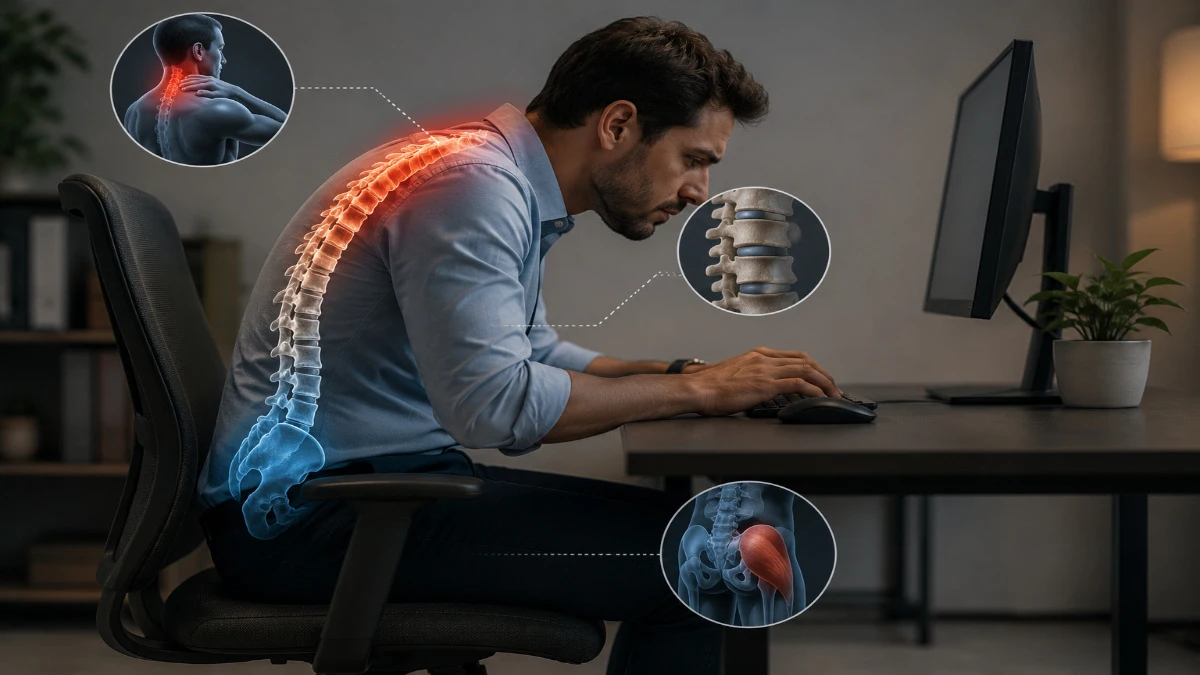
Think about your posture when you are deeply focused on a screen. Your shoulders roll forward. Your chest caves in. Your neck juts out to read the text.
The human spine is designed as a natural, shock-absorbing 'S' curve. Desk work turns it into a 'C' curve.
When you sit in this collapsed position day after day, your anatomy physically adapts to the terrible posture. Your hip flexors, the muscles connecting your lower back to your legs, shorten and tighten from being in a constant state of flexion. At the exact same time, your glute muscles stretch out. They go dormant. Physical therapists actually call this "gluteal amnesia." Your body forgets how to fire the largest muscle group you have.
With tight hips pulling you forward and weak glutes failing to hold you upright, your lower back is forced to take on all the structural stress.
The discs between your vertebrae are like sponges. They soak up fresh blood and nutrients when they expand and contract during movement. When you sit still, that fluid exchange stops. The discs become starved. They dry out. They degenerate. The sharp twinge you feel when you finally stand up isn't just fatigue. It is your skeletal system screaming for relief.
Sluggish Digestion (The Compressed Gut)
Digestion is a mechanical process. It requires space. It requires movement.
When you eat lunch and immediately return to a slumped position over your keyboard, you are physically compressing your entire gastrointestinal tract. Your stomach and intestines are squashed beneath your ribcage.
This compression slows down peristalsis, the wave-like muscle contractions that push food through your digestive system. Everything slows to a crawl. The lunch you ate at noon sits heavy in your stomach at three o'clock.
Without the gentle massage of walking and moving, gas gets trapped. Bloating sets in. Because you are slouched forward, the natural valve at the top of your stomach is put under immense pressure. Stomach acid is easily forced upward. Heartburn and acid reflux become daily nuisances, sending you reaching for antacids to mask a problem caused entirely by your posture.

A Different Approach: The Ayurvedic Perspective
Modern medicine often treats these issues in isolation. A pill for the heartburn. A brace for the back. A fad diet for the belly fat. But looking at the body as a connected ecosystem offers a much better path forward.
There is immense value in how an Ayurvedic lifestyle approaches these modern conditions. Ayurveda, the ancient Indian system of medicine, views health as a state of flow and balance. Stagnation is the ultimate enemy. Sitting all day dampens your Agni (your digestive fire) and aggravates Vata (the energy of movement and air), which directly leads to that familiar bloating, stiffness, and scattered focus.
Embracing Ayurvedic principles offers a gentle, root-cause counterweight to the desk-bound life. It doesn't demand extreme workouts. It relies on subtle, consistent shifts. Drinking warm water with ginger throughout the day to reignite digestion. Eating your largest meal when the sun is highest to match your body’s natural metabolic peak. Practicing Dinacharya, daily routines that include mindful stretching and self-massage to keep the joints lubricated and the blood moving. It is a deeply positive, holistic way to undo the damage of the modern workday, addressing the whole system rather than just silencing the symptoms.
 Breaking the Cycle: How to Fight Back
You probably can’t quit your job. You still have to pay the bills. But you can change how you navigate your workday.
Shifting your mindset from simply surviving the physical discomfort to actively preventing it changes everything.
| The Sedentary Trap | The Active Desk |
| Sitting for 4 hours straight | Standing or pacing every 45 minutes |
| Eating lunch over a keyboard | Walking for 15 minutes after eating |
| Reaching for daily painkillers | Stretching tight hip flexors daily |
| Staring at screens through fatigue | Resting eyes and adjusting posture |
Small, daily habits make a massive difference over time. Here is where to start:
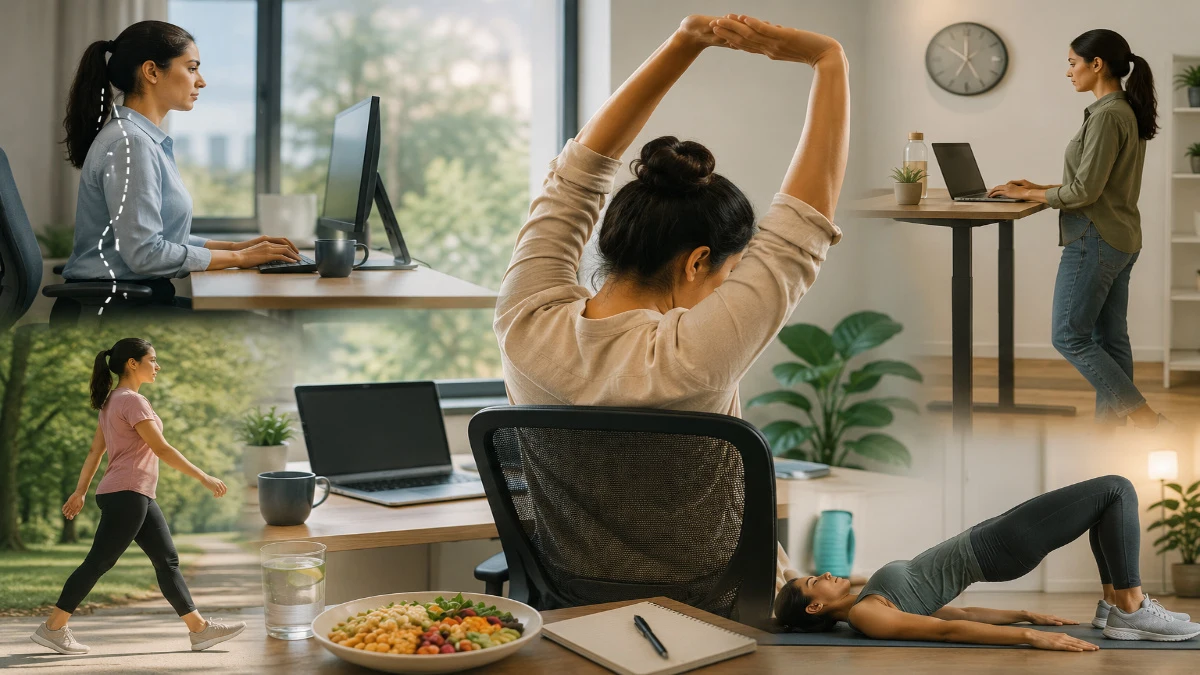
- The 45-Minute Rule: Set a timer. When it goes off, you stand up. You don't need to do a workout. Just stand. Walk to the kitchen. Stretch your arms overhead. This simple act resets your posture, turns your leg muscles back on, and flushes your spinal discs with fresh fluid.
- Audit Your Workspace: Your monitor should be at eye level. If you are looking down, your neck is carrying an extra 20 to 30 pounds of pressure. Your feet should be flat on the floor. Your lower back should be supported.
- Walk After You Eat: Never eat a meal and immediately return to your chair. A ten-minute walk after lunch lowers your blood sugar spikes by up to 30 percent. It opens up your torso. It jumpstarts the mechanical digestion process, preventing the afternoon bloat.
- Wake Up Your Glutes: Do simple glute bridges before you leave for work or after you get home. Remind your body how to use its largest stabilizing muscles. Take the pressure off your fragile lower back.
Final Thoughts
We have normalized feeling terrible at work. We accept the backache, the bloating, and the expanding waistline as the necessary cost of doing business. They aren't.
Your body is remarkably resilient. It wants to heal. It wants to move. When you start listening to the warning signs, when you stop treating a stiff back with just another painkiller and a bloated stomach with just another antacid, you take your health back. Protect your mobility. Defend your digestion. Stand up.
References
WHO guidelines on physical activity and sedentary behaviour
How Desk Jobs Are Quietly Increasing Your Risk of Piles - Laser Gastroenterology Clinic