 Published on
20 Jun, 2026
Published on
20 Jun, 2026 Updated on 20 Jun, 2026
 5126
5126You wake up early, strap on your fitness watch, hit the treadmill or the elliptical for 45 minutes of grueling, sweat-drenched cardio. You burn the calories, and you do this five days a week. And yet, when you step on the scale or look in the mirror, nothing has changed. The weight hasn't budged. In fact, you might even feel a little puffier.
For millions of women dealing with Polyendocrine Metabolic Ovarian Syndrome (PMOS), this isn't just a frustrating plateau; it’s an everyday reality. For years, the standard advice for women dealing with weight gain was simple: Eat less, move more, do lots of cardio. But modern fitness and medical experts are shifting gears aggressively. This is not the only place that the old way of doing things is not working for the PMOS body. It could be exacerbating the issue.
Here are some reasons why replacing the daily treadmill sessions with the weight room could be the metabolic reboot your body is looking for.
The Name Change: Recognising the Real Problem
First, let's talk about the name. You are probably used to hearing "PCOS" (Polycystic Ovary Syndrome). But the medical community is leaning more towards PMOS. Why? Because the old name made it sound like this was just an issue with the ovaries. It's not. It is a full-body, metabolic, and endocrine disorder.
Weight gain in PMOS is no simple problem of willpower. Typically, it's a mix of insulin resistance and chronic low-grade inflammation. This is because the body no longer processes sugars properly. Your hormones panic instead, using the food you eat for energy. They store it as fat. Nearly all of it is directed directly towards the middle area.
When you look at it from this metabolic angle, the way we exercise has to change completely.
The Cardio Trap: Why Sweating Buckets Backfires?
Cardio is great. It really is. It strengthens the heart. It builds stamina. But for a woman with PMOS, high-intensity, prolonged cardio can actually become a massive trap.
All it's about is cortisol. That’s your body's main stress hormone.
If you do a heavy, fast cardio session, you feel it as a stress. During this "stress," your adrenals release cortisol. If your body is well balanced, cortisol will return to normal after exercise. However, PMOS bodies are not like this. They are already under a state of chronic stress and inflammation.
When you add 45 minutes of intense daily cardio on top of an already stressed endocrine system, your cortisol levels stay elevated. High cortisol directly signals your body to hold onto fat. Specifically, it tells your body to store that fat right around your belly to protect your vital organs.
You end up exhausted. Your joints hurt. Your digestion slows down. And your body holds onto every single ounce of fat for dear life. You aren't burning fat. You are just running on fumes.
Muscle as Medicine: The Insulin Fix
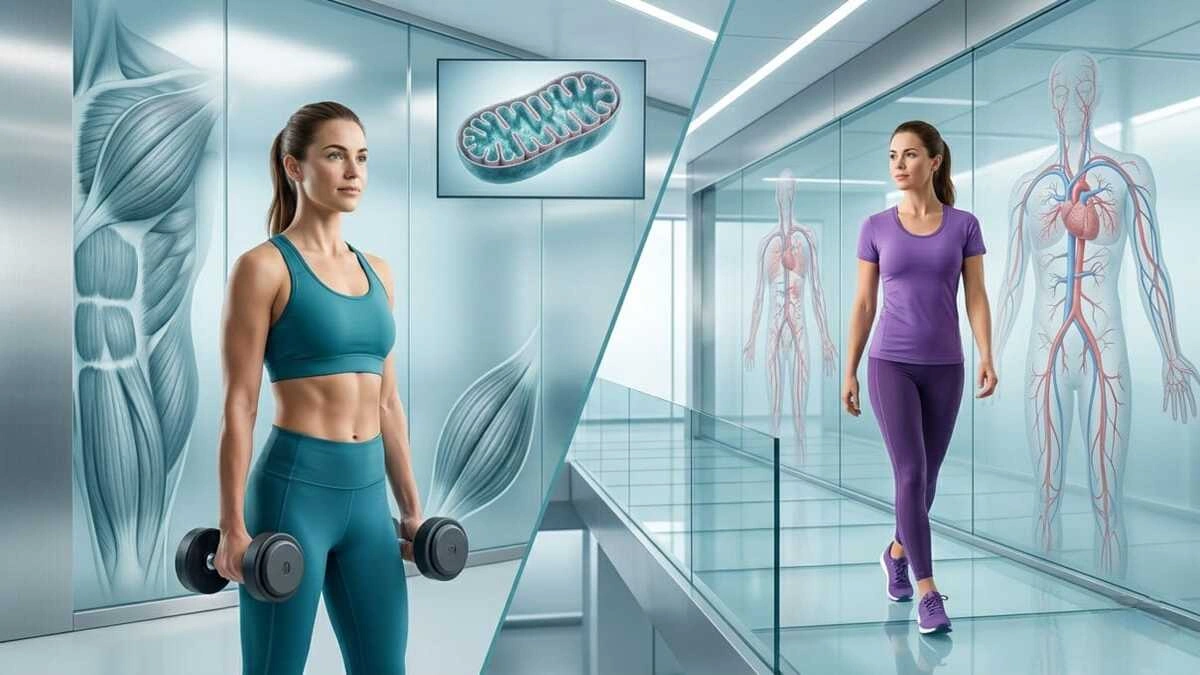
This is where the weight room changes everything. Strength training works completely differently than cardio. When you lift heavy weights, and yes, we mean heavy enough that the last few reps are genuinely difficult, you are doing something incredible for your metabolism: you are building muscle tissue.
Muscle is the most metabolically active tissue in the human body. More importantly, muscle acts like a giant sponge for blood sugar. Remember how the core issue with PMOS is insulin resistance? Basically, your cells refuse to open the door to let glucose (sugar) in, so your body produces more and more insulin, leading to fat storage. But when you build muscle, you increase insulin sensitivity. Muscle contractions allow your cells to take in glucose for energy without needing nearly as much insulin to open the door.
Each time you add some muscle, you have more space for carbs in your body. You eliminate the cause of metabolic slowdown. You change your body's metabolism for food, 24 hours a day.
The Ayurvedic Perspective: A Holistic Catch-Up
It is actually kind of fascinating how modern science is just now figuring out things that traditional holistic systems knew centuries ago.
When we talk about calming the nervous system and fixing the metabolism, it aligns perfectly with an Ayurvedic lifestyle approach. Ayurveda has long recognised that pushing an already exhausted body to its absolute limits, like with chronic intense cardio, worsens what they call a Vata imbalance. This leads to anxiety, burnout, and digestive stagnation.
Instead of brutalising the body, Ayurvedic principles focus on kindling the Agni (the digestive and metabolic fire) without causing massive stress. It encourages syncing your routines with natural circadian rhythms. Waking with the sun. Eating the largest meal when your digestion is strongest at midday. Incorporating grounding, strength-building movements rather than frantic, breathless workouts.
Numerous female individuals who suffer from PMOS have been achieving tremendous results by combining the nervous-system calming practices of Ayurveda with the biomechanics of modern weight lifting.
Building the New Playbook
So, how do you actually make the switch? You don't need to jump into a powerlifting competition. You just need a completely new mindset.
First, stop fearing the bulky look. Women with PMOS often worry that their higher androgen (male hormone) levels will make them look like bodybuilders if they pick up a dumbbell. That simply won't happen. Building massive muscle takes years of intentional, extreme eating and training. What lifting will do is give you a toned, dense, and metabolically efficient body.
Here is what a modern PMOS-friendly fitness routine looks like:
Lift Heavy, But Slow Down.
Aim for three to four days of strength training a week. Focus on compound movements. Things like squats, deadlifts, lunges, push-ups, and rows recruit the largest muscle groups, which gives you the biggest insulin-sensitising bang for your buck. But take your time. Rest for a minute or two between sets; let your heart rate come down. This keeps the cortisol response in check.
Embrace the "Lazy" Cardio.
You don't need to stop moving in between your lifting days. Simply adjust the intensity to change it. Walking is definitely the best option you can take when it comes to PMOS. A low-intensity steady-state workout, such as a 30-minute walk outside, has the opposite effect of a spin class. In fact, it helps to decrease cortisol. It aids digestion.
Rest is Non-Negotiable.
More is not better. If your hormones are out of balance, your body needs recovery time to repair muscle tissue and balance out your endocrine system. If you are feeling deeply fatigued, skip the gym. Go for a slow walk or do some gentle yoga.
The Takeaway
The whole thing is about changing your relationship with exercise. For so long, women have been taught that fitness is a math problem. Calories in, calories out. But PMOS is a hormone problem, not a math problem.
When you stop trying to shrink yourself through endless cardio and start trying to build yourself through strength training, everything shifts. The bloating goes down. The energy comes back. The weight finally starts to move. You stop fighting your body. You start fixing the metabolic engine from the inside out.