 Published on
25 Jul, 2026
Published on
25 Jul, 2026 Updated on 25 Jul, 2026
 5080
5080You book a massage to relax. You want dim lights, soft music, and an hour where nobody asks you for anything. It feels good. It smells good. But an hour later, you are back in your car, your shoulder is still clicking, and that sharp twinge in your lower back returns the moment you hit a pothole.
Traditional spa massages are a wonderful treat. Abhyanga is therapy.
If you have never heard of it, Abhyanga (pronounced ah-bee-yan-ga) is an ancient Ayurvedic practice of massaging the body with warm, herb-infused oils. In the West, it is often brushed off as just another exotic item on a luxury spa menu. That is a mistake. When you look under the hood of this ancient practice, you find a highly systematic approach to joint health, inflammation reduction, and deep cellular repair. It does not just rub the surface. It penetrates.
Doctor's Note
Abhyanga may help improve circulation, reduce stiffness, relax muscles, and support joint health. However, persistent pain, swelling, severe stiffness, or limited movement requires medical evaluation. It should complement, not replace, prescribed treatment. Always consult a qualified Ayurvedic physician or healthcare professional before starting Abhyanga if you have chronic illness or acute symptoms.
The Dashboard Warning Light
To understand why Abhyanga matters, we have to talk about how we currently handle physical discomfort. We have all been there. You climb the stairs and feel a sharp pull in your knee. You wake up with stiff, frozen fingers. When joint pain hits, most of us reach for the easiest, fastest fix available. A painkiller.
It is easy to see why. Painkillers are fast. They are cheap. They are convenient. When you have a busy job, a house to manage, or kids to chase, pausing your life for a sore knee just isn’t an option. So, you take a pill. The pain goes away. You naturally assume the problem is solved.
Let’s be honest. Painkillers are great in the moment. Within half an hour, the throbbing fades and you can get on with your day. But have you noticed that as soon as the pill wears off, the exact same ache comes creeping right back?
Here is the truth. Pain is your body’s alarm system. It is a dashboard warning light telling you something needs attention. A pill turns off the flashing light. It doesn’t fix whatever is going wrong under the hood. Most common pain pills work by simply lowering localized swelling or blocking the pain signals traveling from your nerves to your brain. This gives you a nice window of relief. But feeling better is not the same thing as healing.
Painkillers do not rebuild worn-down cartilage. They do not strengthen weak muscles. They do not fix poor posture or cure an underlying medical disease. While you are happily going about your day pain-free, the joint itself might actually be taking more wear and tear because you cannot feel its natural warning signals. With a false sense of confidence, there is nothing to stop you from pushing the joint too hard.
 When to Stop Numbing and Start Healing
Minor muscle strains might just need a couple of days of rest. But joint pain that repeatedly returns after painkillers wear off should not be ignored. If you rely on a pill just to function, you might be dealing with a deeper structural issue:
- Osteoarthritis (Wear and Tear): Over the years, the smooth, protective cartilage that cushions the ends of your bones slowly wears away. Your bones start rubbing together. It brings stiffness, clicking sounds, and pain that flares up when you move around.
- Rheumatoid Arthritis (Immune System Confusion): Your body’s immune system gets confused and mistakenly attacks the healthy lining of your joints. It causes deep fatigue, swelling, and severe morning stiffness that lingers past thirty minutes.
- Gout (Crystal Buildup): Too much uric acid forms tiny, sharp crystals inside a joint, causing sudden, intense, burning pain that often hits in the middle of the night.
Relying on daily pain medicine for these conditions only masks disease progression. Furthermore, over-the-counter pain relievers every single week quietly creates new problems. Over time, they gradually chip away at your stomach's inner lining, leading to heartburn or ulcers. The burden placed on your kidneys to sift through all that medication starts to take a heavy toll.
Enter the Ayurvedic Lifestyle
When you shift your mindset from simply numbing the pain to actually taking care of the joint, everything changes for the better. This is exactly where an Ayurvedic lifestyle steps in. Ayurveda, India's traditional medical system, aims for lasting comfort and mobility rather than short-term relief. It actively works to slow down or stop joint damage by finding and treating the real reason for the pain.
An Ayurvedic approach looks at the entire ecosystem of your body. It uses anti-inflammatory diets to cool down internal heat. It encourages simple daily habits like walking or swimming because moving around gently encourages the fluid in your joints to keep flowing freely. It emphasizes weight management, knowing that every one pound of extra weight puts four extra pounds of pressure on your knees. It prioritizes getting seven to eight hours of uninterrupted sleep so your body can actually repair torn tissue.
And at the center of this root-cause care is Abhyanga.
 The Science of Warm Oil
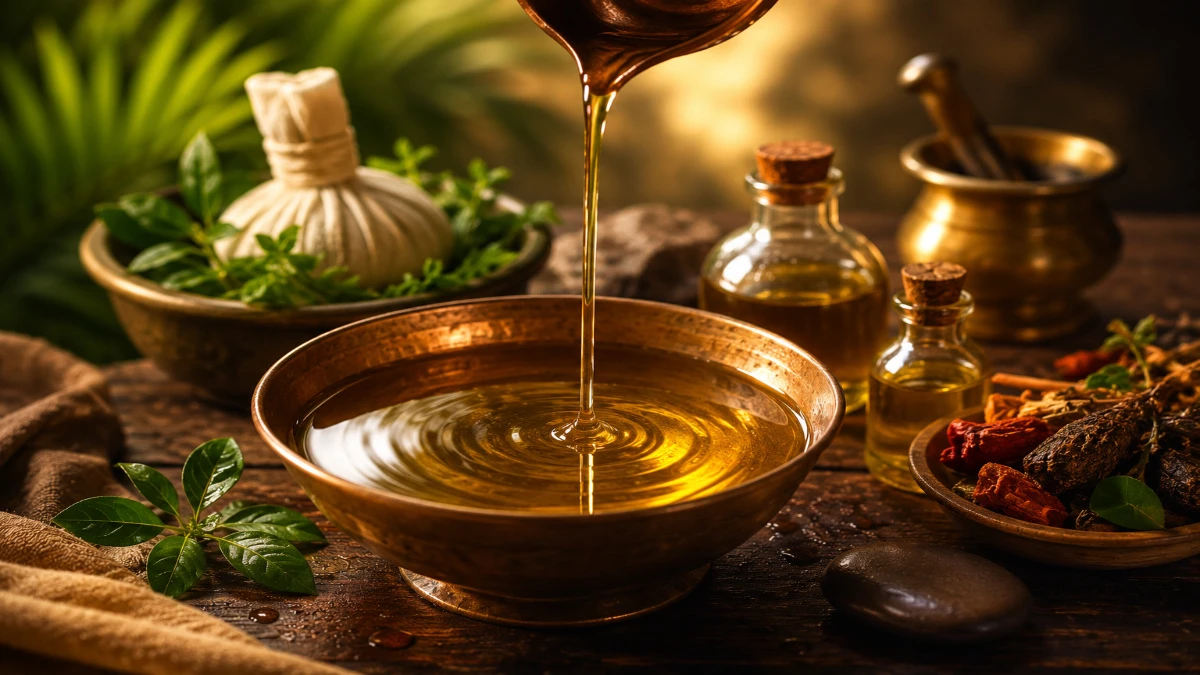
In Ayurveda, the word for oil is Sneha, which also translates to "love" or "affection." But on a purely mechanical level, warm, heavy oil directly counters the dry, rough, and brittle qualities of aging, painful joints.
When you apply warm, herb-infused oil to the skin, it does not just sit on the surface. The skin is highly porous. The warmth opens the pores, allowing active herbal compounds to absorb deep into the tissues. It acts the way oil lubricates a rusty piece of machinery. The friction goes down. The mobility goes up.
Furthermore, Abhyanga targets the lymphatic system. Your lymph nodes are the body's trash collectors, sweeping away metabolic waste and inflammatory byproducts that pool around aching joints. Unlike blood, lymph fluid does not have an automatic pump. It relies entirely on your physical movement. The specific, rhythmic strokes of an Abhyanga massage physically push this stagnant, toxin-heavy fluid out of your joints so the body can flush it away.
How to Practice Self-Abhyanga
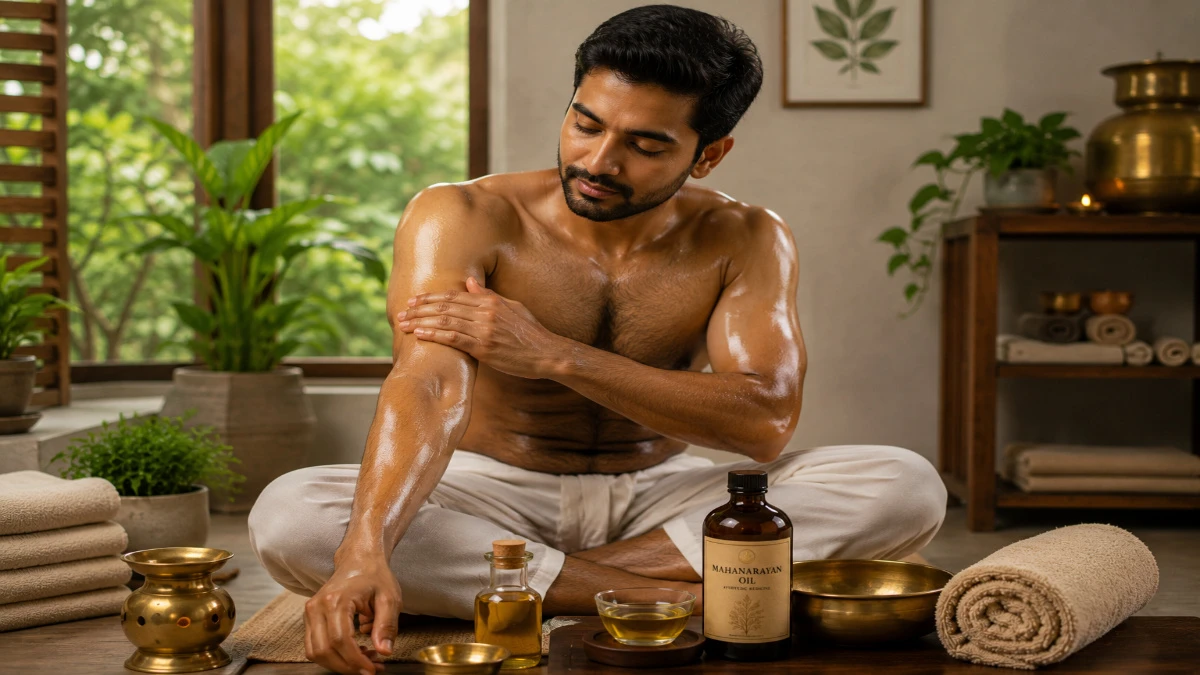
You do not need to visit a high-end clinic to get these benefits. Ayurveda recommends self-Abhyanga as a daily practice. It takes about 15 minutes before your morning shower. However, the technique matters.
Warm the Oil
Never apply cold oil to the body
Place a small bottle of sesame oil (or a medicated Ayurvedic oil like Mahanarayan) into a mug of hot water for a few minutes. Test it on your wrist to ensure it is comfortably warm, not burning.
Start at the Scalp and Ears
Pour a small amount of oil onto your hands and massage your scalp using circular motions. Move down to your ears, gently massaging the outer curves and earlobes. This grounds the nervous system immediately.
Target the Joints and Long Bones
The core technique for joint pain
Move to your arms and legs. Use long, sweeping strokes up and down the long bones of your arms and thighs. Use circular motions directly over your joints (shoulders, elbows, wrists, hips, knees, ankles). The circular motion physically stimulates the joint capsule and encourages the flow of synovial fluid.
Massage the Core
Massage your chest and abdomen using wide, clockwise circular strokes. This follows the natural direction of digestion and helps stimulate internal organs.
Rest and Wash
Do not rush the absorption
Let the oil sit on your skin for 10 to 15 minutes. Use this time to stretch or sit quietly. The resting phase is when the warm oil penetrates the deeper tissue layers. Finally, take a warm shower to rinse off the excess oil, using a mild soap only where necessary.
Beyond the Physical Aches
The benefits of this practice bleed into other areas of your health. Chronic pain keeps your nervous system in a constant state of high alert. You are tense. You are guarding the injury. This physical stress triggers the release of cortisol, which in turn causes more systemic inflammation.
The heavy, warm grounding sensation of Abhyanga acts as a circuit breaker for this stress response. It physically forces the nervous system to shift from "fight or flight" into "rest and digest." People who practice Abhyanga regularly report that they finally sleep through the night without pain waking them up. A good night’s rest is when your body does most of its repair work.
The Long-Term Fix
Quick fixes have their place. If you sprain your ankle on a hike, a painkiller is a great tool to get you down the mountain. But chronic joint pain, persistent stiffness, and losing your ability to move comfortably are not just things you have to accept as a normal part of getting older.
When your body is constantly flashing the warning light, do not just keep hitting the snooze button. It is time to look past the band-aid solutions. Incorporating an Ayurvedic lifestyle, and specifically the targeted therapy of Abhyanga, offers a way to stop masking the problem. With the right care, you can lower inflammation, protect your mobility, avoid permanent joint damage, and stay active and independent for years to come.
References
WHO benchmarks for the practice of ayurveda
(PDF) AYURVEDA ABHYANGA (MASSAGE) PROCEDURE - A REVIEW
Role of Shirodhara and Abhyanga on serum cortisol in Anxiety – A case report - PMC