 Published on
03 Jul, 2026
Published on
03 Jul, 2026 Updated on 03 Jul, 2026
 5095
5095If you went to the doctor a decade or two ago, you probably remember the giant, heavy paper folders. Every time you visited a clinic, the front desk staff had to dig through massive filing cabinets just to find your chart. If you needed to see a specialist across town, you often had to carry a physical stack of your own X-rays and blood test results with you. If a piece of paper got lost, that information was simply gone.
Today, those bulging paper files are quickly becoming a thing of the past. Healthcare has gone digital.
Digital health records are completely changing how doctors store, update and share your medical information. But this shift is not just about saving paper or clearing out office space. It is about making your healthcare faster, much safer and entirely focused on you.
Inside Your Digital Medical File
Think of a digital health record as a highly secure, private digital diary of your entire medical journey. Instead of being locked in a single wooden cabinet at one doctor's office, this digital file can securely travel with you to different hospitals and clinics when you need it to.
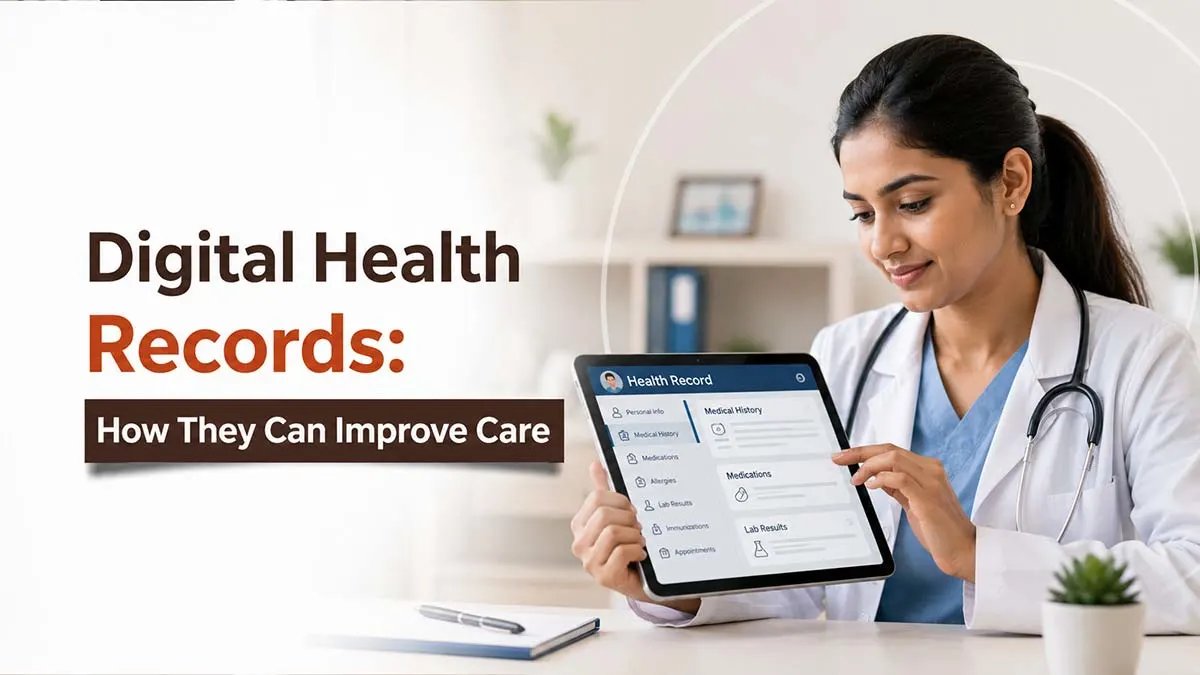
When a doctor opens your digital file, they get an instant, complete picture of your health. A typical file includes:
- Your medical history: Past illnesses, chronic conditions and previous surgeries.
- Your daily medicines: Everything you are currently taking, plus things you took in the past.
- Your allergies: Critical notes on drugs or foods that cause bad reactions.
- Your test results: Blood work, urine tests and lab reports.
- Your scans: X-rays, MRIs and ultrasounds that doctors can look at directly on their screens.
- Your vaccine history: A log of all your shots and boosters.
- Your doctor's notes: The advice and treatment plans your doctors have written down for you.
Having all these details in one easy-to-read place means your healthcare team never has to guess about your past.
.webp)
How the System Actually Works
The beauty of a digital record is that it is always growing and updating in real-time.
When you visit a clinic for a cough, the doctor types in your symptoms and the medicine they prescribed. If they send you down the hall for a quick blood test, the lab does not have to print a paper report and mail it. The lab simply types the results into a computer and it instantly pops up on your doctor's screen.
Many modern hospitals, local pharmacies and testing centers are now linked together. This means the information flows smoothly from one place to another without anyone having to do the busy work of copying papers. Your doctors are always looking at the freshest, most up-to-date information available.
Why This is a Huge Win for You
As a patient, digital records remove a lot of everyday frustration. You no longer have to sit in a waiting room trying to remember the exact name of a pill you took three years ago. You do not have to memorize your entire medical history every time you meet a new specialist. The computer remembers for you.
Even better, this technology puts you in the driver’s seat. Most clinics now offer a patient portal, an app or website where you can log in and see your own file. You can check your own lab results the moment they are ready, send a direct message to your doctor, ask for a prescription refill or book your next appointment right from your phone.
Making Your Doctor's Job Easier
Doctors and nurses love digital systems because they save precious time. Instead of spending ten minutes hunting down a misplaced paper chart, a doctor can pull up your file in two seconds.
It also completely solves the famous problem of "bad doctor handwriting." Because everything is typed, there is no confusion over what a prescription says or what a note means.
More importantly, it builds a team around you. If you are dealing with a complex issue like heart disease, you might have a general doctor, a heart specialist, and a nutritionist. With digital records, all three of these experts can look at the same notes. They can talk to each other through the system and coordinate your care so everyone is on the same page.
Catching Mistakes Before They Happen
Humans make mistakes, but in medicine, a small mistake can be dangerous. Digital records act like an incredibly smart safety net.
Let's say a doctor accidentally tries to prescribe you a medicine that will react badly with a blood pressure pill you are already taking. The computer system will immediately flash a warning sign on the screen, stopping the doctor from making the error.
The same thing happens with allergies. If you are allergic to penicillin, the system will block any prescription that contains it.
Digital files also save you from repeating expensive tests. If an emergency room doctor can see that you just had a chest X-ray two days ago at a different clinic, they can just look at that old scan instead of making you pay for and go through a brand new one.
.webp)
When Every Second Counts
In a medical emergency, time is everything. If you arrive at an emergency room very sick or unable to speak, you cannot tell the nurses what you are allergic to or what diseases you have.
If the hospital uses a connected digital system, the emergency room staff can type in your name and instantly see your whole medical history. They will immediately know your blood type, what major surgeries you have had, and what medicines are in your system. This fast access allows them to make safe, life-saving decisions in minutes.
A Nudge to Stay Healthy
Digital records are not just for when you are sick; they are excellent at keeping you healthy, too.
These smart systems can track your age and health history, automatically sending out reminders. Your doctor's office might send you an automatic text message letting you know it is time for your yearly flu shot, a routine blood pressure check, or a cancer screening. For people living with long-term issues like diabetes, this kind of constant monitoring keeps small problems from turning into big emergencies.
.webp)
Perfect for Virtual Doctor Visits
Over the last few years, talking to a doctor through a video call known as telemedicine has become incredibly popular. Digital records make this perfectly smooth.
While you are sitting on your couch at home looking at your phone, your doctor is looking at your complete digital file on their screen. They can see your past test results, ask you how you are feeling, update your chart and send a prescription straight to your local pharmacy with a single click.
Are Your Secrets Safe?
It is completely normal to worry about your private health details living on a computer. However, healthcare organizations take this very seriously.
Digital health systems use bank-level security. The information is locked behind heavy digital encryption. Only approved doctors and nurses are given passwords to see your file and the computer keeps a strict log of exactly who opened your chart and when they looked at it. While nothing on the internet is ever foolproof, hospitals spend millions of dollars constantly upgrading their digital locks to keep hackers out.
.webp)
How to Take Charge of Your File
You can get the most out of this technology by taking a few simple steps:
- Keep your info fresh: Always make sure your phone number, address and emergency contacts are up to date in the system.
- Check for mistakes: Log into your patient portal once in a while. If you see a medicine listed that you stopped taking years ago, let your doctor know so they can delete it.
- Ask questions: If you read a test result in your portal and do not understand the medical words, write them down and ask your doctor at your next visit.
- Use the tools: Take advantage of the app to message your care team instead of waiting on hold on the telephone.
Conclusion
Digital health records have already changed the medical world, and they are only going to get smarter. In the near future, computers might be able to look at your family history and your test results to warn your doctor that you might get sick before you even feel any symptoms.
By ditching the heavy paper folders and moving everything online, healthcare is becoming much more organized and connected. It means your doctors can spend less time pushing paper around and more time doing what they do best: taking care of you.
References
WHO recommendations on home-based records for maternal, newborn and child health