.webp)
 Published on
08 Jul, 2026
Published on
08 Jul, 2026 Updated on 08 Jul, 2026
 5127
5127Have you ever looked at a very old, faded black-and-white photograph of your ancestors? You might stare at a great-grandfather and notice that he has the exact same tilt of the chin as you do. Or maybe your grandmother passed down her deep brown eyes to your mother, and then to you. It is a strange and beautiful feeling to know that pieces of people from the past are living and breathing inside you right now.
But have you ever flipped that thought around and looked into the future?
Imagine it is the year 2200. That is roughly seven generations from now. Will a child running around in that future world still carry a piece of you? Will they have your laugh, your height, or perhaps your quick temper? What exactly do we leave behind when we are long gone?
When we ask this question, we usually get two very different types of answers. One comes from the bright, modern laboratories of genetic science. The other comes from the ancient, quiet wisdom of Ayurveda. Surprisingly, when you put them side by side, they are telling us the exact same story.
Let us break down the mystery of what you are actually passing down to the future.
The Math of Your Bloodline
To understand what happens seven generations from now, we first have to look at how biology works. The math of human life is actually quite simple, but it moves very fast.
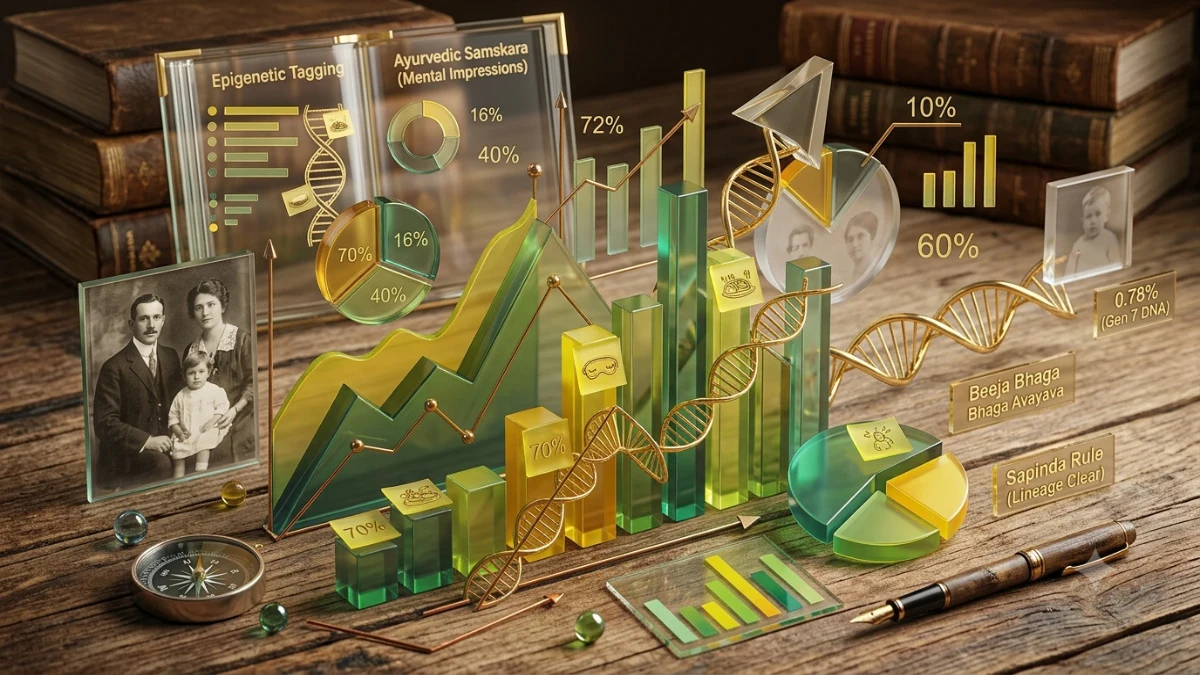
When you have a child, you give them exactly half of your DNA. The other half comes from your partner. So, your child is 50% you. When that child grows up and has a baby, they pass on half of their DNA. That means your grandchild is roughly 25% you.
Every time a new generation is born, your genetic footprint gets cut in half.
- Generation 1 (Child): 50%
- Generation 2 (Grandchild): 25%
- Generation 3 (Great-Grandchild): 12.5%
- Generation 4: 6.25%
- Generation 5: 3.12%
- Generation 6: 1.56%
- Generation 7: 0.78%
By the time we reach that child playing in the year 2200, less than 1% of their DNA will trace directly back to you. Your genetic material has been mixed, matched, and watered down by over a hundred other ancestors who joined the family tree along the way.
If you just look at the raw math, it might feel a little sad. It seems like after seven generations, you are almost completely erased. But this is where modern science takes a fascinating turn.
The Sticky Notes on Your DNA
For a long time, scientists thought that your DNA was like a fixed, hard-coded book. They believed that whatever was written in the book was permanent, and you just handed that exact same book to your children.
Today, science knows that is only half the story.
You do pass down a "book" of genes, but throughout your life, you are constantly adding "sticky notes" to the pages. Everything you do leaves a mark. The food you eat, the amount of sleep you get, the air you breathe, and even the stress or trauma you experience all of these things add chemical tags to your DNA.
These tags do not change the words in the book, but they tell the body which pages to read and which pages to skip. In science, this is called epigenetics.
Here is the mind-blowing part
when you have a child, you do not just pass down the book. You also pass down the sticky notes.If a farmer lives through a terrible famine, his body learns to hold onto every single calorie just to survive. That survival habit places a sticky note on his DNA. When he has children, they might be born with bodies that naturally store fat, even if there is plenty of food around.
Your lifestyle today is turning certain genetic switches "on" and "off." And those switch settings can travel down the family line for generations. So, while the child in 2200 might only have 1% of your actual genetic code, the way their body behaves might be directly shaped by the habits you are building right now.
The Ancient Science of the Seed
Long before microscopes and DNA sequencing were invented, the teachers of Ayurveda completely understood this concept. They just used different words to explain it.
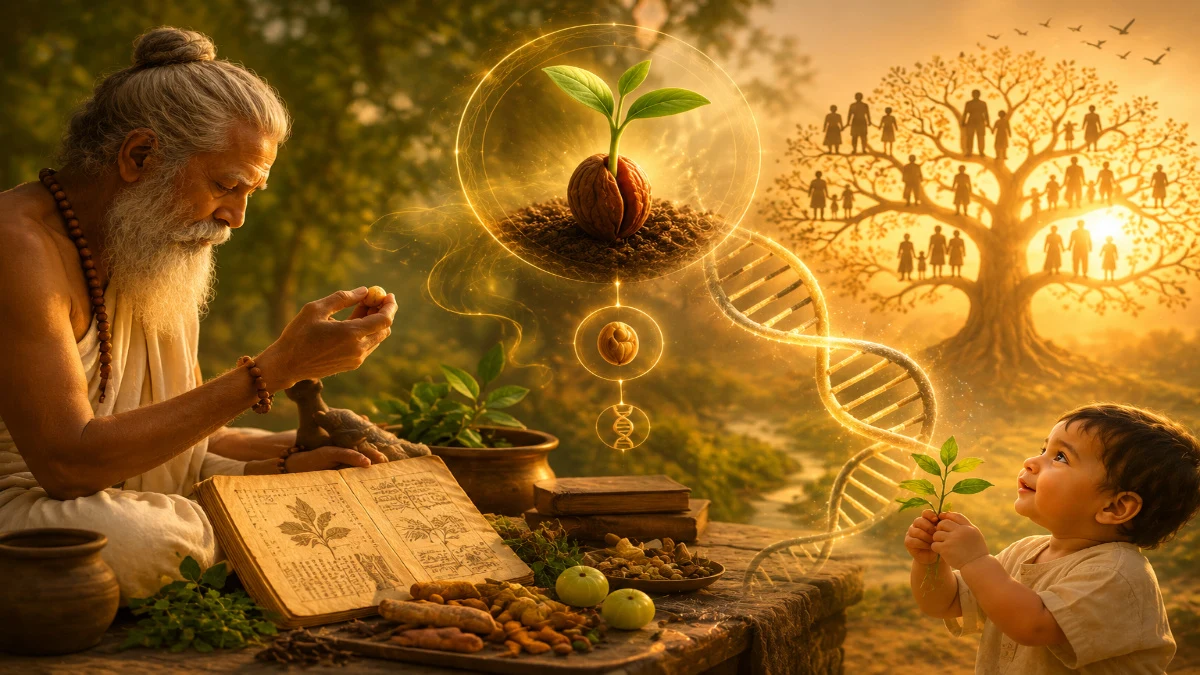
Instead of talking about cells and chromosomes, Ayurvedic texts like the Charaka Samhita explain human life using the language of nature. They compared the creation of a child to the growing of a plant.
In Ayurveda, your genetic material is called the Beeja (the seed). But the ancient doctors knew that a seed is not just a single, solid thing. They divided it into smaller and smaller parts:
- Beeja: The whole seed (the sperm and the ovum).
- Beeja Bhaga: The core parts of the seed (what we now call chromosomes).
- Beeja Bhaga Avayava: The tiny, invisible fragments inside those parts (what we now call genes and DNA).
Thousands of years ago, Ayurveda stated that if a specific part of the Beeja Bhaga is damaged by a poor diet, bad habits, or illness, the child will be born with a weakness in that exact same area of the body. If you damage the "eye" part of the seed, the child will have weak eyes. It is a stunningly accurate description of how genetic diseases work.
The Four Pillars of a Good Harvest
Ayurveda goes even deeper. It teaches that getting a healthy plant requires more than just a good seed. If you want a strong future generation, four things must come together perfectly:
- Ritu (The Right Timing): Just as you cannot plant wheat in the wrong season, human health depends on the right age and the right biological timing for having children.
- Kshetra (The Soil): In human terms, this is the womb and the mother's overall physical health. If the soil is toxic, even the best seed will not grow well.
- Ambu (The Water and Nutrition): This represents the food, hydration, and emotional nourishment the parents consume.
- Beeja (The Seed itself): The genetic material passed down by both the mother and the father.
If a person eats highly processed foods, stays awake all night, and lives in a state of high stress, Ayurveda says their "seed" becomes weak. The "soil" becomes dry. Even if they pass down their physical traits, they are passing down a compromised foundation.
The Seven Generation Rule
Now, let us bring it all back to the magic number: seven generations.
Have you ever wondered why traditional Indian families strictly check the Gotra (lineage) before a marriage?
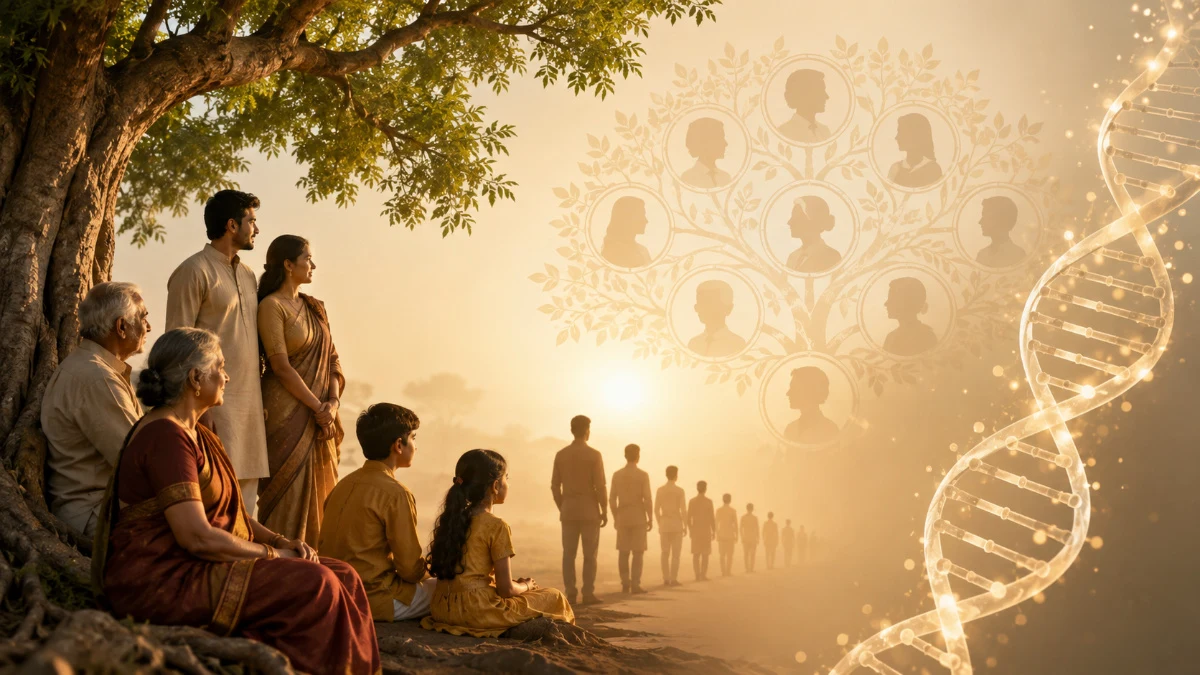
For thousands of years, there has been a strict cultural rule: you should not marry anyone who shares a common ancestor with you within the last seven generations.
This practice, called Sapinda, was not just a random social rule. It was deeply rooted in ancient science.
The Ayurvedic sages somehow figured out exactly what modern genetic math just showed us. They knew that it takes exactly seven generations for the Beeja (the genetic material) of a specific ancestor to completely dissolve and become a tiny, harmless fraction.
If two people marry within those seven generations, the hidden weaknesses in their shared family seed might combine and grow stronger, causing diseases in their children. By waiting until the seventh generation has passed, the genetic pool is considered completely refreshed and safe. Ancient wisdom and modern math line up perfectly.
Passing Down the Invisible Things
There is one final piece to this puzzle. Beyond the physical body, what else goes down the family line?
Ayurveda introduces a beautiful concept called Samskara “ deep mental impressions, habits, and emotional traits that a soul carries”
Have you ever seen a child who is naturally fearful of water, even though they have never had a bad experience with a pool? Or a baby who naturally loves a specific type of music that their great-grandmother used to sing?
Modern science is just starting to study how trauma, fear, and even joy might be passed down through those "sticky notes" on our DNA. But Ayurveda has always taught that a parent's state of mind at the time of conception, and the mother's emotions during pregnancy, directly print Samskaras onto the child's mind.
If you live a life full of deep anxiety, you might be passing a subtle shadow of that anxiety into the future. But the reverse is also true. If you work hard to heal your mind, if you learn to stay calm, and if you nourish your body with good food, you are passing down a legacy of strength.
| Viewpoint | How Traits are Passed | How Lifestyle Affects the Future | How Long the Link Lasts |
| Modern Genetics | Through DNA and Chromosomes | "Sticky notes" on genes turn traits on or off | Math shows it halves every generation (~1% by gen 7) |
| Ancient Ayurveda | Through the Beeja (the seed) | Bad habits damage the Beeja Bhaga (inner seed) | Rules advise clearing the lineage for exactly 7 generations |
The Bridge Between the Past and the Future
So, will your DNA still exist seven generations from now?
Yes, a tiny, quiet fraction of your genetic code will be sitting inside that child in the year 2200. But more importantly, the echo of your choices will be there.
We often think of inheritance as money, land, or gold jewelry passed down in a safe. But your real inheritance is biological. Every time you choose a fresh, nourishing meal over heavy junk food, you are cleaning up the Beeja. Every time you take a deep breath and let go of anger, you are removing a negative Samskara. You are literally writing a better future for someone you will never even meet.
You are not just a random person living in the present day. You are the vital bridge between a hundred ancestors who came before you, and a hundred generations that will follow. The seed is in your hands right now.