 Published on
14 Jul, 2026
Published on
14 Jul, 2026 Updated on 14 Jul, 2026
 5106
5106We have all been there. The alarm clock rings, you push back the covers, and swing your legs over the edge of the bed. But when you try to stand up, your lower back refuses to straighten. Your knees let out a loud, hollow pop, and your fingers feel incredibly tight and swollen, almost like they belong to someone else. You take a few slow, shuffling steps toward the bathroom, waiting for your limbs to finally "warm up."
When this happens, we usually blame external things. We tell ourselves that the AC was too cold, our mattress is getting old, or that we simply slept in an awkward position. Most of us just accept this morning struggle as an unavoidable part of getting older. We stand under a hot shower, wait for the stiffness to melt away, and get on with our busy day.
However, waking up stiff every morning is not something you should simply dismiss as a bad mattress or an awkward sleeping position.It is a bright warning sign that something inside your body deserves attention. It's a bright, obvious warning light from inside your body. During sleep, your body should be resting, repairing, and lubricating your joints for the day. When you get up in the morning feeling like a rusted tin man, you have a problem with the nighttime repair cycle. The first 20 minutes of the day is an honest preview of your interior condition, according to Ayurveda.
But not all stiffness is the same. Just like we have different traditional drinks for different summer moods, your body requires entirely different fixes depending on exactly how you feel stiff. Are your joints cracking? Do they feel heavy and swollen? Let us break it down simply.
Why We Need to Look at the Stomach, Not Just the Bones?
We have all been told a million times to "do more stretching" when we feel stiff. And yes, gentle movement is essential. But joint health is about a lot more than just stretching your muscles.
In Ayurveda, the health of your joints is directly tied to the health of your digestion. When you eat heavy, cold, or highly processed food, especially late at night, your stomach simply cannot digest it properly while you sleep. Your digestive fire (Agni) is naturally lower at night.
When food remains undigested in the stomach, it becomes heavy, sticky, and toxic waste called Ama. According to Ayurveda, this sticky waste can circulate through the body and contribute to various health concerns.
So, that painful stiffness you feel at 7:00 AM? That is often the physical sensation of your body trying to push through a layer of toxic, sticky glue that built up overnight. To fix the problem, you have to look at what kind of stiffness you are dealing with.
The "Bone-Dry" Stiffness: High Vata
This is incredibly common as we get older, or during the dry, cold winter months.
How it feels: When you wake up, your joints don't necessarily look swollen or red, but they feel completely locked. When you try to bend your knees or rotate your ankles, you hear loud cracking, popping, or grinding sounds. The stiffness feels sharp, brittle, and dry. It usually goes away fairly quickly once you take a hot shower or walk around for ten minutes.
What is actually happening: This is a classic sign of high Vata dosha (the energy of wind, dryness, and movement). Your joints naturally contain a thick, protective lubricating fluid (called Sleshaka Kapha). If Vata increases, which is frequently as a result of stress, over-exercising, or overeating cold, dry foods, then this internal oil literally dries out. Your joints are like the wooden door hinges that are totally devoid of grease.
The Best Fix: Warmth and oil. A hot cup of tea isn't enough here; you need to lubricate the body from the outside in. Before your morning shower, gently massage warm sesame oil into your stiffest joints. Sesame oil is heavy, warming, and deeply penetrates the skin to instantly pacify that dry, erratic Vata wind.

The "Heavy and Sticky" Stiffness: Toxic Ama
If Vata is like a dry hinge, this type of stiffness feels like you are trying to move through wet cement.
How it feels: You don't just feel stiff; you feel heavy, lethargic, and exhausted. Your fingers might look a little puffy or swollen, and it is hard to make a tight fist. Unlike the dry popping of Vata, this stiffness is dull, deep, and stubborn. It might take an hour or two of moving around before you finally feel normal.
What is actually happening: This is the direct result of that sticky Ama (toxins) we talked about earlier, often combined with heavy Kapha dosha. You likely ate a heavy, cheesy, or sweet meal too late at night. Your body couldn't digest it, and the resulting toxic sludge has settled heavily into your joint spaces, blocking the natural flow of energy and fluid.
The Best Fix: The goal is to stimulate warmth from within. On awakening, make a large glass of water and boil it with a few pieces of fresh crushed ginger. Ginger essentially is a hug for your sluggish digestive system. Like natural kindling for your digestive fire, it burns out and eliminates the sticky Ama that clogs your joints.
The "Red, Hot, and Painful" Stiffness: Amavata
This is the most severe type of stiffness, and it requires careful attention.
How it feels: You wake up and your joints, often symmetrically, like both wrists or both knees, are incredibly stiff, visibly swollen, and feel warm or hot to the touch. The pain is intense and throbbing. Trying to move does not make it better right away; in fact, it might hurt intensely just to hold a toothbrush.
What is actually happening: In Ayurveda, this is known as Amavata, which closely mirrors the symptoms of Rheumatoid Arthritis. This happens when the sticky Ama in your joints mixes with the fiery Pitta dosha. Your body’s immune system gets confused and attacks the toxic buildup, creating a massive, hot, inflammatory fire right inside the joint lining.
Doctor’s Note
Going forward, we must always prioritise safety. If your morning stiffness lasts for more than one hour and is accompanied by visible swelling, redness, and severe pain, please consult a doctor or a rheumatologist immediately. Prolonged morning stiffness is the number one clinical red flag for autoimmune conditions like Rheumatoid Arthritis. While Ayurvedic diet and lifestyle changes are fantastic for supporting your healing, active, hot joint inflammation can cause permanent bone damage if left medically untreated. Never ignore a joint that is hot to the touch.
Which Fix Should You Choose?
Since we aren't looking at an X-ray, let us just think about your morning and match the routine to your current need.
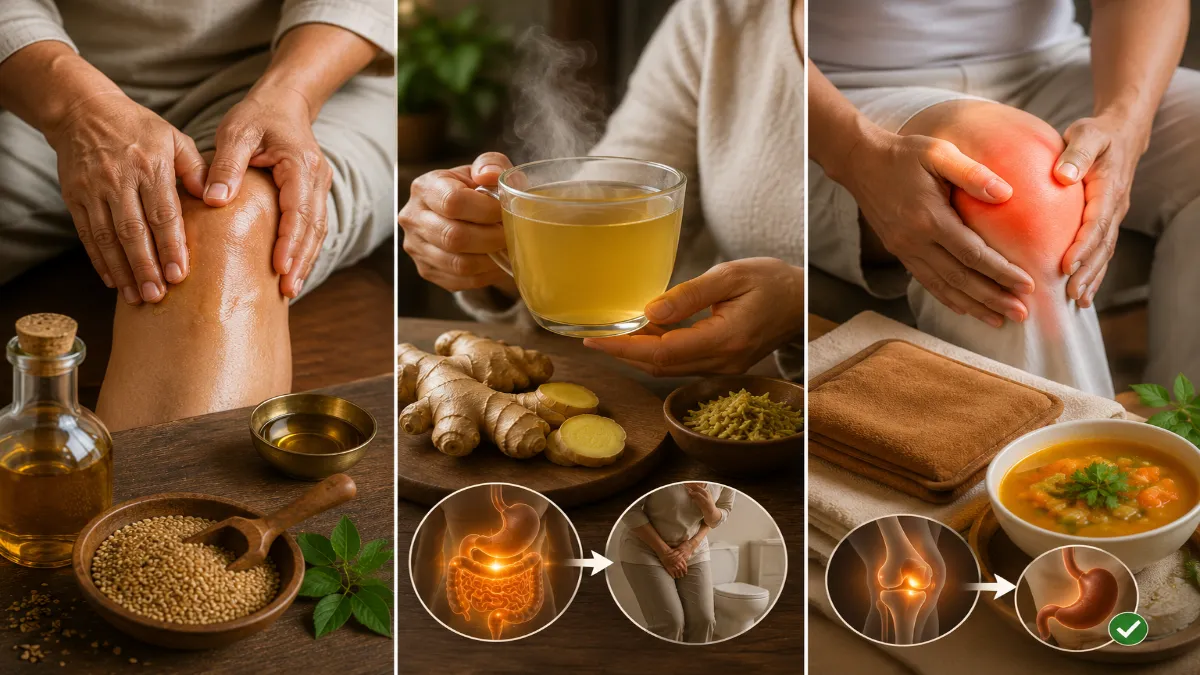
For joints that feel dry, brittle, and crack each time you take a step, opt for the Warm Sesame Oil. The deep lubricating oil will penetrate into your tissues, restore your natural lubrication, and prevent grinding friction.
If you are feeling lethargic, heavy, and your hands feel like puffy balloons, grab a glass of Hot Ginger Water. The sharp, warming spice will instantly kickstart your digestion, melt the sticky toxins, and help you flush them out in the bathroom.
If you are dealing with hot, red, throbbing joints, skip the heavy oils entirely. Apply dry heat, like a warm sandbag or a dry heating pad, and focus entirely on eating very light, easily digestible soups until the intense inflammation goes down.
A Few Things to Keep in Mind
While these traditional routines are wonderful, everyone's body is different. Here is who should be a little careful:
- Never oil a hot joint: If your stiffness is accompanied by redness and heat (Pitta/Amavata), applying heavy massage oil will trap the heat inside and make the swelling significantly worse. Stick to dry heat only.
- Watch your dinner clock: The single most effective way to cure morning stiffness is to change your evening routine. If you eat dinner at 9:30 PM and go to sleep at 10:30 PM, your body will always create joint-clogging Ama. Try to eat a light dinner before sunset, or at least three hours before your head hits the pillow.
- Don't force a cold muscle: If you wake up stiff, do not immediately launch into a heavy, intense workout or deep yoga stretches. Your internal engine is cold. Drink your warm water, take a warm shower, and let the body naturally lubricate itself before you demand hard physical labor from it.
Conclusion
We don't need to look for fancy, expensive orthopedic gadgets to survive our mornings. We’ve already figured out the best ways to keep our bodies flexible, lubricated, and light.
Morning stiffness has survived as a universal human complaint because we have stopped listening to our digestion. You don't have to just accept the pain. Listen to your body. Rub some warm sesame oil on those cracking knees. Drink a hot glass of ginger water when you feel heavy and sluggish. And most importantly, give your stomach a break before bedtime. Fix your digestion, keep your body warm, and enjoy the beautiful freedom of stepping out of bed with ease!
References:
Muscle Stiffness: Causes, Diagnosis, Treatment, and More