
 Published on
20 Jul, 2026
Published on
20 Jul, 2026 Updated on 20 Jul, 2026
 5078
5078Almost every woman goes through a delayed or early period at some point in her life. If your cycle acts up just once, there is usually no reason to panic. But when irregular periods become a repeating pattern month after month, your body is trying to send you a message.
When a period is late, the mind usually races to a few common guesses: Is it PCOD? Is it my thyroid? Or am I just taking too much stress? The truth is, all three of these things can completely mess up your monthly cycle. Because the warning signs of these three issues look very similar, it is easy to get confused.
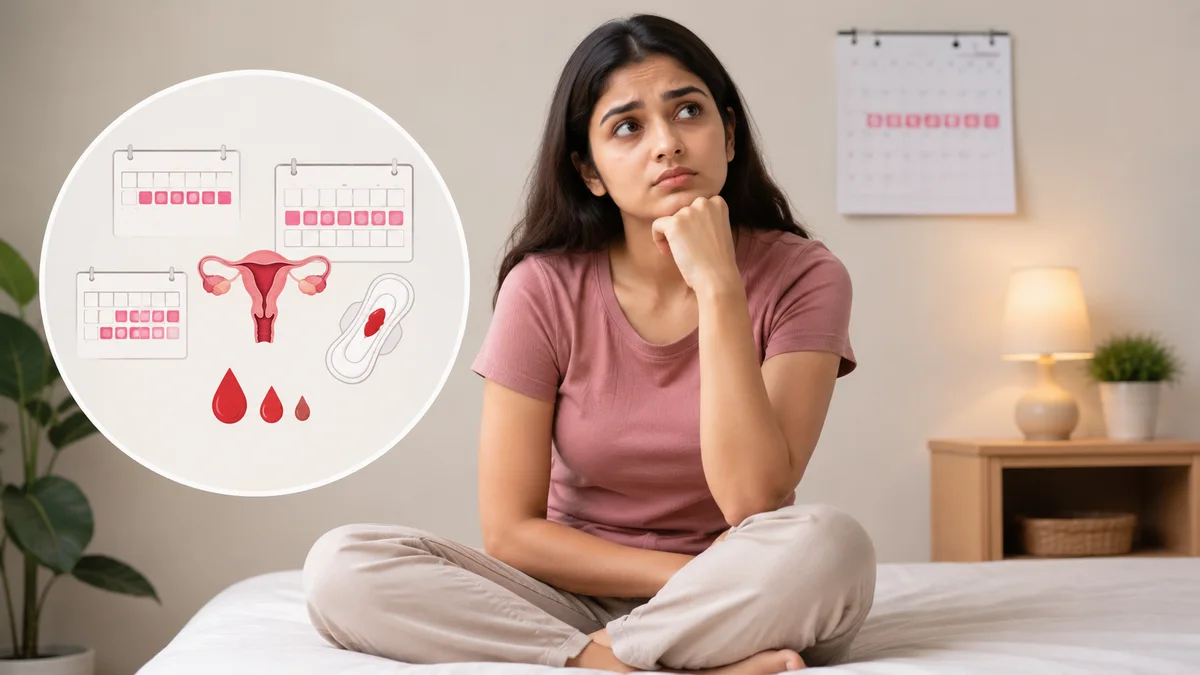
What Counts as an Irregular Menstrual Cycle?
A healthy period cycle usually lasts anywhere from 21 to 35 days for most women. Our body has its own rhythm, so subtle changes can occur from month to month, which are completely fine.
Your cycle is considered irregular:
- If your periods arrive too early, 21 days or too late than 35 days.
- If you completely skip your periods for multiple months in a row.
- If your bleeding becomes very heavy or surprisingly light.
- The number of days between your periods keeps changing drastically every month.
- If you notice random spotting or bleeding on the days between your periods.
How Hormones Control Your Menstrual Cycle
Your menstrual cycle is basically a team effort. It relies on constant, clear communication between your brain, your ovaries, and your thyroid gland.
The first step starts from your brain sending signals to your ovaries to start getting an egg ready. Then, the ovaries respond by making hormones such as estrogen and progesterone. Meanwhile, your thyroid glands stay in the background playing the role of the body’s battery, as it controls your energy, metabolism, and how well your other hormones work in a team.
If just one of these team members gets confused, tired, or overworked, the whole cycle gets thrown off track.
Could PCOD Be the Reason Behind Irregular Periods?
Polycystic Ovary Disease (PCOD) is one of the most common reasons young women experience delayed periods today.
In simple terms, PCOD creates a hormonal imbalance that stops your ovaries from releasing an egg on time. If there is no egg released, your period either gets delayed or does not show up at all.
If PCOD is the reason behind your missed periods, you will likely notice a few other frustrating signs:
- Weight gain, especially around your belly.
- Acne and pimples all over your face.
- Excess hair growth on your face, chin, or chest.
- Excessive hair fall and hair thinning.
- Facing difficulties in losing weight.
Can Thyroid Problems Affect Your Menstrual Cycle?
Yes, it can. Your thyroid is a small butterfly gland in your body that controls everything in your body, even your menstrual cycle.
Hypothyroidism (Underactive Thyroid): When your thyroid is lazy and slow, your whole body slows down. If this is causing your irregular periods, you might experience:
- Your periods get delayed
- You may face excessive bleeding
- You always feel exhausted and sleepy
- You gain weight easily.
- You struggle with constipation.
- You have extremely dry skin and hair.
- You feel cold even when the weather is warm.
Hyperthyroidism (Overactive Thyroid): On the flip side, if your thyroid is working too fast, your body goes into overdrive.
You might notice:
- You have very light periods
- You missed your period cycles
- You are losing weight quickly and without even trying
- Feeling highly anxious and restless

Can Stress Really Delay or Stop Your Periods?
Yes, and it happens much more often than people realize.
When you are under heavy stress, your brain hits a survival mode. It produces high amounts of a stress hormone called cortisol. When cortisol levels go up, your brain decides that right now is not a safe time to make a baby. To protect you, it simply shuts down your reproductive hormones, hitting the "pause" button on your period.
Some common hidden stressors include:
- Emotional worries about family
- Pressure from school, college or your workplace
- Financial troubles
- Lack of sleep
- Working out hard at the gym
- Losing weight too fast
- Recovering from a severe illness
Doctor’s Note
PCOD, thyroid issues, and stress require entirely different treatments, so irregular periods should never be self-diagnosed. Consult a gynecologist for a pelvic ultrasound and hormone/thyroid tests if you skip three consecutive cycles, experience severe pain, heavy bleeding (soaking a pad every hour), or sudden physical changes.
PCOD vs Thyroid vs Stress: How Do the Symptoms Differ?
Since PCOD, thyroid issues and stress can all delay your period, how do you tell them apart? While the symptoms do overlap, there are a few clear clues you can look for.
If it is PCOD, you will mostly notice physical changes: Along with late periods, you will likely struggle with acne, facial hair, and weight gain around your belly. You might feel fine energy-wise, but your skin, hair, and weight will feel out of your control.
If it is your Thyroid, you will mostly feel a change in your energy: The biggest red flag for thyroid issues is extreme fatigue. If you are sleeping for nine hours and still waking up feeling totally drained, gaining weight all over, feeling unusually cold, or struggling with dry skin, your thyroid is likely the culprit.
If it is Stress, it is mostly tied to your lifestyle and mood.: You won't suddenly grow facial hair. Instead, your missed period will likely be paired with bad sleep, high anxiety, feeling overwhelmed, or a recent major change in your life (like a new job, a breakup, or a crazy diet).
Because these signs can be confusing, trying to guess what is wrong on your own can lead to unnecessary worry.
The Ayurvedic View on Irregular Periods
In Ayurveda, irregular periods are not considered as the cause of a single thing, but it connects it to the overall imbalance of the body and doshas:
Vata (The Stress Factor): Vata is the movement controller of the body. If you take high stress, don't sleep well, and are always anxious, then it gets affected, leading to an imbalance in the body, which in turn leads to irregular periods.
Kapha (The PCOD Factor): Kapha is the controller of body structure and moisture. If you sit too much and have weak digestion, then it may get imbalanced and lead to the creation of toxins in the body, which later can block reproductive channels of the boyd leading to missed period.
Pitta (The Metabolism Factor): Pitta is the controller of body heat and energy. When Pitta flares up, it can trigger early periods, extra heavy bleeding, and inflammation, which often mimics a thyroid problem.

Lifestyle Changes That Support a Healthy Menstrual Cycle
Whether you are dealing with PCOD, a sluggish thyroid, or heavy stress, your daily habits play a massive role in fixing your hormones. Medicine helps, but your lifestyle is the true foundation.
- Eat a Balanced, Simple Diet: You do not need fancy diets. Just focus on eating real food. Fill your plate with fresh vegetables, whole grains, lentils, and good proteins. Cut back on sugary drinks, packaged chips, and bakery items. Keeping your blood sugar stable does wonders for your hormones.
- Stay Physically Active: Moving your body is pure magic for your cycle. It helps balance your insulin, manages your weight, and burns off stress. You do not need to run a marathon; a brisk 30-minute walk in the park most days of the week is more than enough.
- Prioritize Sleep: Your hormones repair themselves while you sleep. Staying awake until 3 AM, staring at a phone screen, confuses your brain and your ovaries. Try your best to get seven to nine hours of proper, uninterrupted sleep every night.
- Manage Your Stress: Since stress can literally stop your periods, finding ways to relax is not a luxury; it is a necessity. Find what works for you. It could be deep breathing, listening to calm music, writing your thoughts in a journal, or simply chatting with a good friend.
Can Irregular Periods Be Managed Naturally Alongside Medical Care?
Yes, natural changes and medical care work beautifully together.
You cannot fix a true thyroid disorder just by eating well; you will likely need a simple daily medicine to give your body the hormones it is missing. But for PCOD, natural lifestyle changes like daily walking and eating clean are actually the main treatment. And if stress is your only issue, fixing your sleep and taking a break is exactly what the doctor will order.
The most important step is simply finding out why your periods are late first, rather than blindly trying home remedies.
When Should You Visit a Doctor?
You must schedule an appointment at the earliest:
- Three consecutive periods are skipped.
- You've had irregular periods for over six months.
- The flow of blood during menstruation is excessive to the point where you have to keep changing your sanitary napkins every hour.
- Severe pain is felt in the lower abdomen.
- Unexplained growth of body hair or rapid weight gain occurs suddenly.
- You wish to conceive, yet have not been able to.
Final Thoughts
Irregular cycles are not a disorder; they are a symptom. They are a signal that your body gives you to alert you that something within it is out of sync.
The three biggest offenders are PCOD, thyroid dysfunction, and stress. By observing any factor in your life, such as your body mass index, skin condition, mood, and energy levels, you may be able to figure out what is wrong. Do not ignore these symptoms. Consult a physician, make alterations to your lifestyle, and support your body in any way possible. It is possible to bring your system and body back into natural order with some effort and correct management.
References
Polycystic Ovary Syndrome: Etiology, Current Management, and Future Therapeutics - PMC
Menstrual Cycle Characteristics in Women With and Without Thyroid Disease - PMC
To Evaluate the Effect of Perceived Stress on Menstrual Function - PMC