 Published on
28 Jul, 2026
Published on
28 Jul, 2026 Updated on 28 Jul, 2026
 5078
5078Yoga has long held a reputation as a natural cure for a bad back. Walk into almost any physical therapy clinic or primary care office, and you will likely find a pamphlet suggesting gentle yoga poses to relieve lower back tension. For millions of people, a regular studio practice brings genuine relief. It stretches tight muscles, builds core strength, and calms a stressed nervous system.
Yet there is a quieter reality playing out in emergency rooms and chiropractic offices. Every week, yoga practitioners show up with fresh spinal strains, aggravated herniated discs, and severe flare-ups. The culprit is rarely yoga itself. It is usually the wrong pose, performed by the wrong body, at the wrong time.
When your lower back is already irritable, certain movements do far more damage than good. Protecting your spine starts with knowing exactly what to skip.
Doctor's Note
If you have persistent back pain, a slipped disc, sciatica, osteoporosis, or have recently undergone spinal surgery, avoid attempting advanced yoga poses without professional guidance. A personalised exercise plan, proper technique, and timely medical evaluation can reduce the risk of further injury while supporting long-term spinal health.
Poses That Put Your Lower Back in the Crosshairs
Not all yoga poses are created equal. When a spine is compromised,whether by general muscular stiffness, a bulging disc, or age-related wear, several popular postures exert dangerous shearing forces and high compressive loads.
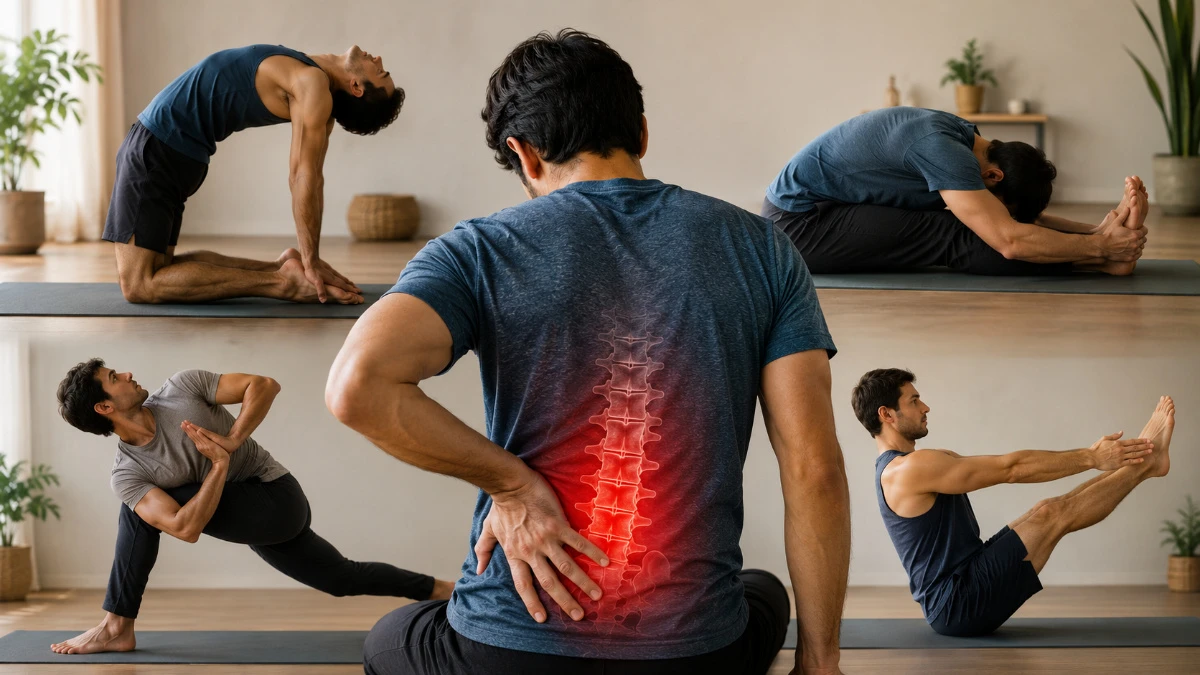
1. Deep Backbends (Camel, Bow, and Full Wheel)
Deep backbends sound like an ideal way to reverse the slouched posture of desk work. They aren't always safe. Poses like Camel (Ustrasana), Bow (Dhanurasana), and Full Wheel (Urdhva Dhanurasana) demand extensive extension from the lumbar spine. If your shoulders and upper back are tight, your body steals mobility from the lower back.
The result is severe compression of the lumbar vertebrae and facet joints. For anyone with spinal stenosis or degenerated discs, this backward pinching narrows the spinal canal even further, irritating surrounding nerves and triggering sharp, radiating pain.
2. Rounded Forward Folds (Seated Forward Bend and Big Toe Pose)
Forward folds are frequently introduced as gentle, relaxing stretches. Look closely at how most people execute a Seated Forward Fold (Paschimottanasana). Instead of hinging cleanly from the hip sockets, the lower back rounds into a pronounced C-curve.
Notice how rounding the lower back forces the spinal discs backward. When you yank your torso forward using your hamstrings or arms, you create tremendous pressure on the front of the vertebrae. This forces the gelatinous center of your spinal discs outward. If you have a known disc bulge or herniation, deep forward folding can easily push that disc right into a nerve root.
3. Aggressive Closed Twists (Crescent Lunge Twist and Revolved Triangle)
Twisting can feel wonderfully restorative when done gently. Loaded or forced twists are a different story. In postures like Crescent Lunge Twist (Parivrtta Anjaneyasana), you are asking your spine to rotate while it is simultaneously extended and holding body weight.
The lumbar spine was anatomically built for flexion and extension, not massive rotation; the thoracic spine (mid-back) is supposed to do the heavy lifting when you turn. Cranking your torso around against fixed hips puts massive rotational torque directly on the lower lumbar discs. That twisting motion can tear or irritate the delicate outer fibers of the disc, known as the annulus fibrosus.
4. Unsupported Core Poses (Boat Pose)
Building core strength is essential for spinal health, but Boat Pose (Navasana) often backfires. Holding your legs elevated while balancing on your sit bones requires tremendous hip flexor and abdominal strength. The moment your core muscles fatigue, your hip flexors pull aggressively on the lumbar spine, causing the lower back to sag and collapse. This transfers the entire weight of your lower body straight onto the sacrum and lumbar joints.
Traps: Mindset and Mechanics That Cause Harm
Beyond individual poses, bad habits on the mat convert helpful stretches into painful injuries. Modifying your physical mindset is just as critical as modifying your poses.
HIGH-RISK HABITS TO CUT OUT
- Chasing aesthetic depth instead of joint safety
- Locking out the knees during forward bends
- Ignoring sharp, pin-prick, or electric sensations
- Forcing rotations using arm leverage
- Comparing your flexibility to others in the room
Locking your knees during standing poses is another frequent mistake. When the knees lock out, the pelvis tilts forward, pulling the lower back into excessive arching. Keeping a soft, micro-bend in the knees keeps the hamstrings pliable and allows the pelvis to stay neutrally aligned over the ankles.
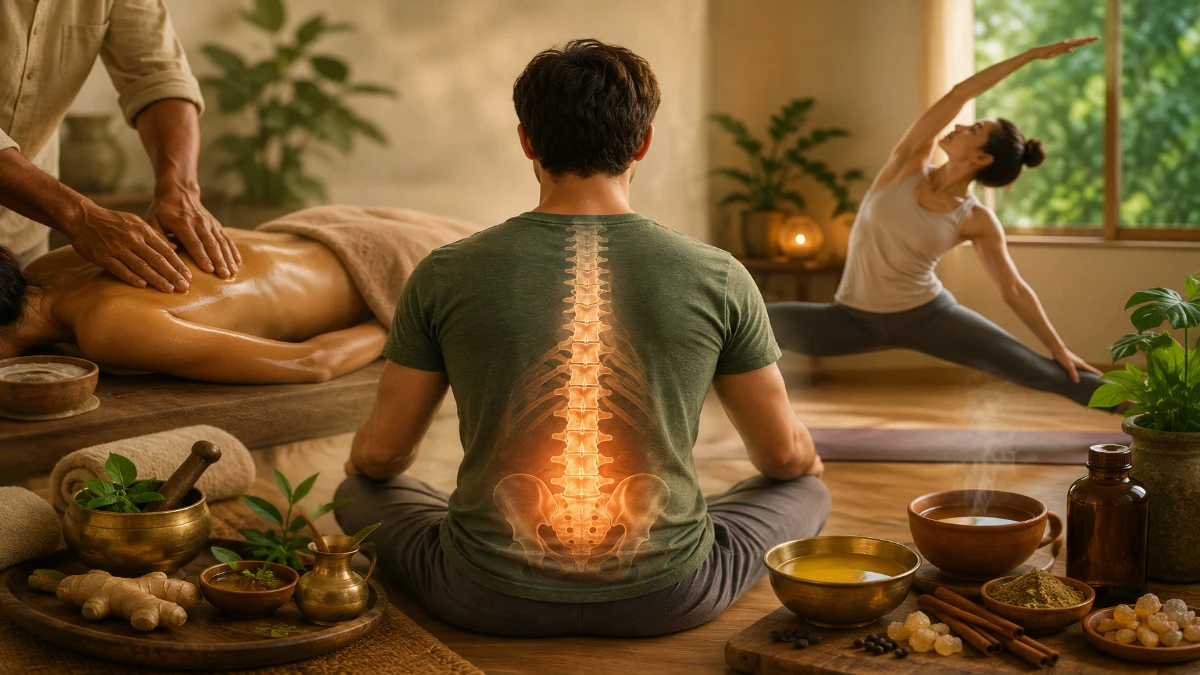 A Holistic View: Where Ayurvedic Wisdom Meets Spinal Care
Movement alone is not the whole story where backs are concerned; traditional systems of medicine such as Ayurveda have another angle that sheds light on why back pain occurs in the first place.
According to Ayurvedic medicine, low back pain, which is classified under Katishoola, is mostly caused by the imbalance of Vata dosha. Vata is responsible for movement, blood flow, and the nervous system, having inherent properties of being dry, cold, light, and unstable. Imbalance of Vata is caused by stress, excessive physical activity, poor digestion, and cold climate, which makes the tissues dehydrated. The joints become rigid; spinal discs dehydrate, becoming much more prone to injury.
Treatment of back pain from the Ayurvedic point of view consists of moistening and warming up the musculoskeletal system. Changes in lifestyle and yoga practice can do wonders:
Warming Oil Treatments (Abhyanga): Massaging your lower back area with warm sesame oil, or with medicinal oils such as the Mahanarayan oil, prior to bathing will warm cold, tight muscles and improve circulation in the affected area. Therapies such as Kati Vasti, where the oil is held over your sacrum using a dough ring, have been created specifically for dehydration of spinal discs.
Warming, Nourishing Diet: Replacing your cold salads and raw smoothies with warm foods prepared with healthy fats such as ghee or sesame oil will internally ground the excess Vata. The daily intake of warm ginger tea will help you maintain optimal digestive function without the accumulation of inflammatory waste.
Natural Botanicals: Herbs from Ayurveda such as Ashwagandha will help strengthen weak muscle tissue, while Shallaki (Boswellia) provides natural anti-inflammatory support for your irritated joints, without aggravating your digestive system.
Creating a warm and nourished internal environment, combined with careful movement, creates conditions for healing of your spine.
Safe Alternatives: What You Should Be Doing Instead
Avoiding these risky poses does not imply lounging around. It only means doing other poses that offer support without putting your delicate spinal structures to strain.
| Risky Pose | Safer Alternative | How It Helps |
| Camel Pose (Ustrasana) or Full Wheel Pose (Chakrasana) | Supported Bridge Pose | Uses a yoga block under the sacrum to support the pelvis and distribute body weight evenly, reducing strain on the lower back. |
| Seated Forward Bend (Paschimottanasana) | Cat-Cow Series (Marjaryasana Bitilasana) | Promotes gentle spinal flexion and extension, improving mobility without placing excessive pressure on the spine. |
| Crescent Lunge Twist | Supine Twist with a Bolster | Performed lying on the back, helping keep the spine in a neutral position while the bolster supports the knees and reduces stress on the back. |
| Boat Pose (Navasana) | Bird-Dog or Forearm Plank | Builds up the core, back extensor, and stabilizer muscles without putting any strain on the lower back. |
Reclaiming Your Practice
Yoga was never meant to be a performance or an extreme sport. It is a system designed to build self-awareness and restore equilibrium. If a pose requires you to force, strain, or hold your breath, it is a signal that your body isn't ready for it, and that is completely fine.
By ditching high-risk backbends, bending your knees during folds, and supporting your recovery with grounding lifestyle habits, you give your body the space it needs to mend. Pay attention to the quiet signals your back gives you long before they turn into loud screams. A safe practice is always a sustainable one.
References
National Institute of Naturopathy
Yoga: Effectiveness and Safety | NCCIH
Low-Back Pain and Complementary Health Approaches: What You Need To Know | NCCIH