
Successful Treatments
Clinics
Doctors
Types of Arthritis: Osteoarthritis, Rheumatoid Arthritis and More
 Published on 13 Sep, 2026
 Updated on 13 Sep, 2026

Explore Symptoms
- Home / Diseases & Ayurveda / Digestive Disorders / Ayurvedic Treatment for Jaundice / Types of Arthritis: Osteoarthritis, Rheumatoid Arthritis and More
Arthritis is a broad medical term that means swelling and inflammation in the joints. It is not a single disease but a concise word that defines hundreds of diseases that cause pain, stiffness, tenderness, reduced mobility, warmth, or redness in the joints. In a healthy joint, there is a smooth, rubbery layer of cushion, known as cartilage, that protects our bones from rubbing against each other. When you have arthritis, this protective layer wears down, or the immune system mistakenly attacks it, causing joint pain.
Types of Arthritis
The most common conditions include the following:
.webp)
Osteoarthritis
Osteoarthritis is the most common type of arthritis. It is caused by the wear and tear or damage of joint cartilage between the bones. Cartilage is the protective layer of the bones, which helps protect them from any sort of damage. Healthy cartilage allows joints for frictionless movement, but when its get tear down, the bones may begin to grind against each other. This can lead to joint pain, swelling, and reduced mobility in a person.
In Ayurveda, OA is called Sandhigatavata, which is caused by an imbalance in the Vata dosha, controller of air and movement in the body. Another factor that is responsible for joint pain is weak digestion. When digestion is weak, the food is not processed properly; it creates sticky waste, Ama, in the body. These hidden toxins travel through the spaces of your joints and get stuck inside them, causing pain and inflammation.
.webp)
Rheumatoid arthritis
Rheumatoid arthritis is an autoimmune condition in which the body’s immune system mistakenly attacks the body. It usually happens when the body’s immune system doesn't work properly and attacks the lining of the joints, called synovium. This disease commonly affects hands, knees, or ankles and causes pain on both sides of the body, such as both wrists or both knees. This chronic condition causes inflammation, joint deformity, and also affects other parts of the body such as the eyes, skin, lungs, or heart.
In Ayurveda, RA is called Amavata, which is caused by weak digestion. When your food is not able to be digested properly because of weak digestion, it creates a toxic waste in your body, known as Ama. Another factor that is responsible is the imbalance in the Vata Dosha (governs air and movement. It pushes the toxic waste into your joints, which causes pain, swelling, and redness.
Other common types
.webp)
Gout
Gout is a very painful type of arthritis that usually strikes suddenly, often in the middle of the night. It happens when your body has too much uric acid, a waste product of the body. Gout mainly affects the big toe of your leg, but it can also develop in other parts of the body. The joint quickly becomes red, swollen, and so sensitive that even a mild touch causes severe pain. In Ayurveda, it is known as Vatarakta and happens when there is an imbalance in the Vata dosha, and it pushes heated, toxic blood into the joints, usually triggered by poor digestion or a bad lifestyle.
.webp)
Psoriatic Arthritis
This type of joint pain is directly linked to psoriasis, an immune condition that causes red, itchy, and scaly patches on the skin. In psoriatic arthritis, the confused immune system attacks both the skin and the inner lining of the joints. It often causes your entire fingers or toes to swell up, and it can also cause deep pain in your lower back or heels. In Ayurveda, this happens when deep-seated toxins (Ama) disrupt both the blood and the bone tissues at the exact same time. Managing it requires cleaning the blood to heal the skin and the sore joints together.
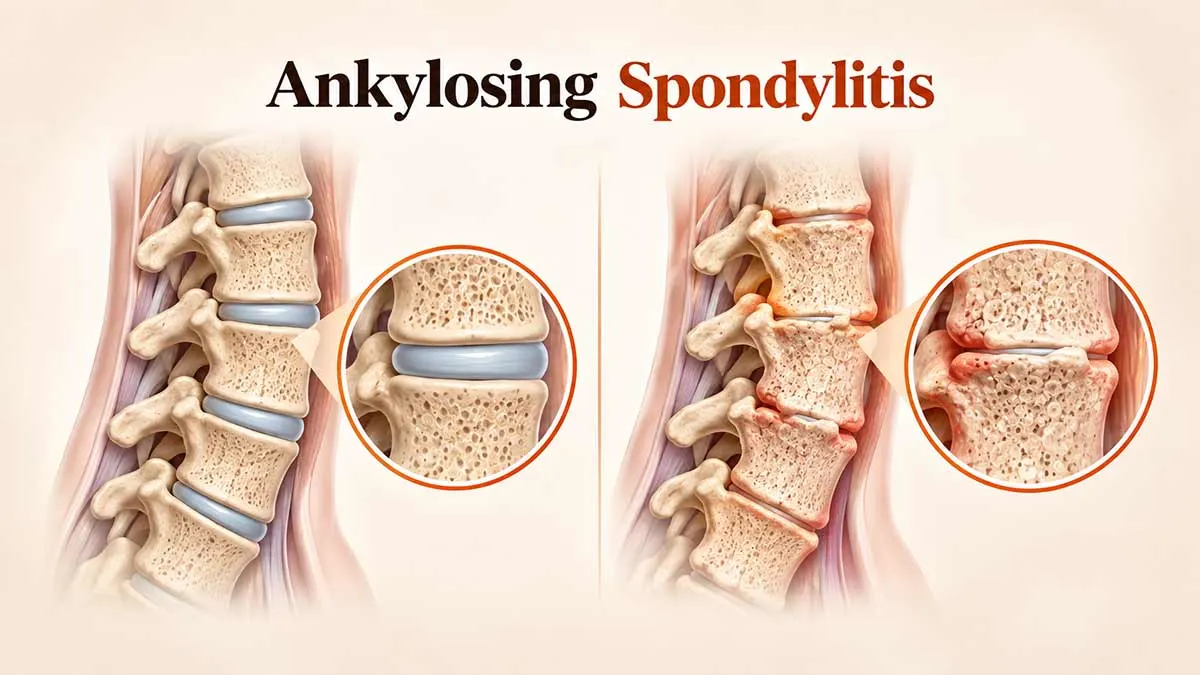
Ankylosing Spondylitis
Ankylosing spondylitis is a specific type of immune arthritis that primarily attacks the spine. It causes severe, chronic swelling between your spinal bones, leading to deep lower back pain and extreme stiffness, especially in the morning. Over time, if the swelling is not stopped, the body tries to heal itself by growing new bone. This can cause the bones in your spine to completely fuse together. Ayurveda views this as a severe buildup of stiff, dry Vata energy locking up the back. Keeping the spine moving daily and reducing internal swelling are the most important steps to prevent permanent fusing.
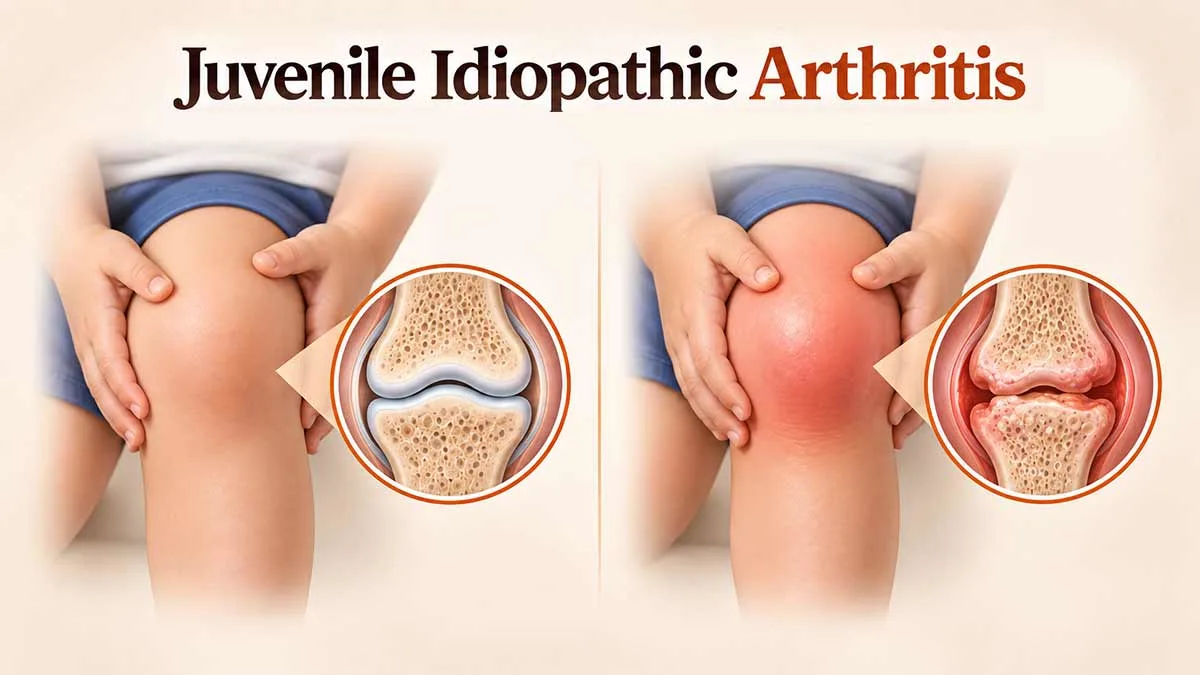
Juvenile Idiopathic Arthritis
Juvenile Idiopathic Arthritis (JIA) is a common type of chronic arthritis that affects children below the age of 16 and can affect any part of the child's body. JIA is an autoimmune disease in which the body’s immune system mistakenly attacks the synovium, the lining of the joints. This causes joint pain and inflammation in the hands, joints, fingers, legs, ankles, and other parts of the body. In Ayurveda, JIA is called Amavata Vyadhi, which is directly linked with weak digestion. When a child’s stomach struggles to break down the food, it creates a heavy, sticky, and toxic waste, known as Ama. Another factor that is responsible for the joint pain in children is an imbalance in the Vata dosha (which governs air and movement in the body). An imbalance in Vata pushes the toxic waste into the joint space, which causes joint pain.
Pattern differences
| Type of Arthrites | How It Shows Up In The Body |
| Osteoarthritis (OA) | It usually hits large weight-bearing body parts like hips and knees, mainly on one side of the body. |
| Rheumatoid Arthrites (RA) | It attacks small parts of the body mainly and on both sides, such as the hands, wrists, ankles, or feet. It makes the joints stiff for hours in the morning for hours. |
| Gout | It causes sudden, intense, burning pain usually on one side of the body. A flare-up mostly starts at night and mainly in the big toe of the leg. |
| Psoriatic Arthritis | It brings joint swelling, also with red, scaly, and itchy skin patches. It often makes fingers or toes swell up heavily. |
| Ankylosing Spondylitis | It primarily attacks the lower back and spine. Unlike most joint pain, it actually feels much worse after resting and gets better when you start moving around. |
| Juvenile Idiopathic Arthritis (JIA) | It affects children under 16, causing joint swelling, sudden limping, and morning stiffness that makes playing or walking difficult. |
Why One Treatment Does Not Fix Every Disease?
In Ayurveda, arthritis is not considered a single disease that can be fixed by one single pill or syrup. The treatment plan is completely based on which specific energy (Vata, Pitta, or Kapha) is out of balance in your body. For example, if your joints feel dry, cold, and make a popping or cracking sound, it means your Vata energy is too high. Then the treatment will focus on deeply lubricating the right bones wth arm, heavy herbal oil massages.
However, if your joints are red hot to the touch and heavily swollen, it means sticky waste ama and fiery heat are trapped inside your body. If you try to rub warm oil on this specific type of swelling, the heat and pain will actually get much worse. Instead, the doctor must completely skip the massage first and focus on an internal cooling cleanse to flush out the toxin sludge.
This is why an Ayurvedic practitioner or doctor needs to understand your unique symptoms first before deciding if your joints need to be warmed up, oiled, or cooled down and detoxed.
Diagnosis of Arthritis
To confirm the diagnosis, a regular doctor will ask you about your symptoms and will do your physical and medical examination. They may ask you about a blood test to check the markers of inflammation or a confused immune system in your blood. They may also take X-rays or an MRI to check your bones. This will help in This shows the that the joint is dried out or rubbing together, or if the cartilage is damaged or not because of the severe swelling.
An Ayurvedic doctor will look at your prakriti, which of the body’s internal energies (Vata, Pitta & Kapha) is imbalanced. They will check your pulse (Nadi Pariksha) to see how energy and blood are flowing in your body. They will ask detailed questions about your digestion; if you have constipation, bloating, or gas, it means that Ama is building up. They will also check your tongue in the morning; if it has a white, thick coating, then it means there is a buildup of toxins in the body.
Choose A Type-Specific Guide
Since every kind of joint pain acts differently in the body, you cannot rely on a single treatment to fix every disease. Select your specific type of arthritis below to know your healing guide for your condition:
- Osteoarthritis: In this type, learn how to properly lubricate dry joints and how to naturally build your worn-down cartilage
- Rheumatoid Arthrites (RA): In this, discover how to safely remove the toxic waste and calm down an overactive immune system
- Gout: First, find out how to cool down your blood and effectively clear out trapped uric acid and crystals.
- Psoriatic Arthritis: In this, get targeted relief strategies for joint swelling and uncomfortable skin flare-ups.
- Ankylosing Spondylitis: In this, Access specific Ayurvedic therapies designed to ease deep stiffness in your lower back and spine
- Juvenile Idiopathic Arthritis (JIA): Explore a safe and wholly customized healing approach designed specifically for growing children.
References
Juvenile Idiopathic Arthritis - StatPearls - NCBI Bookshelf
Gout - StatPearls - NCBI Bookshelf
Psoriatic Arthritis - StatPearls - NCBI Bookshelf
FAQs
Signs that rheumatoid arthritis is getting worse include sharper joint pain, increased swelling, and morning stiffness that lasts for more than an hour.
Yes, a person can live a long and full life with arthritis, though severe forms can sometimes affect overall life expectancy if left untreated.
If you have osteoarthritis, you should avoid foods that increase inflammation and promote weight gain, such as added sugars, refined carbohydrates, and red or processed meats.
Eating foods rich in healthy fats, antioxidants, and hydration-boosting nutrients helps support natural joint lubrication and synovial fluid health.
The main difference is that Osteoarthritis is a mechanical wear-and-tear condition that breaks down joint cartilage, while Rheumatoid Arthritis is an autoimmune disease where the immune system attacks the joint linings.
Yes, rheumatoid arthritis can affect your eyes because the inflammation spreads to connective tissues like collagen in the eyes.
You can reduce high uric acid naturally in Ayurveda by balancing the body's Vata and Pitta doshas through dietary adjustments, herbal teas, and lifestyle changes. In Ayurveda, high uric acid is linked to Vatarakta (gout), caused by poor digestion and the buildup of toxic waste (Ama).
Consult Experienced Ayurveda Doctors for Arthritis




















Our Happy Patients
-
 Sunita Malik - Knee Pain
 -
 Abhishek Mal - Diabetes
 -
 Vidit Aggarwal - Psoriasis
 -
 Shanti - Sleeping Disorder
 -
 Ranjana - Arthritis
 -
 Jyoti - Migraine
 -
 Renu Lamba - Diabetes
 -
 Kamla Singh - Bulging Disc
 -
 Rajesh Kumar - Psoriasis
 -
 Dhruv Dutta - Diabetes
 -
 Atharva - Respiratory Disease
 -
 Amey - Skin Problem
 -
 Asha - Joint Problem
 -
 Sanjeeta - Joint Pain
 -
 A B Mukherjee - Acidity
 -
 Deepak Sharma - Lower Back Pain
 -
 Vyjayanti - Pcod
 -
 Sunil Singh - Thyroid
 -
 Sarla Gupta - Post Surgery Challenges
 -
 Syed Masood Ahmed - Osteoarthritis & Bp
Blogs
- Diet and Lifestyle Advice to Help Deal with Jaundice
- 6 Home Remedies for the Effective Management of Jaundice
- 2 Yoga Asanas that Bring Relief from Jaundice
- Simple & Effective Home Remedies For Jaundice
- Accelerate Your Dengue Recovery with Ayurveda
- कमज़ोरी और आँखों में पीलापन? Jaundice के लिए बेस्ट आयुर्वेदिक ट्रीटमेंट
Home Remedies
- पेट में गैस, जलन या संक्रमण? इन घरेलू उपायों से पाएं राहत
- पेट में गैस, अपच और फुलाव का आयुर्वेदिक इलाज - मुफ़्त परामर्श
- एनल फिशर से परेशान हैं? ये आयुर्वेदिक नुस्खे देंगे राहत और आराम
- कब्ज़ का आयुर्वेदिक इलाज - मुफ़्त परामर्श
- एसिड रिफ्लक्स का घरेलू इलाज - मुफ़्त आयुर्वेदिक परामर्श
- Food Poisoning का आयुर्वेदिक इलाज - मुफ़्त परामर्श
- क्या बार-बार उल्टी हो रही है? इन घरेलू उपायों से पाएं तुरंत आराम
- क्या आप जानते हैं? इन नुस्खों से पेट दर्द जड़ से खत्म होता है!
- बार-बार एसिडिटी? ये देसी नुस्खे तुरंत देंगे आराम!
- दवा की ज़रूरत नहीं! लूज़ मोशन का रामबाण इलाज घर पर ही
- Home Remedies for Vomiting
- Home Remedies for Piles
- Home Remedies for Food Poisoning
- Home Remedies for Stomach Infection
- Home Remedies for Bloating
- Home Remedies for Anal Fissure
- Home Remedies for Constipation
- Home Remedies for Acid Reflux
- Home Remedies for Acidity
- Home Remedies for Stomach Pain
Related Disease
- Ayurvedic Treatment for Acid Reflux
- Ayurvedic Treatment for Anemia
- Ayurvedic Treatment For Anorexia
- Ayurvedic Treatment for Chronic Fatigue Syndrome
- Ayurvedic Treatment For Gastritis
- Ayurvedic Treatment For Colitis
- Ayurvedic Treatment For Crohn’s Disease
- Ayurvedic Treatment for Weakness and Fatigue
- Ayurvedic Treatment For Flatulence
- Ayurvedic Treatment for Gallstones
- Ayurvedic Treatment for Jaundice
- Ayurvedic Treatment for Liver Cirrhosis
- Ayurvedic Treatment for Sickle Cell Anaemia
- Ayurvedic Treatment For Piles And Fissure
- Ayurvedic Treatment for Irritable Bowel Syndrome (IBS)
- Ayurvedic Treatment For Hyperacidity
- Ayurvedic Treatment for Constipation
- Ayurvedic treatment for Coeliac Disease
- Ayurvedic Treatment for Peptic Ulcer
- Ayurvedic Treatment for Tapeworm
- Ayurvedic Treatment for Typhoid
- Ayurvedic Treatment for Diarrhea
- Ayurvedic Treatment for Diverticulitis
- Ayurvedic Treatment for Pinworms
- Ayurvedic Treatment for Cholera
- Ayurvedic Treatment for Emphysema
- Ayurvedic Treatment for Food Poisoning
- Ayurvedic Treatment for Atherosclerosis
- Ayurvedic Treatment for Thalassemia
- Ayurvedic Treatment for High Triglycerides
- Get Ayurvedic Treatment for Gastroenteritis
Latest Blogs
- Do You Really Need A Protein Shake on A Non-Workout Day?
- Is Eating Only ‘Clean Food’ Making Your Diet Less Flexible?
- Air Fried Is Not Automatically Healthy: What Still Matters
- Why Remote Work Can Blur Hunger, Break and Sleep Cues
- Why Fast City Life Can Make You Feel Busy but Physically Underactive
- The Hidden Cost of Eating Lunch at Your Desk Every Day
- Air fryer में बना हर खाना healthy होता है—क्या यह सच है?
- बारिश में जूते देर तक गीले रहने से पैरों की skin क्यों परेशान होने लगती है?
- वीकेंड पर meal timing पूरी तरह बदलना सोमवार को पेट क्यों बिगाड़ सकता है?
- Why Your Energy Drops After Long Hours of Concentration
- Why Your Mouth Feels Dry Every Morning
- बच्चों का breakfast बहुत मीठा हो तो school-time hunger पर क्या असर पड़ सकता है?
- Monsoon Mornings: Why Appetite Can Be Low but Evening Cravings High
- Why Monday Digestion Can Feel Different After a Weekend Routine
- बच्चे खाना खाते समय screen देखें तो fullness signal क्यों miss कर सकते हैं?
- गुड़ और चीनी में से ‘healthy sugar’ चुनना कितना meaningful है
- AC Bedrooms in Humid Weather: Comfort vs Overcooling
- रोज़ coconut water पीना हर किसी के लिए जरूरी क्यों नहीं है?
- मॉनसून में बाल जल्दी oily और scalp itchy क्यों हो सकता हैं?
- Why Seasonal Routine Changes Can Affect Digestion Before You Notice
Ayurvedic Doctor In Top Cities
- Ayurvedic Doctors in Bangalore
- Ayurvedic Doctors in Pune
- Ayurvedic Doctors in Delhi
- Ayurvedic Doctors in Hyderabad
- Ayurvedic Doctors in Indore
- Ayurvedic Doctors in Mumbai
- Ayurvedic Doctors in Lucknow
- Ayurvedic Doctors in Kolkata
- Ayurvedic Doctors in Patna
- Ayurvedic Doctors in Vadodara
- Ayurvedic Doctors in Ahmedabad
- Ayurvedic Doctors in Chandigarh
- Ayurvedic Doctors in Gurugaon
- Ayurvedic Doctors in Jaipur
- Ayurvedic Doctors in Kanpur
- Ayurvedic Doctors in Noida
- Ayurvedic Doctors in Ranchi
- Ayurvedic Doctors in Bhopal
- Ayurvedic Doctors in Ludhiana
- Ayurvedic Doctors in Dehradun