
Successful Treatments
Clinics
Doctors
Gout Diagnosis and Similar Joint Conditions
 Published on 29 Sep, 2026
 Updated on 08 Oct, 2026

Explore Gout Diagnosis
- Home / Diseases & Ayurveda / Joint & Muscle Pain / Ayurvedic Treatment for Gout: Uric Acid, Joint Pain & Flare-Up Management / Gout Diagnosis and Similar Joint Conditions
History And Joint Examination
The diagnostic process always begins with a detailed patient history and a physical examination of the joint. Your doctor will look for the classic hallmarks of a gout attack: an explosive onset ( usually peaking within 12 to 24 hours), extreme localized tenderness, and skin that appears shiny, red, and warm to the touch.
Your physician will also ask about your recent activities and diet to rule out immediate mechanical causes. For example, a sudden injury, such as a sprained ankle or a stubbed toe, will cause massive swelling and pain, but it is always tied to a specific traumatic event. The doctor will also evaluate the joints for signs of osteoarthritis. While it causes joint pain and swelling, it is a mechanical wear-and-tear disease that develops incredibly slowly over many years, causing a dull, grinding ache rather than the sudden, fiery explosion characteristic of gout.
Joint-Fluid Crystal Test
The absolute gold standard for definitively diagnosing gout is a procedure known as arthrocentesis, or a joint fluid crystal test. Because blood tests can be misleading during an active attack, doctors prefer to look directly inside the affected joint. After numbing the area, the doctor inserts a thin needle into the joint space to collect fluid. The fluid is immediately examined under a specialized polarized light microscope. If the doctor observes needle-shaped monosodium urate crystals within, exhibiting negative birefringence, a gout diagnosis is confirmed with 100% certainty.
Uric Acid Blood Test
A serum uric acid blood test is a standard part of the diagnostic workup, but it is frequently misunderstood. This test measures the concentration of uric acid currently floating in your bloodstream. While a high baseline uric acid level ( above 6.8 mg/dL) is a strong indicator of gout risk, checking these levels during an active flare is notoriously unreliable. The intense physical stress and inflammation of an attack cause the kidneys to flush uric acid out of the blood at an accelerated rate, often resulting in a normal lab reading right when you are in most pain. Therefore, blood tests are best used as a baseline measurement two to four weeks after the attack has fully resolved.
Ultrasound and specialised CT
Uses high - frequency sound waves to view joint structures, cartilage and soft tissues.
Standard X-rays cannot detect uric acid crystals and are mostly used to rule out fractures or underlying osteoarthritis. However, high-resolution ultrasound is incredibly effective at detecting gout. It can reveal the double contour sign, a visible frosty layer of uric acid crystals coating the smooth cartilage inside the joint. Additionally, Dual-Energy CT ( DECT) scans can accurately identify the chemical composition of soft tissues, color -coding hidden uric acid crystal deposits ( tophi) on the monitor, providing undeniable visual proof of the disease.
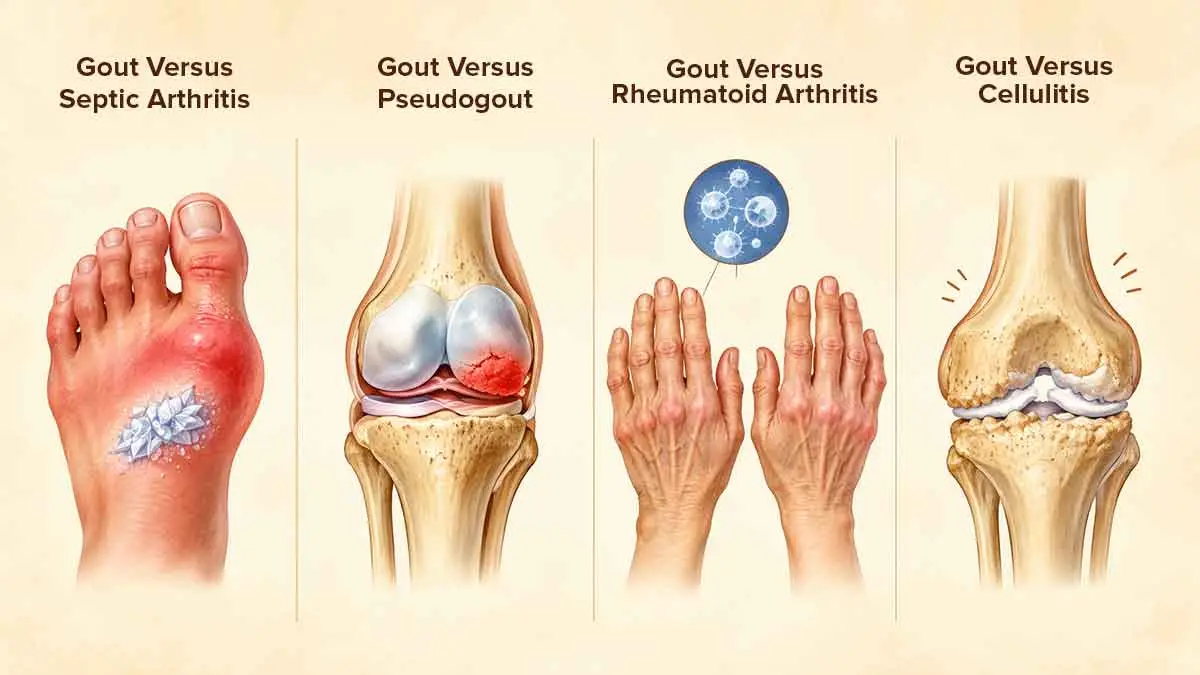
Gout Versus Septic Arthritis
This is the most critical differential diagnosis your doctor will make: septic arthritis is a severe, rapidly progressing bacterial infection inside the joint capsule. To the naked eye, it looks exactly like gout in the joint is fiercely red, massively swollen, hot, and agonizingly painful. However, septic arthritis is a medical emergency. If left untreated, trapped bacteria will permanently destroy the joint's cartilage and bone within a matter of days, and the infection can spread to the bloodstream. The crucial differentiator is systemic illness. Septic arthritis frequently causes a high fever, severe chills, and uncontrollable shaking. Do not delay care for a fever, severe chills, or uncontrollable shaking. Do not delay care for a fever with a hot joint. If your joint pain is accompanied by fever, you must go to the emergency room immediately.
Gout Versus Pseudogout
Pseudogout is gout’s nearly identical twin. Medically known as calcium pyrophosphate deposition (CPPD) disease, it is also caused by microscopic crystals attacking the joint space. The primary difference lies in the chemistry. While gout is caused by needle-shaped uric acid crystals, pseudogout is caused by rhomboid-shaped calcium pyrophosphate crystals. Additionally, while gout famously targets the big toe for its first attack, pseudogout overwhelmingly prefers to strike the knee or the wrist. Because the symptoms are clinically indistinguishable from the outside, a joint fluid test is the only definitive way to tell them apart.
Gout Versus Rheumatoid Arthritis
Rheumatoid arthritis ( RA) is a chronic autoimmune disorder where the body’s immune system mistakenly attacks its own joint linings. While both conditions cause severe joint inflammation, their patterns are very different.
Gout typically attacks one joint at a time in an asymmetrical pattern. Rheumatoid arthritis is symmetrical, usually attacking the same joints on both sides of the body simultaneously. Furthermore, RA causes prolonged morning stiffness that lasts for hours and features a slower, more insidious onset, whereas a gout attack peaks rapidly overnight.
Gout Versus Cellulitis
Cellulitis is a deep bacterial skin infection that can easily be confused with a gout flare, especially if it occurs on the foot or lower leg. Like gout, cellulitis causes the skin to become tightly swollen, painfully tender, hot, and bright red.
However, cellulitis is an infection of the skin tissue, not the joint capsule. It almost always stems from a visible entry wound such as a scrape or a bug bite, an ulcer, or a severely ingrown toenail. The redness in cellulitis tends to rapidly spread outwards in a creeping pattern like septic arthritis; it is frequently accompanied by systemic fever and swollen lymph nodes, requiring immediate antibiotic treatment.
Why First Attacks Need Assessment
If you wake up with a violently painful, swollen joint for the very first time, you must not attempt to self-diagnose or treat it at home with leftover painkillers. Because a first-time gout attack is clinically indistinguishable from a dangerous joint infection (septic arthritis) or a skin infection (cellulitis), a medical professional must officially assess the joint. Securing an accurate, documented diagnosis during your first attack ensures you do not accidentally ignore a life-threatening infection, and it paves the way for proper, long-term uric acid management.
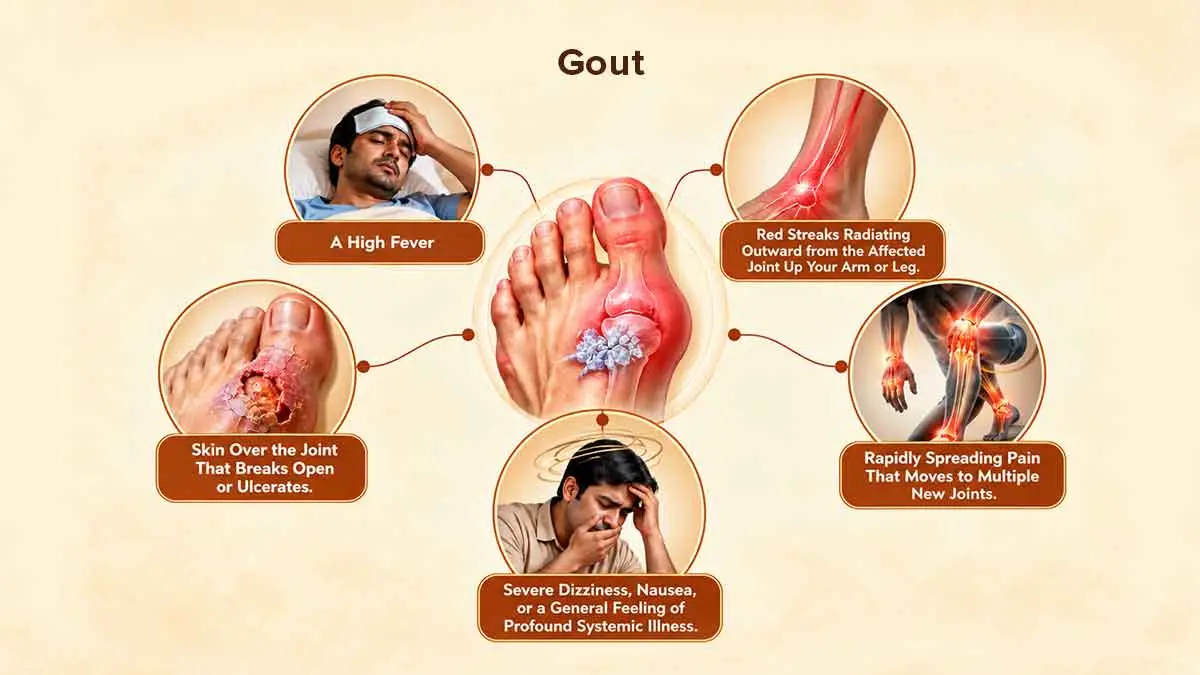
Urgent Warning Signs
While typical gout is agonizing, it is not immediately life-threatening. However, you must seek urgent emergency medical care if your joint pain is accompanied by any of the following red flags:
- A high fever (above 100.4°F or 38°C), chills, or night sweats.
- Red streaks radiating outward from the affected joint up your arm or leg.
- Skin over the joint that breaks open, ulcerates, or begins weeping pus.
- Rapidly spreading pain that moves to multiple new joints within hours.
- Severe dizziness, nausea, or a general feeling of profound systemic illness.
A hot, red, swollen joint can be a sign of gout, but it can also signal septic arthritis, a rapidly destructive, life-threatening bacterial infection. This guide breaks down the critical differences between the two, highlighting why a fever or spreading redness requires immediate emergency intervention, and how doctors use joint fluid analysis to save infected cartilage before permanent physical damage occurs.
References
Gout: Diagnosis, Treatment, and Steps to Take
Find Jiva Ayurveda Clinics for Gout Treatment Near You
Consult Experienced Ayurveda Doctors for Gout





















Our Happy Patients
-
 Sunita Malik - Knee Pain
 -
 Abhishek Mal - Diabetes
 -
 Vidit Aggarwal - Psoriasis
 -
 Shanti - Sleeping Disorder
 -
 Ranjana - Arthritis
 -
 Jyoti - Migraine
 -
 Renu Lamba - Diabetes
 -
 Kamla Singh - Bulging Disc
 -
 Rajesh Kumar - Psoriasis
 -
 Dhruv Dutta - Diabetes
 -
 Atharva - Respiratory Disease
 -
 Amey - Skin Problem
 -
 Asha - Joint Problem
 -
 Sanjeeta - Joint Pain
 -
 A B Mukherjee - Acidity
 -
 Deepak Sharma - Lower Back Pain
 -
 Vyjayanti - Pcod
 -
 Sunil Singh - Thyroid
 -
 Sarla Gupta - Post Surgery Challenges
 -
 Syed Masood Ahmed - Osteoarthritis & Bp
Diagnostic Marker
Blogs
- What is Gout? Causes and home treatment
- Are you suffering from Gout pain? Try these 5 natural home remedies
- List Of Foods To Avoid With Gout & Why
- Ayurvedic Approach to Gout Home Remedies in India
- सर्दियों में यूरिक एसिड और गाउट क्यों बढ़ते हैं? आयुर्वेद से जानिए दर्द से राहत का प्राकृतिक तरीका
- गाउट में बार-बार दवाइयाँ लेने से किडनी पर क्या असर होता है? और आयुर्वेद कैसे राहत देता है
- Gout के मरीज़ को किन चीजों से तुरंत सावधान हो जाना चाहिए?
- Uric Acid Test Normal आया पर Joint Pain बना हुआ है — Pseudo-Gout हो सकता है
- Gout Attack बार-बार क्यों लौटता है जबकि दवा चालू है? असली Trigger समझिए
- क्या सिर्फ खान-पान से uric acid control हो सकता है? पूरा सच जानिए
Home Remedies
Related Disease
- Ayurvedic Treatment for Ankylosing Spondylitis: Pain, Symptoms, Causes & Care
- Ayurvedic Treatment for Cervical Spondylosis: Neck Pain, Stiffness & Management
- Ayurvedic Treatment for Arthritis: Joint Pain Relief & Long-Term Management
- Ayurvedic Treatment for Osteoarthritis: Knee Pain, Symptoms and Management
- Ayurvedic Treatment for Gout: Uric Acid, Joint Pain & Flare-Up Management
- Ayurvedic Treatment for Sciatica: Managing Nerve Pain & Leg Discomfort
- Ayurvedic Treatment for Rheumatoid Arthritis: Joint Swelling, Symptoms & Care
- Ayurvedic Treatment for Frozen Shoulder: Pain, Symptoms, Causes & Care
- Ayurvedic Treatment for Deep Vein Thrombosis (DVT): Leg Swelling, Risks and Treatment
- Ayurvedic Treatment for Achilles Tendon Disorders: Pain, Symptoms, Causes & Care
- Ayurvedic Treatment for Rickets: Symptoms, Causes & Management
- Ayurvedic Treatment for Ganglion Cyst: Symptoms, Causes & Management
- Ayurvedic Treatment for Osteoporosis: Pain, Symptoms, Causes & Care
- Ayurvedic Treatment for AVN Avascular Necrosis: Pain, Symptoms, Causes & Care
- Ayurvedic Treatment for Osteomyelitis: Symptoms, Causes & Care Options
- Ayurvedic Treatment for Cerebral Palsy: Symptoms, Causes & Supportive Care
Latest Blogs
- Late Dinner Plus Poor Sleep: Why Ayurveda Looks At The Pattern, Not One Habit
- परिवार के साथ बैठकर खाना खाने से Portion और Eating Speed पर क्या फर्क पड़ सकता है?
- कब्ज़ में इंडियन-स्टाइल टॉयलेट बेहतर है? टॉयलेट पोस्चर के बारे में क्या पता है
- दूध, दही और लस्सी से IBS के लक्षण कब बढ़ सकते हैं?
- कभी कब्ज़, कभी दस्त? बार-बार बदलती पेट की आदतों को कैसे समझें
- क्या आयरन, कैल्शियम या कुछ दवाओं से कब्ज़ हो सकती है? डॉक्टर से कब बात करें
- पीरियड्स के दौरान IBS के लक्षण कुछ लोगों में क्यों बढ़ सकते हैं?
- व्रत या उपवास में कब्ज़ बढ़ जाती है? नवरात्रि में किन बातों का ध्यान रखें
- सफ़र में कब्ज़ क्यों हो जाती है? यात्रा से पहले क्या तैयारी करें
- खूब पानी पीने के बाद भी कब्ज़ क्यों बनी रह सकती है?
- बुज़ुर्ग माता-पिता को कब्ज़ रहती है? परिवार किन बातों का ध्यान रखे
- क्या खूनी बवासीर में ऑपरेशन ही एकमात्र विकल्प है? इलाज के विकल्प समझें
- शौच में खून देखकर घबरा गए? जानिए पहले क्या समझें और क्या करें
- रोटी, चावल और दही: कब्ज़ होने पर खाने में क्या बदलाव मदद कर सकते हैं?
- रोज़ बाइक से ऑफिस जाते हैं और बवासीर की सूजन परेशान करती है? जानिए सफ़र का असर
- IBS में दवा से राहत मिलने के बाद भी लक्षण दोबारा क्यों हो सकते हैं?
- IBS में कौन-सा खाना परेशानी बढ़ाता है? फ़ूड डायरी कैसे मदद कर सकती है
- मानसून में पेट की परेशानी बढ़ती लगती है? IBS और मौसम के संबंध को समझें
- बवासीर में सिट्ज़ बाथ कैसे करें? फायदे, सावधानियाँ और कब बचें
- बवासीर के मस्से बाहर निकलते हैं? ग्रेड 1 से 4 का मतलब समझें
Ayurvedic Doctor In Top Cities
- Ayurvedic Doctors in Bangalore
- Ayurvedic Doctors in Pune
- Ayurvedic Doctors in Delhi
- Ayurvedic Doctors in Hyderabad
- Ayurvedic Doctors in Indore
- Ayurvedic Doctors in Mumbai
- Ayurvedic Doctors in Lucknow
- Ayurvedic Doctors in Kolkata
- Ayurvedic Doctors in Patna
- Ayurvedic Doctors in Vadodara
- Ayurvedic Doctors in Ahmedabad
- Ayurvedic Doctors in Chandigarh
- Ayurvedic Doctors in Gurugaon
- Ayurvedic Doctors in Jaipur
- Ayurvedic Doctors in Kanpur
- Ayurvedic Doctors in Noida
- Ayurvedic Doctors in Ranchi
- Ayurvedic Doctors in Bhopal
- Ayurvedic Doctors in Ludhiana
- Ayurvedic Doctors in Dehradun