
Successful Treatments
Clinics
Doctors
Gout vs Rheumatoid Arthritis key differences
 Published on 30 Sep, 2026
 Updated on 08 Oct, 2026

Explore Gout Diagnosis
- Home / Diseases & Ayurveda / Joint & Muscle Pain / Ayurvedic Treatment for Gout: Uric Acid, Joint Pain & Flare-Up Management / Gout Diagnosis and Similar Joint Conditions / Gout vs Rheumatoid Arthritis key differences
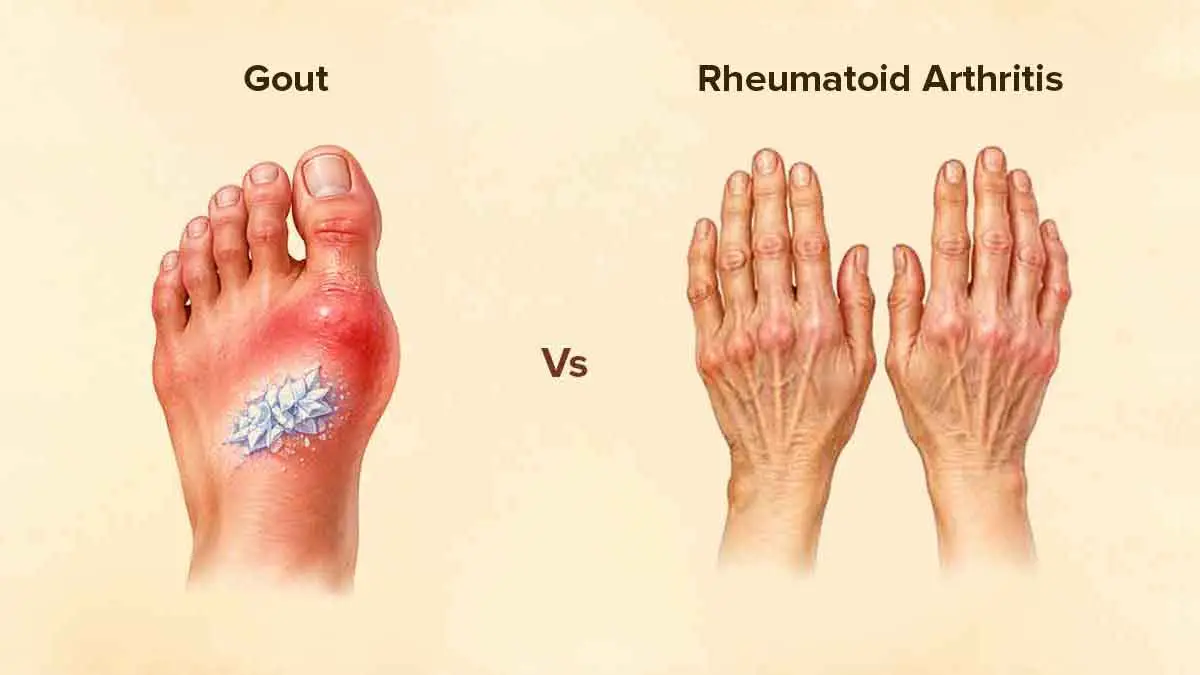
Quick Comparison Table
To understand the core differences at a glance, here is how two conditions stack up against one another:
| Feature | Gout | Rheumatoid Arthritis (RA) |
| Underlying Root Cause | Metabolic (uric acid crystal deposition in joint spaces) | Autoimmune ( immune system attacks the synovium) |
| Speed of onset | Sudden: Intense, overnight flares reaching maximum severity in hours | Insidious: gradually worsens over weeks or months |
| joint symmetry | Asymmetric: Usually affects a single joint or a few scattered joints at one time. | symmetrical ( attacks identical joints on both sides) |
| Primary joint Targets | Lower body: Classically targets the base of the big toe (podagra), ankles, and knees. | Wrist, middle, and base knuckles of the hands |
| Morning stiffness | Short-lived; usually improves quickly after moving. | Prolonged: lasts longer than 60 minutes daily |
| Subcutaneous lumps | Tophi (chalky urate crystals in joint fluid) | Rheumatoid Arthritis (RA) ( firm, fleshy tissue masses). |
| Definitive Diagnosis | Joint fluid aspiration (negative for birefringent monosodium urate crystals) and elevated serum uric acid. | anti - ccp antibodies, rheumatoid factor |
| Core Medications | Urate-lowering therapies (Allopurinol Colchicine | DMARDs ( methotrexate), biologics, immunosuppressants |
Sudden Attacks Versus Persistent Inflammation
The timeline of your pain offers one of the most massive clinical clues when differentiating these two diseases.
A gout attack behaves like a flash fire. It is famously explosive, often waking a patient from a deep sleep with a joint that feels like it has been crushed. The pain, swelling, and redness reach their absolute maximum intensity incredibly fast, usually within 12 to 24 hours. In its early stages, a gout flare will completely resolve within a week or two, returning the joint to a completely normal, pain-free state.
Rheumatoid Arthritis, conversely, behaves like a slowly rising tide. It is a chronic, persistent disease that develops insidiously. Patients typically notice a slow, creeping progression of aching, profound fatigue, and mild swelling that worsens over several weeks or months. Unlike early gout, which vanishes between attacks, RA inflammation smolders constantly beneath the surface. Without powerful disease-modifying medications, the joints rarely return to a completely normal state.
One Joint Versus Multiple Joints
The distribution of which joints hurt at the same time differs markedly between the two conditions. Gout is typically monoarticular and asymmetrical. In the first several years of the disease, gout almost exclusively attacks one single joint at a time (monoarticular). Even as the disease progresses to involve more joints, the pattern remains entirely random and asymmetrical. A patient might have a severely swollen right big toe and a throbbing left knee, while the left toe and right knee remain perfectly healthy.
Rheumatoid arthritis is polyarticular and highly symmetrical.RA overwhelmingly strikes multiple joints simultaneously. Most importantly, its hallmark feature is symmetry. If the disease is actively destroying the knuckles of your left hand and your left wrist, it will almost certainly be attacking the exact corresponding knuckles and wrist on your right hand in a mirrored fashion.
Typical Joints
While both diseases have the potential to infiltrate almost any joint in the human body, they have strong, distinct anatomical preferences.
Gout demonstrates a massive preference for the lower extremities and cooler, peripheral joints. The undisputed primary target is the first metatarsophalangeal (MTP) joint at the base of the big toe. Gout also frequently attacks the midfoot, ankles, and knees.
Rheumatoid arthritis overwhelmingly prefers the upper extremities, specifically targeting the small, delicate joints of the hands and wrists.RA frequently attacks the metacarpophalangeal (MCP) joints ( the large knuckles at the base of the fingers) and the proximal interphalangeal (PIP) joints. Interestingly, RA noticeably spares the joints closest to fingernails ( the DIP joints), and it very rarely presents as isolated, sudden attacks in the big toe.
Morning stiffness
Joint stiffness upon waking up in the morning is a universal complaint among all arthritides, but the specific duration of this stiffness serves as a crucial diagnostic separator.
If you have gout, your joint will be incredibly stiff and immobile during an active flare due to the massive physical fluid buildup. However, once the acute attack burns out, the morning stiffness completely completely vanihses.
You will wake up with perfectly flexible joints during the intercritical periods. In RA, a prolonged “morning gel phenomenon” is a classic, daily reality.RA patients experience widespread, rigid joint stiffness upon waking that lasts for significantly longer than 60 minutes. It often takes hours of hot showers, stretching, and continuous movement before their hands and joints feel loose enough to grip a coffee mug or button a shirt.
Tophi And Rheumatoid Nodules
Both advanced, unmanaged gout and chronic rheumatoid arthritis can produce visible, firm lumps under the skin, but their internal composition and outward behaviour are entirely different.
Gouty Tophi are a physical collection of solid monosodium urate crystals. They feel hard and rubbery or stony-like to the touch. Because they are packed with chemical crystals, tophi often display a yellowish or chalky white colour visible beneath thinned, stretched skin. They typically form on the outer ear and fingertips and over the elbows. Crucially, if the fragile skin over a tophus tears, it will leak a thick, white, chalky paste.
Rheumatoid Nodules occur in roughly a quarter of RA patients. They are firm, flesh-colored,non-tender masses made of dense, inflammatory immune tissue, not crystals. They typically develop over mechanical pressure points, such as the extensor surface of the forearms, elbows, or the Achilles tendons; unlike tophi, rheumatoid nodules never appear white or chalky, and they do not ulcerate to discharge white paste.
Blood And Joint-Fluid Tests
Because visual symptoms can sometimes overlap in complex cases, definitive differentiation requires precise laboratory analysis.
Blood Work Differences
For Gout, doctors check serum uric acid (SUA). Levels consistently remaining above 6.8 mg/dL support a gout diagnosis. Standard autoimmune markers will be negative. For rheumatoid arthritis, doctors look for specific autoimmune antibodies, primarily Rheumatoid factor ( RF) and Anti-cyclic citrullinated peptide (anti-CCP) antibodies. The presence of anti-CCP is highly specific and practically guarantees an RA diagnosis.
Joint Fluid Analysis (Arthrocentesis)
Extracting synovial fluid directly from a swollen joint provides the ultimate, undeniable answer. Under a polarized light microscope, gout fluid reveals needle-shaped monosodium urate crystals glowing with a distinct optical property called negative birefringence. RA joint fluid, however, shows massive concentrations of white blood cells and inflammatory proteins but is strictly free of any uric acid crystals.
Can Both Occur?
For decades, the medical community largely believed that gout and rheumatoid arthritis were mutually exclusive, a theory known as the “ gout RA exclusion hypothesis.”Doctors assumed that the systemic immune environment of RA somehow protected the joints against urate crystallization.
Modern rheumatology has proven this false. While it is statistically rare, both conditions can and do coexist in the same individual. A patient with established, long-standing rheumatoid arthritis can independently develop metabolic hyperuricemia and suffer superimposed acute gout flares on top of their baseline RA pain. Diagnosing this complex overlap requires finding physical needle-shaped urate crystals in the joint fluid alongside positive anti-CCP blood antibodies.
When To See A Rheumatologist
You should see a rheumatologist if you experience sudden, severe joint pain attacks or persistent joint swelling and morning stiffness lasting longer than 30 minutes without a clear cause. If you are experiencing debilitating morning stiffness lasting longer than an hour. If your blood tests reveal positive autoimmune markers ( RF or CCP), or if standard anti-inflammatory gout treatment completely fails to resolve your joint flares.
References
Gout Initially Mimicking Rheumatoid Arthritis and Later Cervical Spine Involvement - PMC
Rheumatoid Arthritis vs. Gout: How to Tell the Difference
https://www.ncbi.nlm.nih.gov/pmc/articles/PMC5260195/pdf/edinbmedj74305-0022.pdf
Find Jiva Ayurveda Clinics for Gout Treatment Near You
Consult Experienced Ayurveda Doctors for Gout





















Our Happy Patients
-
 Sunita Malik - Knee Pain
 -
 Abhishek Mal - Diabetes
 -
 Vidit Aggarwal - Psoriasis
 -
 Shanti - Sleeping Disorder
 -
 Ranjana - Arthritis
 -
 Jyoti - Migraine
 -
 Renu Lamba - Diabetes
 -
 Kamla Singh - Bulging Disc
 -
 Rajesh Kumar - Psoriasis
 -
 Dhruv Dutta - Diabetes
 -
 Atharva - Respiratory Disease
 -
 Amey - Skin Problem
 -
 Asha - Joint Problem
 -
 Sanjeeta - Joint Pain
 -
 A B Mukherjee - Acidity
 -
 Deepak Sharma - Lower Back Pain
 -
 Vyjayanti - Pcod
 -
 Sunil Singh - Thyroid
 -
 Sarla Gupta - Post Surgery Challenges
 -
 Syed Masood Ahmed - Osteoarthritis & Bp
Diagnostic Marker
Blogs
- What is Gout? Causes and home treatment
- Are you suffering from Gout pain? Try these 5 natural home remedies
- List Of Foods To Avoid With Gout & Why
- Ayurvedic Approach to Gout Home Remedies in India
- सर्दियों में यूरिक एसिड और गाउट क्यों बढ़ते हैं? आयुर्वेद से जानिए दर्द से राहत का प्राकृतिक तरीका
- गाउट में बार-बार दवाइयाँ लेने से किडनी पर क्या असर होता है? और आयुर्वेद कैसे राहत देता है
- Gout के मरीज़ को किन चीजों से तुरंत सावधान हो जाना चाहिए?
- Uric Acid Test Normal आया पर Joint Pain बना हुआ है — Pseudo-Gout हो सकता है
- Gout Attack बार-बार क्यों लौटता है जबकि दवा चालू है? असली Trigger समझिए
- क्या सिर्फ खान-पान से uric acid control हो सकता है? पूरा सच जानिए
Home Remedies
Related Disease
- Ayurvedic Treatment for Ankylosing Spondylitis: Pain, Symptoms, Causes & Care
- Ayurvedic Treatment for Cervical Spondylosis: Neck Pain, Stiffness & Management
- Ayurvedic Treatment for Arthritis: Joint Pain Relief & Long-Term Management
- Ayurvedic Treatment for Osteoarthritis: Knee Pain, Symptoms and Management
- Ayurvedic Treatment for Gout: Uric Acid, Joint Pain & Flare-Up Management
- Ayurvedic Treatment for Sciatica: Managing Nerve Pain & Leg Discomfort
- Ayurvedic Treatment for Rheumatoid Arthritis: Joint Swelling, Symptoms & Care
- Ayurvedic Treatment for Frozen Shoulder: Pain, Symptoms, Causes & Care
- Ayurvedic Treatment for Deep Vein Thrombosis (DVT): Leg Swelling, Risks and Treatment
- Ayurvedic Treatment for Achilles Tendon Disorders: Pain, Symptoms, Causes & Care
- Ayurvedic Treatment for Rickets: Symptoms, Causes & Management
- Ayurvedic Treatment for Ganglion Cyst: Symptoms, Causes & Management
- Ayurvedic Treatment for Osteoporosis: Pain, Symptoms, Causes & Care
- Ayurvedic Treatment for AVN Avascular Necrosis: Pain, Symptoms, Causes & Care
- Ayurvedic Treatment for Osteomyelitis: Symptoms, Causes & Care Options
- Ayurvedic Treatment for Cerebral Palsy: Symptoms, Causes & Supportive Care
Latest Blogs
- Late Dinner Plus Poor Sleep: Why Ayurveda Looks At The Pattern, Not One Habit
- परिवार के साथ बैठकर खाना खाने से Portion और Eating Speed पर क्या फर्क पड़ सकता है?
- कब्ज़ में इंडियन-स्टाइल टॉयलेट बेहतर है? टॉयलेट पोस्चर के बारे में क्या पता है
- दूध, दही और लस्सी से IBS के लक्षण कब बढ़ सकते हैं?
- कभी कब्ज़, कभी दस्त? बार-बार बदलती पेट की आदतों को कैसे समझें
- क्या आयरन, कैल्शियम या कुछ दवाओं से कब्ज़ हो सकती है? डॉक्टर से कब बात करें
- पीरियड्स के दौरान IBS के लक्षण कुछ लोगों में क्यों बढ़ सकते हैं?
- व्रत या उपवास में कब्ज़ बढ़ जाती है? नवरात्रि में किन बातों का ध्यान रखें
- सफ़र में कब्ज़ क्यों हो जाती है? यात्रा से पहले क्या तैयारी करें
- खूब पानी पीने के बाद भी कब्ज़ क्यों बनी रह सकती है?
- बुज़ुर्ग माता-पिता को कब्ज़ रहती है? परिवार किन बातों का ध्यान रखे
- क्या खूनी बवासीर में ऑपरेशन ही एकमात्र विकल्प है? इलाज के विकल्प समझें
- शौच में खून देखकर घबरा गए? जानिए पहले क्या समझें और क्या करें
- रोटी, चावल और दही: कब्ज़ होने पर खाने में क्या बदलाव मदद कर सकते हैं?
- रोज़ बाइक से ऑफिस जाते हैं और बवासीर की सूजन परेशान करती है? जानिए सफ़र का असर
- IBS में दवा से राहत मिलने के बाद भी लक्षण दोबारा क्यों हो सकते हैं?
- IBS में कौन-सा खाना परेशानी बढ़ाता है? फ़ूड डायरी कैसे मदद कर सकती है
- मानसून में पेट की परेशानी बढ़ती लगती है? IBS और मौसम के संबंध को समझें
- बवासीर में सिट्ज़ बाथ कैसे करें? फायदे, सावधानियाँ और कब बचें
- बवासीर के मस्से बाहर निकलते हैं? ग्रेड 1 से 4 का मतलब समझें
Ayurvedic Doctor In Top Cities
- Ayurvedic Doctors in Bangalore
- Ayurvedic Doctors in Pune
- Ayurvedic Doctors in Delhi
- Ayurvedic Doctors in Hyderabad
- Ayurvedic Doctors in Indore
- Ayurvedic Doctors in Mumbai
- Ayurvedic Doctors in Lucknow
- Ayurvedic Doctors in Kolkata
- Ayurvedic Doctors in Patna
- Ayurvedic Doctors in Vadodara
- Ayurvedic Doctors in Ahmedabad
- Ayurvedic Doctors in Chandigarh
- Ayurvedic Doctors in Gurugaon
- Ayurvedic Doctors in Jaipur
- Ayurvedic Doctors in Kanpur
- Ayurvedic Doctors in Noida
- Ayurvedic Doctors in Ranchi
- Ayurvedic Doctors in Bhopal
- Ayurvedic Doctors in Ludhiana
- Ayurvedic Doctors in Dehradun