
Successful Treatments
Clinics
Doctors
Understanding Gout Joints, Stages and Tophi
 Published on 28 Sep, 2026
 Updated on 06 Oct, 2026

Explore Gout Joints, Stages and Tophi
- Home / Diseases & Ayurveda / Joint & Muscle Pain / Ayurvedic Treatment for Gout: Uric Acid, Joint Pain & Flare-Up Management / Understanding Gout Joints, Stages and Tophi
Joints Gout Can Affect
Uric acid crystals are highly sensitive to temperature and physical stress, which is why they predominantly settle in the cooler, weight -bearing extremities furthest from your body’s core. While the big toe is the initial target for about half of sufferers, many other joints are highly vulnerable.
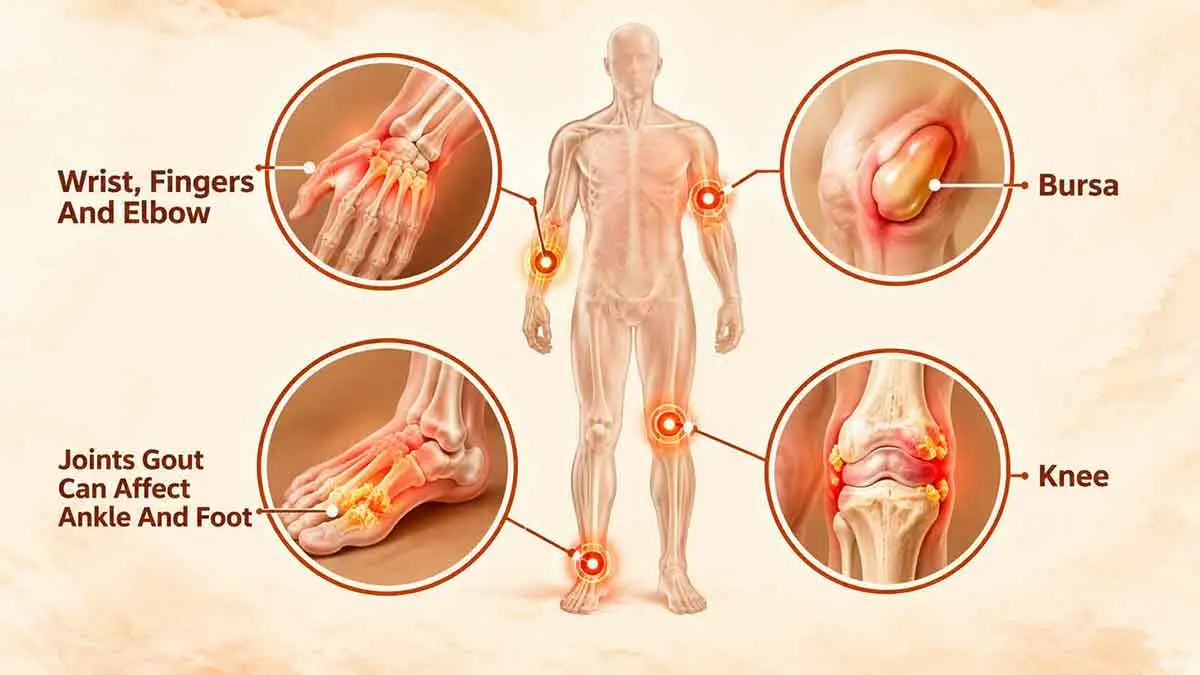
Ankle And Foot
The entire foot architecture is at risk. Gout frequently attacks the midfoot (instep), the heel, and the ankle joint itself. Because these structures bear your entire body weight, crystal deposits here can cause excruciating pain when standing or walking. It can also severely inflame the Achilles tendon at the back of the heel.
Wrist, Fingers And Elbow
While lower extremities are typically hit first, upper extremity gout becomes much more common as the disease progresses, or in older patients ( particularly postmenopausal women ). Gout in the hands can mimic the appearance of rheumatoid arthritis or severe osteoarthritis, causing the knuckles and finger joints to become swollen, stiff, and visibly deformed. The elbows are also frequent targets, often making it impossible to bend or straighten the arm.
Bursa
Gout does not limit itself strictly to the interior of a joint capsule; it also attacks the bursa. Bursae are small, fluid -filled sacs that act as gliding cushions between bones, tendons, and skin. Uric acid crystals frequently accumulate in the olecranon bursa ( at the tip of the elbow) and the prepatellar bursa ( at the front of the kneecap), causing these sacs to swell massively into painful, fluid-filled lumps.
Knee
The knee is the largest joint in the body and a very frequent target for acute gout attacks, because it contains a massive amount of synovial fluid; a gout flare here can cause the knee to swell to twice its normal size, making it completely impossible to bend the leg or bear weight.
First Attack And Intermittent Gout
For most people, the clinical journey begins with an abrupt, agonizing first attack. This initial flare usually strikes a single joint, often at night, causing it to become red, hot, swollen, and exquisitely painful within just 12 to 24 hours. Without medication, this first attack will naturally peak and slowly burn itself out over the course of a week or two.
Once the pain subsides, the joint completely returns to normal. There is no lingering stiffness, and the patient feels entirely cured. This phase is known as intermittent acute gout. In the early years of the disease, these attacks might only happen once a year, or even once every few years, lulling the patient into a false sense of security that the problem has resolved itself.
Time Between Attacks
The period of complete pain-free normalcy between active gout flares is medically referred to as the “ intercritical period”. this arguably the most dangerous stage of gout, simply because it is deceptive. Even though you are experiencing absolutely zero pain or swelling, the underlying metabolic problem has not gone away. Your blood uric acid levels remain dangerously high. During this silent period, microscopic uric acid crystals are continuously precipitating out of your blood and depositing into the cartilage of your joints, and your immune system is temporarily ignoring them, but the structural burden on your joints is compounding daily. The length of this intercritical period shrinks as the disease progresses; a patient who once had years between flares will soon find them happening every few months.
Frequent Or Chronic Gout
If left untreated or improperly managed, intermittent gout eventually evolves into chronic gout. As the silent crystal burden inside the joints becomes too massive for the tissues to handle, the nature of the attacks begins to change.
Instead of explosive flares that completely resolve, the attacks become more frequent, last significantly longer, and begin to overlap. More importantly, gout stops being a single joint tissue. A flare might start in the big toe, spread to the ankle, and simultaneously ignite the knee. Eventually, the patient reaches a state where the joints never fully recover between attacks, resulting in a constant, lingering, low-grade ache and permanent stiffness.
What Tophi Are
The most visible hallmark of advanced, unmanaged gout is the formation of tophi. Tophi are hard, chalky, nodular masses of solid uric acid crystals that have accumulated in massive quantities under the skin. They often look like pale yellow or white lumps, sometimes visible right through the surface of the skin. Tophi typically develop after a decade or more of chronically high uric acid. They most frequently form on the edges of the ears and around the finger joints, over the elbows, and along the Achilles tendon. While they are usually not as intensely painful as an acute flare, they are a sign of severe systemic crystal overload. Curious about how these lumps are safely dissolved, when they require surgical removal, and the risks of a tophus bursting? Check out our website for more or get in touch with Jiva.
Joint Damage And Mobility
The transition into chronic and tophaceous gout brings devastating consequences for physical mobility. Uric acid crystals are physically sharp and highly acidic. When massive amounts of these crystals are packed into a joint space, they mechanically grind away the smooth protective cartilage every time you move. Furthermore, tophi can actually infiltrate the bone tissue itself over time; these masses carve out “punched-out erosions in the bone, fundamentally destroying the joint’s architecture. Fingers can become permanently crooked, ankles can lose their range of motion, and patients may eventually require walking aids or joint replacement surgeries. The physical damage caused by advanced tophaceous gout is irreversible.
How Stage Affects Treatment
Your doctor's approach to treating gout changes radically depending on the stage of your disease. In the early, intermittent stages, treatment focuses heavily on acute symptom management using NSAIDs, colchicine, or steroids to quickly extinguish the temporary fires, followed by moderate lifestyle changes to lower uric acid. However, once you enter the frequent or chronic stages, or if tophi appear, the strategy aggressively shifts. Daily urate-lowering therapies ( like allopurinol or febuxostat) become mandatory to drive blood uric acid levels well below 6.0 mg/dL, or even lower ( below 5.0 mg/dL ), to force the solid tophi to slowly dissolve back into the bloodstream. In the most severe treatment-resistant cases of chronic tophaceous gout, specialized intravenous infusions like pegloticase may be utilized to rapidly melt away massive crystal burdens.
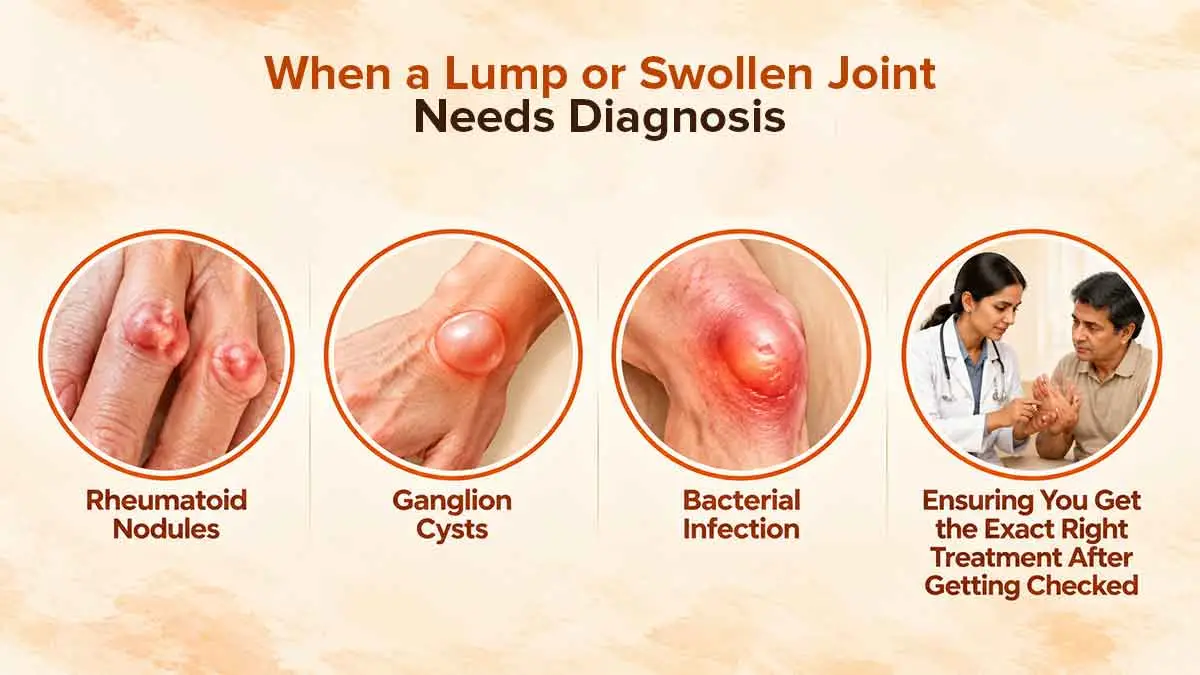
When A Lump Or Swollen Joint Needs Diagnosis
If you discover a firm lump over a joint or experience persistent swelling, you must have it medically evaluated. Do not assume every lump is a tophus, even if you have a known history of gout.
The human body can produce a variety of lumps that mimic tophi perfectly. Rheumatoid arthritis can cause firm “ rheumatoid nodules” on the elbows and fingers. Severe osteoarthritis creates hard, bony outgrowths called osteophytes ( Heberden’s nodes ) on the finger joints. Ganglion cysts can create fluid -filled masses on the knees. Most importantly, a rapidly growing, warm or tender lump could be a sign of bacterial infection. A doctor can easily differentiate these using physical examination and ultrasound or by extracting a tiny sample of fluid from the lump to check for the unmistakable presence of uric acid crystals, ensuring you get the exact right treatment for your specific condition.
References
Gout Symptoms, Causes, & Risk Factors | NIAMS
Tophi as first manifestation of gout - Indian Journal of Dermatology, Venereology and Leprology
Find Jiva Ayurveda Clinics for Gout Treatment Near You
Consult Experienced Ayurveda Doctors for Gout





















Our Happy Patients
-
 Sunita Malik - Knee Pain
 -
 Abhishek Mal - Diabetes
 -
 Vidit Aggarwal - Psoriasis
 -
 Shanti - Sleeping Disorder
 -
 Ranjana - Arthritis
 -
 Jyoti - Migraine
 -
 Renu Lamba - Diabetes
 -
 Kamla Singh - Bulging Disc
 -
 Rajesh Kumar - Psoriasis
 -
 Dhruv Dutta - Diabetes
 -
 Atharva - Respiratory Disease
 -
 Amey - Skin Problem
 -
 Asha - Joint Problem
 -
 Sanjeeta - Joint Pain
 -
 A B Mukherjee - Acidity
 -
 Deepak Sharma - Lower Back Pain
 -
 Vyjayanti - Pcod
 -
 Sunil Singh - Thyroid
 -
 Sarla Gupta - Post Surgery Challenges
 -
 Syed Masood Ahmed - Osteoarthritis & Bp
Diagnostic Marker
Blogs
- What is Gout? Causes and home treatment
- Are you suffering from Gout pain? Try these 5 natural home remedies
- List Of Foods To Avoid With Gout & Why
- Ayurvedic Approach to Gout Home Remedies in India
- सर्दियों में यूरिक एसिड और गाउट क्यों बढ़ते हैं? आयुर्वेद से जानिए दर्द से राहत का प्राकृतिक तरीका
- गाउट में बार-बार दवाइयाँ लेने से किडनी पर क्या असर होता है? और आयुर्वेद कैसे राहत देता है
- Gout के मरीज़ को किन चीजों से तुरंत सावधान हो जाना चाहिए?
- Uric Acid Test Normal आया पर Joint Pain बना हुआ है — Pseudo-Gout हो सकता है
- Gout Attack बार-बार क्यों लौटता है जबकि दवा चालू है? असली Trigger समझिए
- क्या सिर्फ खान-पान से uric acid control हो सकता है? पूरा सच जानिए
Home Remedies
Related Disease
- Ayurvedic Treatment for Ankylosing Spondylitis: Pain, Symptoms, Causes & Care
- Ayurvedic Treatment for Cervical Spondylosis: Neck Pain, Stiffness & Management
- Ayurvedic Treatment for Arthritis: Joint Pain Relief & Long-Term Management
- Ayurvedic Treatment for Osteoarthritis: Knee Pain, Symptoms and Management
- Ayurvedic Treatment for Gout: Uric Acid, Joint Pain & Flare-Up Management
- Ayurvedic Treatment for Sciatica: Managing Nerve Pain & Leg Discomfort
- Ayurvedic Treatment for Rheumatoid Arthritis: Joint Swelling, Symptoms & Care
- Ayurvedic Treatment for Frozen Shoulder: Pain, Symptoms, Causes & Care
- Ayurvedic Treatment for Deep Vein Thrombosis (DVT): Leg Swelling, Risks and Treatment
- Ayurvedic Treatment for Achilles Tendon Disorders: Pain, Symptoms, Causes & Care
- Ayurvedic Treatment for Rickets: Symptoms, Causes & Management
- Ayurvedic Treatment for Ganglion Cyst: Symptoms, Causes & Management
- Ayurvedic Treatment for Osteoporosis: Pain, Symptoms, Causes & Care
- Ayurvedic Treatment for AVN Avascular Necrosis: Pain, Symptoms, Causes & Care
- Ayurvedic Treatment for Osteomyelitis: Symptoms, Causes & Care Options
- Ayurvedic Treatment for Cerebral Palsy: Symptoms, Causes & Supportive Care
Latest Blogs
- Late Dinner Plus Poor Sleep: Why Ayurveda Looks At The Pattern, Not One Habit
- परिवार के साथ बैठकर खाना खाने से Portion और Eating Speed पर क्या फर्क पड़ सकता है?
- कब्ज़ में इंडियन-स्टाइल टॉयलेट बेहतर है? टॉयलेट पोस्चर के बारे में क्या पता है
- दूध, दही और लस्सी से IBS के लक्षण कब बढ़ सकते हैं?
- कभी कब्ज़, कभी दस्त? बार-बार बदलती पेट की आदतों को कैसे समझें
- क्या आयरन, कैल्शियम या कुछ दवाओं से कब्ज़ हो सकती है? डॉक्टर से कब बात करें
- पीरियड्स के दौरान IBS के लक्षण कुछ लोगों में क्यों बढ़ सकते हैं?
- व्रत या उपवास में कब्ज़ बढ़ जाती है? नवरात्रि में किन बातों का ध्यान रखें
- सफ़र में कब्ज़ क्यों हो जाती है? यात्रा से पहले क्या तैयारी करें
- खूब पानी पीने के बाद भी कब्ज़ क्यों बनी रह सकती है?
- बुज़ुर्ग माता-पिता को कब्ज़ रहती है? परिवार किन बातों का ध्यान रखे
- क्या खूनी बवासीर में ऑपरेशन ही एकमात्र विकल्प है? इलाज के विकल्प समझें
- शौच में खून देखकर घबरा गए? जानिए पहले क्या समझें और क्या करें
- रोटी, चावल और दही: कब्ज़ होने पर खाने में क्या बदलाव मदद कर सकते हैं?
- रोज़ बाइक से ऑफिस जाते हैं और बवासीर की सूजन परेशान करती है? जानिए सफ़र का असर
- IBS में दवा से राहत मिलने के बाद भी लक्षण दोबारा क्यों हो सकते हैं?
- IBS में कौन-सा खाना परेशानी बढ़ाता है? फ़ूड डायरी कैसे मदद कर सकती है
- मानसून में पेट की परेशानी बढ़ती लगती है? IBS और मौसम के संबंध को समझें
- बवासीर में सिट्ज़ बाथ कैसे करें? फायदे, सावधानियाँ और कब बचें
- बवासीर के मस्से बाहर निकलते हैं? ग्रेड 1 से 4 का मतलब समझें
Ayurvedic Doctor In Top Cities
- Ayurvedic Doctors in Bangalore
- Ayurvedic Doctors in Pune
- Ayurvedic Doctors in Delhi
- Ayurvedic Doctors in Hyderabad
- Ayurvedic Doctors in Indore
- Ayurvedic Doctors in Mumbai
- Ayurvedic Doctors in Lucknow
- Ayurvedic Doctors in Kolkata
- Ayurvedic Doctors in Patna
- Ayurvedic Doctors in Vadodara
- Ayurvedic Doctors in Ahmedabad
- Ayurvedic Doctors in Chandigarh
- Ayurvedic Doctors in Gurugaon
- Ayurvedic Doctors in Jaipur
- Ayurvedic Doctors in Kanpur
- Ayurvedic Doctors in Noida
- Ayurvedic Doctors in Ranchi
- Ayurvedic Doctors in Bhopal
- Ayurvedic Doctors in Ludhiana
- Ayurvedic Doctors in Dehradun