
Successful Treatments
Clinics
Doctors
Tophi in Gout: Signs, Risks and Treatment
 Published on 29 Sep, 2026
 Updated on 08 Oct, 2026

Explore Gout Joints, Stages and Tophi
- Home / Diseases & Ayurveda / Joint & Muscle Pain / Ayurvedic Treatment for Gout: Uric Acid, Joint Pain & Flare-Up Management / Understanding Gout Joints, Stages and Tophi / Tophi in Gout: Signs, Risks and Treatment
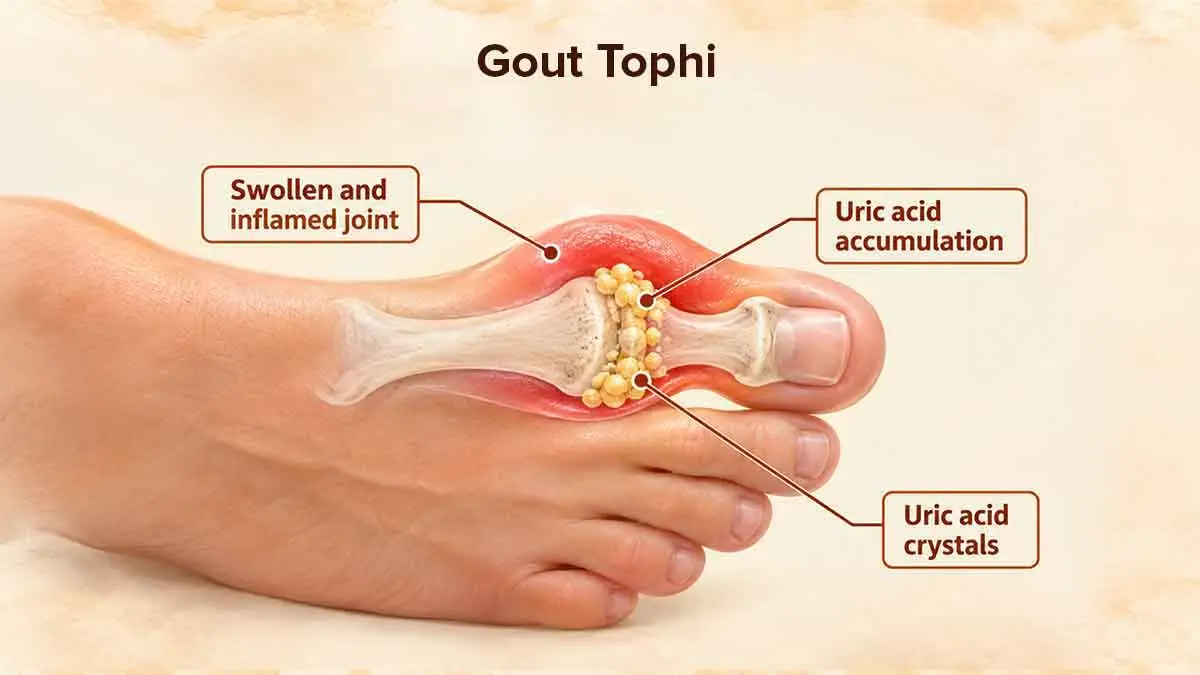
What Tophi Are
Tophi are dense, macroscopic aggregations of monosodium urate crystals encapsulated by an inflammatory immune response. When uric acid levels remain persistently high, the body's tissues become saturated, causing the excess urate to precipitate into needle-like crystals.
The body's immune system recognises these crystal deposits as foreign material. In response, macrophages and other immune cells surround the crystals, attempting to clear them. When they fail to break the crystals down, the immune cells form a chronic granuloma, a defensive wall of fibrous tissue around the urate core. This organised structure of uric acid, immune cells, and fibrous connective tissue is what constitutes a tophus. While they take years to become visible to the naked eye, microscopic tophi can begin forming long before a patient detects their first palpable lump.
Where They Commonly Appear
Urate crystals precipitate most readily in cooler, avascular ( lacking a robust blood supply ) areas of the body, making peripheral joints and specific soft tissues the prime locations for tophi formation .common sites includes ;
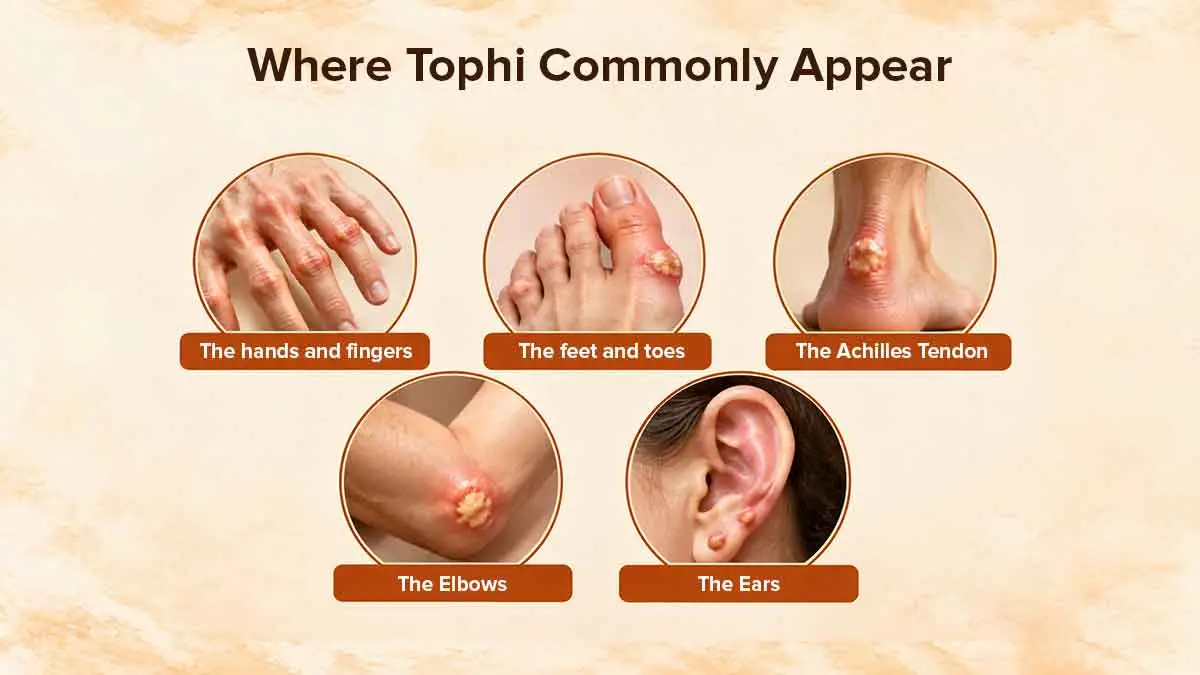
The hands and fingers
Specifically the distal interphalangeal ( DIP) and proximal interphalangeal (PIP) joints, as well as the finger pads.
The feet and toes
The first metatarsophalangeal joint ( the base of the big toe ) is the most iconic site, but the heel and midfoot are also highly susceptible.
The Achilles Tendon
Tophi frequently embed within the fibre of the Achilles, thickening the tendon and altering foot mechanics.
The Elbows
The olecranon bursa ( the fluid-filled sac at the point of the elbow) is a classic location for massive, prominent tophi.
The Ears
Specifically the helix ( the outer rim of cartilage ), where small, pearl-like tophi can develop.
Less commonly, tophi can deposit in internal structures, including the spine, heart valves, and the vocal cords, though these presentations are rare.
How They Look And Feel
Tophi are firm, rock-like accumulations of monosodium urate crystals that form under the skin in people with advanced, poorly managed gout.
- Appearance: They look like swollen, bulbous, or irregular lumps under the skin. They can range in size from a small pea to a large tangerine. They are usually chalky white, yellow, or skin-colored. As they grow, they stretch the skin taut, sometimes revealing a visible white head.
- Texture: They are typically hard, firm, and rock-like to the touch.
- Sensation: Tophi themselves are usually painless because they are established, inactive crystal deposits. However, they can become highly tender and painful if they trigger a sudden gout flare-up, stretch the skin uncomfortably tight, or grow large enough to compress nearby nerves.
How Doctors Confirm Them
While a physician can often suspect a tophus based on visual appearance and medical history, formal medical tests are required to confirm the diagnosis and rule out mimicking conditions like rheumatoid nodules or infection.
The Perfect Standard: Needle Aspiration and Polarized Microscopy
The definitive way to confirm a tophus is for a doctor to extract a small sample of fluid or paste from the lump using a fine needle (aspiration). This sample is analyzed under a polarized light microscope. Confirmation is achieved when the clinician identifies needle-shaped, negatively birefringent monosodium urate crystals.
Advanced Imaging Scans:
- Ultrasound: Highly effective at visualizing early urate crystal clustering in cartilage or soft tissues before a lump is fully visible.
- Dual-Energy CT (DECT): The gold standard of imaging for gout. DECT scans combine multiple X-ray angles to specifically map, color-code, and quantify uric acid crystal deposits throughout an entire limb.
- Conventional X-Rays: Used primarily to evaluate the extent of existing bone damage, revealing classic gouty "punched-out" or "rat-bite" bone erosions.
- Blood Tests: Clinicians will check serum uric acid levels. However, blood tests alone cannot confirm a tophus; some individuals have normal uric acid levels during acute inflammation, while others have high levels but never develop tophi.
Joint, Skin, and Nerve Complications
Joint
Tophus do not merely rest on top of bones: they actively erode them. The chronic inflammation triggered by the tophus stimulates osteoclasts ( cells that break down bone) while inhibiting osteoblasts. Over time, the tophus carves out ‘punched-out” erosions in the bone, complete with overhanging edges, eventually destroying the joint cartilage. This results in severe, irreversible joint deformity and loss of mobility.
Skin Compromise
As the tophus expands outwards, it stretches the overlying epidermis to its absolute limit. This skin becomes paper-thin, fragile, and devoid of normal elasticity and blood supply. Minor friction can easily tear this compromised tissue, leading to open, non-healing wounds.
Nerve Compression
Because tophi take up physical space in confined anatomical corridors, they can impinge on adjacent nerves. A tophus developing in the wrist can compress the median nerve, triggering severe carpal tunnel syndrome. Similarly, spinal tophi can cause radiculopathy or spinal stenosis, leading to radiating nerve pain, numbness, or weakness in the limbs.
Urate-Lowering Treatment Goals
The occurrence of a tophus automatically indicates that the patient suffers from severe and chronic gout, which warrants an aggressive approach in drug treatment. The tophus can be completely dissolved, but it requires reducing the blood uric acid level sufficiently below the saturation point of gout. It is necessary to keep the level of uric acid <6 mg/dL in order to prevent the formation of new crystals and dissolution of monosodium urate crystals.
Stricter Goal for Patients with Severe Disease: In case of severe or advanced gout, i.e., for patients with palpable tophus, chronic arthropathy, or recurrent flares, the target must be set at <5 mg/dL (300 µmol/L).
Treat-to-Target Therapy: Dose titration is needed, which means that drugs should be increased until the patient reaches the required goal.
Acute Gout Flare Prevention during Therapy Onset: It is necessary to co-administer anti-inflammatory prophylaxis (e.g., colchicine, NSAIDs) for 3-6 months due to the risk of flare associated with reduced uric acid level.
Long-Term Remission: Eradicate flares, shrink and dissolve tophi completely, and maintain optimal physical function and low pain scores over 12 or more months.
Protecting Skin Over A Tophus
Until systemic medications can dissolve the nodule, daily local management is essential to prevent the overlying skin from breaking down.
Shoe Modification
Tophi on feet require wide toe box shoes or custom orthotics. Friction from standard, rigid footwear will quickly rub the thin skin over a tophus raw.
Moisturization
Keep the skin hydrated with thick, unscented emollients; dry, cracked skin is more prone to splitting when stretched by an underlying nodule.
Padding
Use moleskin or hydrocolloid patches or soft silicone sleeves over prominent tophi on the elbows or toes to absorb mechanical shear forces during daily activities.
Prevent Trauma
Be cautious during daily activities to avoid bumping or scratching the bulbous growth, as fragile skin over a tophus tears easily.
When Drainage, Ulceration, or Infection Needs Care
A ruptured tophus is a clinical emergency that requires prompt medical evaluation. When the thin skin over a tophus tears, the nodule ulcerates, leaking a thick, chalky, white paste resembling toothpaste or cottage cheese.
Risks of Ulceration:
Urate itself is sterile, and the chalky discharge is not inherently infectious. However, the open wound creates a direct, avascular pathway into the joint space and the bloodstream. Because the blood supply to a tophus is poor, the body's white blood cells cannot easily reach the area to fight off invading bacteria.
Signs of Secondary Infection:
Seek immediate urgent care if the area around an ulcerated tophus develops spreading redness (erythema), becomes hot to the touch, generates a foul odor, discharges yellow pus (distinct from white urate), or is accompanied by a systemic fever.
Surgical Intervention:
While surgery is a last resort for gout, it is indicated when a tophus becomes heavily infected, threatens the viability of the surrounding skin (necrosis), or causes severe, unmanageable nerve compression. A surgeon may perform a debridement to scoop out the urate paste and remove necrotic tissue, allowing the wound bed to finally heal.
References
Tophi as first manifestation of gout - Indian Journal of Dermatology, Venereology and Leprology
Find Jiva Ayurveda Clinics for Gout Treatment Near You
Consult Experienced Ayurveda Doctors for Gout





















Our Happy Patients
-
 Sunita Malik - Knee Pain
 -
 Abhishek Mal - Diabetes
 -
 Vidit Aggarwal - Psoriasis
 -
 Shanti - Sleeping Disorder
 -
 Ranjana - Arthritis
 -
 Jyoti - Migraine
 -
 Renu Lamba - Diabetes
 -
 Kamla Singh - Bulging Disc
 -
 Rajesh Kumar - Psoriasis
 -
 Dhruv Dutta - Diabetes
 -
 Atharva - Respiratory Disease
 -
 Amey - Skin Problem
 -
 Asha - Joint Problem
 -
 Sanjeeta - Joint Pain
 -
 A B Mukherjee - Acidity
 -
 Deepak Sharma - Lower Back Pain
 -
 Vyjayanti - Pcod
 -
 Sunil Singh - Thyroid
 -
 Sarla Gupta - Post Surgery Challenges
 -
 Syed Masood Ahmed - Osteoarthritis & Bp
Diagnostic Marker
Blogs
- What is Gout? Causes and home treatment
- Are you suffering from Gout pain? Try these 5 natural home remedies
- List Of Foods To Avoid With Gout & Why
- Ayurvedic Approach to Gout Home Remedies in India
- सर्दियों में यूरिक एसिड और गाउट क्यों बढ़ते हैं? आयुर्वेद से जानिए दर्द से राहत का प्राकृतिक तरीका
- गाउट में बार-बार दवाइयाँ लेने से किडनी पर क्या असर होता है? और आयुर्वेद कैसे राहत देता है
- Gout के मरीज़ को किन चीजों से तुरंत सावधान हो जाना चाहिए?
- Uric Acid Test Normal आया पर Joint Pain बना हुआ है — Pseudo-Gout हो सकता है
- Gout Attack बार-बार क्यों लौटता है जबकि दवा चालू है? असली Trigger समझिए
- क्या सिर्फ खान-पान से uric acid control हो सकता है? पूरा सच जानिए
Home Remedies
Related Disease
- Ayurvedic Treatment for Ankylosing Spondylitis: Pain, Symptoms, Causes & Care
- Ayurvedic Treatment for Cervical Spondylosis: Neck Pain, Stiffness & Management
- Ayurvedic Treatment for Arthritis: Joint Pain Relief & Long-Term Management
- Ayurvedic Treatment for Osteoarthritis: Knee Pain, Symptoms and Management
- Ayurvedic Treatment for Gout: Uric Acid, Joint Pain & Flare-Up Management
- Ayurvedic Treatment for Sciatica: Managing Nerve Pain & Leg Discomfort
- Ayurvedic Treatment for Rheumatoid Arthritis: Joint Swelling, Symptoms & Care
- Ayurvedic Treatment for Frozen Shoulder: Pain, Symptoms, Causes & Care
- Ayurvedic Treatment for Deep Vein Thrombosis (DVT): Leg Swelling, Risks and Treatment
- Ayurvedic Treatment for Achilles Tendon Disorders: Pain, Symptoms, Causes & Care
- Ayurvedic Treatment for Rickets: Symptoms, Causes & Management
- Ayurvedic Treatment for Ganglion Cyst: Symptoms, Causes & Management
- Ayurvedic Treatment for Osteoporosis: Pain, Symptoms, Causes & Care
- Ayurvedic Treatment for AVN Avascular Necrosis: Pain, Symptoms, Causes & Care
- Ayurvedic Treatment for Osteomyelitis: Symptoms, Causes & Care Options
- Ayurvedic Treatment for Cerebral Palsy: Symptoms, Causes & Supportive Care
Latest Blogs
- Late Dinner Plus Poor Sleep: Why Ayurveda Looks At The Pattern, Not One Habit
- परिवार के साथ बैठकर खाना खाने से Portion और Eating Speed पर क्या फर्क पड़ सकता है?
- कब्ज़ में इंडियन-स्टाइल टॉयलेट बेहतर है? टॉयलेट पोस्चर के बारे में क्या पता है
- दूध, दही और लस्सी से IBS के लक्षण कब बढ़ सकते हैं?
- कभी कब्ज़, कभी दस्त? बार-बार बदलती पेट की आदतों को कैसे समझें
- क्या आयरन, कैल्शियम या कुछ दवाओं से कब्ज़ हो सकती है? डॉक्टर से कब बात करें
- पीरियड्स के दौरान IBS के लक्षण कुछ लोगों में क्यों बढ़ सकते हैं?
- व्रत या उपवास में कब्ज़ बढ़ जाती है? नवरात्रि में किन बातों का ध्यान रखें
- सफ़र में कब्ज़ क्यों हो जाती है? यात्रा से पहले क्या तैयारी करें
- खूब पानी पीने के बाद भी कब्ज़ क्यों बनी रह सकती है?
- बुज़ुर्ग माता-पिता को कब्ज़ रहती है? परिवार किन बातों का ध्यान रखे
- क्या खूनी बवासीर में ऑपरेशन ही एकमात्र विकल्प है? इलाज के विकल्प समझें
- शौच में खून देखकर घबरा गए? जानिए पहले क्या समझें और क्या करें
- रोटी, चावल और दही: कब्ज़ होने पर खाने में क्या बदलाव मदद कर सकते हैं?
- रोज़ बाइक से ऑफिस जाते हैं और बवासीर की सूजन परेशान करती है? जानिए सफ़र का असर
- IBS में दवा से राहत मिलने के बाद भी लक्षण दोबारा क्यों हो सकते हैं?
- IBS में कौन-सा खाना परेशानी बढ़ाता है? फ़ूड डायरी कैसे मदद कर सकती है
- मानसून में पेट की परेशानी बढ़ती लगती है? IBS और मौसम के संबंध को समझें
- बवासीर में सिट्ज़ बाथ कैसे करें? फायदे, सावधानियाँ और कब बचें
- बवासीर के मस्से बाहर निकलते हैं? ग्रेड 1 से 4 का मतलब समझें
Ayurvedic Doctor In Top Cities
- Ayurvedic Doctors in Bangalore
- Ayurvedic Doctors in Pune
- Ayurvedic Doctors in Delhi
- Ayurvedic Doctors in Hyderabad
- Ayurvedic Doctors in Indore
- Ayurvedic Doctors in Mumbai
- Ayurvedic Doctors in Lucknow
- Ayurvedic Doctors in Kolkata
- Ayurvedic Doctors in Patna
- Ayurvedic Doctors in Vadodara
- Ayurvedic Doctors in Ahmedabad
- Ayurvedic Doctors in Chandigarh
- Ayurvedic Doctors in Gurugaon
- Ayurvedic Doctors in Jaipur
- Ayurvedic Doctors in Kanpur
- Ayurvedic Doctors in Noida
- Ayurvedic Doctors in Ranchi
- Ayurvedic Doctors in Bhopal
- Ayurvedic Doctors in Ludhiana
- Ayurvedic Doctors in Dehradun