Fatty liver disease has quietly become common; nearly one in three people (about 30% - 38%) globally are affected by this. Most people have almost no early symptoms; that's why they ignore it. Means your liver could be struggling without you feeling a thing. Here's why?
Why Fatty Liver Often Has No Symptoms
Even when fat accumulates in the liver cells, the liver works properly and repairs itself. Most of the time, the reason is that there are no visible symptoms or signs, but some people feel upper abdomen (belly) pain, severe fatigue, and unexplained weight changes. This may vary from person to person, perhaps depending on their age, weight, and health conditions. Some of the important reasons are:
- The liver has a high reserve capacity that means it has extra working space. It does not require its tissue to perform daily body tasks.
- The liver tissue lacks pain receptors, which means it does not have pain-sensing nerves. Discomfort only happens in severe conditions, when the outer covering of the liver stretches from swelling or inflammation.
- The fat accumulation happens gradually over months or years due to the liver's slow progression; this gives time to the body to adjust without any sudden distress.
- In the early stages, the liver gives uncertain signs like mild tiredness or weakness that people often confuse with a sedentary lifestyle, lack of sleep, and aging.
Ayurvedic Views On Silent Fat Accumulation:
According to Ayurveda, fat accumulated in the liver remains hidden deep within the Srotas (tissue channels) without causing serious systemic distress, as long as Agni (digestive fire) is intact; that's why early-stage fatty liver (Yakrit Vikara) is often quiet. Some of the important factors are:
- Dhatuleena Ama: Fat accumulates slowly at the cellular level when metabolic toxins (Ama) mix with concentrated fat.
- Srotorodha: The accumulation of heavy fatty matter and localised poison (Ama) will result in a steady blockage of Rakta-vaha srotas (micro-channels). The body smoothly adapts to this obstruction for a long time due to gradual restriction, avoiding acute pain or distress signals.
- Quite dosha imbalance: In the early stages of fatty liver, the Pitta dosha, which is responsible for heat, metabolism, and inflammation, is not yet provoked; that’s why severe symptoms like pain, swelling, yellowing of the skin (kamala or jaundice), and inflammation come later when Pitta or extreme Vata joins with Kapha dosha to create Yakritodara (tissue scarring).
Subtle Symptoms You May Overlook
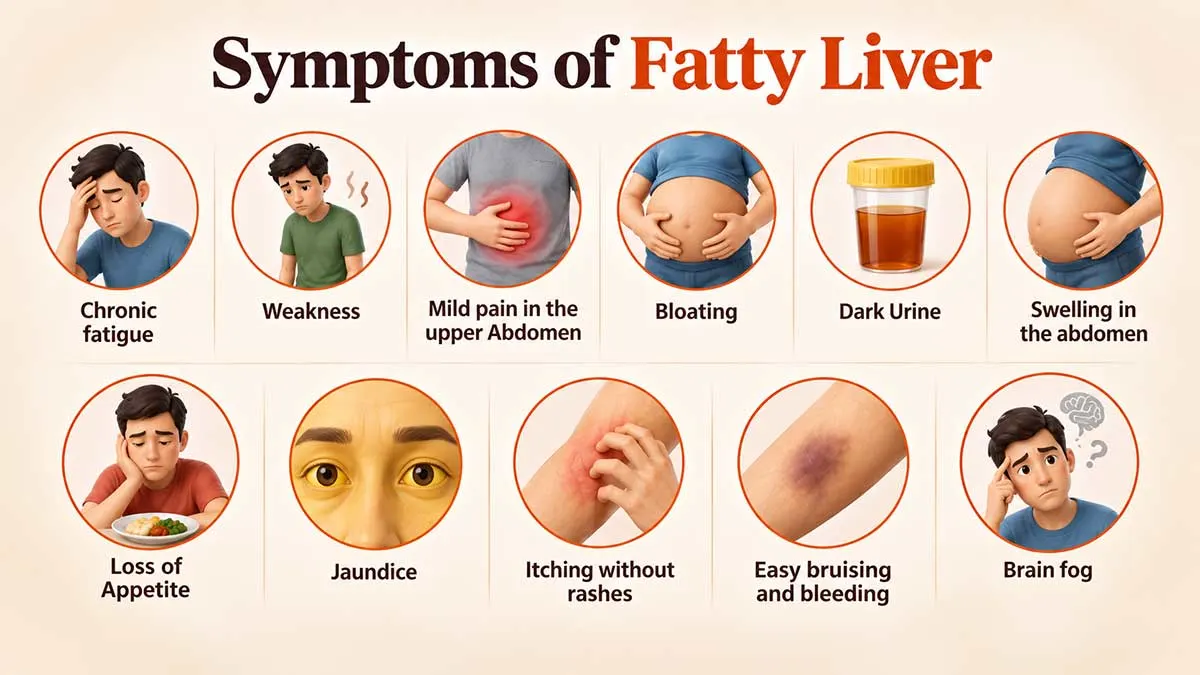
Fatty liver is often silent, but when subtle signs do show up, they are very easily mistaken for other health problems. Some possible non-specific symptoms are:
- General Malaise (Klama): You may feel a sense of being unwell, weak, and inactive.
- Constant Fatigue (Alasya): You may feel low energy levels and not feel like doing anything, even with complete rest.
- Appetite loss (Aruchi): You may notice reduced desire for food or may experience irregular hunger patterns.
- Digestive instability (Ajeerna): If you feel mild bloating or excess gas even after eating a very small amount of food, then it may be a sign of fatty liver.
- Abdominal discomfort: You may feel a mild ache, pressure, or fullness in the upper right side of the abdomen near the ribs.
- Unexplained weight loss: If your weight drops unintentionally, it may be a sign of Yakrit roga. But it usually happens in advanced conditions.
- Sour Burping: If you constantly feel tasteless or sour burping after or without eating anything, it may be a sign of weak processing of nutrients (Annavaha srotas impairment) and can affect Yakrit.
Symptoms That May Point To Another Cause
These are some red flags that can cause advanced Yakrit roga (liver disease) such as cirrhosis or MASH, if not treated on time:
- Easy bleeding, such as frequent nosebleeds or unexplained bruises, can happen when the liver stops making essential blood- clotting proteins.
- Swelling in the abdomen or lower legs can cause severe Ascites or Edema.
- Yellowing of the eyes and skin can be signs of severe jaundice.
- Mental confusion or brain fog can signal hepatic encephalopathy, where Ama (toxins) affect brain cells.
- Changes in waste color to dark can be a sign of severe liver dysfunction.
When Testing Is Considered
Mild Yakrit roga (liver imbalances) can be treated with natural and Ayurvedic support; nevertheless, some situations require serious attention. It's important to remember the difference between the two. People should not put off treatment or rely completely on home remedies because the situation becomes dangerous when they ignore such symptoms or when their laboratory results exceed a critical threshold.
The liver is an important organ; we should not ignore warning signs that could later affect our health. Early diagnosis and treatment can help prevent future liver dysfunction. If you’re facing these symptoms, then consider visiting Jiva’s professional health expert:
- Liver enzymes are extremely high on the ALT and AST report.
- Frequent vomiting or nausea
- Dark colored waste regularly
- Ongoing pain in the upper abdomen
- Yellowing of eyes and skin
- Swelling in the legs or abdomen
- Loss of appetite
- Unusual sleepiness
- Severe weakness or low energy throughout the day
- Already diagnosed with liver disease
- Genetical condition
These situations need proper testing, monitoring, and medical supervision.
How Ayurveda Sees Signs Of Advanced Liver Disease
According to Ayurveda, the Yakrit (liver) is the centre of Ranjan Pitta, which is responsible for blood formation and color. When liver problems become long-term or severe, they can lead to conditions similar to advanced liver disease, decompensated cirrhosis, or liver failure. At this stage, the disease can affect the whole body.
According to ancient Ayurvedic texts like Charaka Samhita, advanced liver problems can be classified as Yakrit roga, Kamala (jaundice), or Udara roga (abdominal disorders).
Ayurveda says these are the signs of advanced liver disease:
- Kumbha Kamala (severe Jaundice): In the initial stages, Kamala may be neglected, which advances into a deep-rooted chronic stage, Kumbha Kamala. Symptoms include the yellowing of eyes, skin, nails, and urine due to highly aggravated Pitta dosha; the patient may look highly frail due to Dhatu Kshya (deep tissue depletion).
- Jalodara (Ascites): Liver disorders disturb the circulation and metabolism in the abdomen; the abdominal cavity gets severely filled with fluid, and this condition is known as Jalodara, which commonly means water in the abdomen. Symptoms include a swollen abdomen caused by a heavy imbalance of Prana Vayu, Apana Vayu, and Agni (digestive fire) obstructing the Udakavaha srotas (fluid channels). The enlarged veins and swollen abdomen become visible in this case.
- Halimaka (Malignant): When Pitta and Vata dosha become excessively aggravated, they burn the body’s energy reserve; this results in Halimaka. Symptoms include chronic fever, severe body aches, drowsiness, loss of physical strength, and skin lose their healthy glow and turning slightly dark green or yellowish pale.
- Severe Srotorodha (Channel blockages): Advanced liver disorder destroys Dhatu Agni (metabolism), which creates severe Ama (toxins). Symptoms include loss of appetite, persistent nausea or vomiting, and bleeding tendencies from the nose, mouth, or in stool caused by Raktapitta.
These advanced liver disorders are known as Krichrasadhya (extremely difficult to treat) or Asadhya (incurable) in Ayurveda, and these conditions need serious medical treatment.
How May Fatty Liver Affect You?
According to Ayurveda, Yakrit roga can lead to many health problems in the long run, even if you do not feel any symptoms during the initial stage. This roga (disease) can be treated by focusing on the root cause. This is how you may get affected by fatty liver:
Right-Side Abdominal Discomfort
It generally feels like a dull aching or a heavy sensation in the upper abdomen or the upper right side of the belly or under the ribs. It can happen when excess fat builds up and makes the liver stretch or swell; in this case, the liver gets slightly enlarged, and the second reason is enlarged organ presses against nearby structures, creating pressure or extreme discomfort. It may worsen after eating heavy or fatty meals or even after consuming alcohol.
Fatigue With Fatty Liver
It is the most commonly reported symptom by people with Yakrit roga. It is generally known as metabolic dysfunction because the liver acts as the power station of the body, which converts food into energy and stores glucose; when excess fat accumulated liver struggles to process energy. Fat accumulation triggers low-grade inflammation, which can cause severe fatigue or physical exhaustion. It may worsen with conditions like sleep disorders, obesity, and metabolic syndrome.
What To Do Next?
If you have any of these symptoms, you need to take some urgent actions:
- See a specialist: Schedule an appointment with Jiva’s specialised Ayurvedic doctors.
- Get blood Tests done: Tests like LFTs, Ultrasound, FibroScan, blood tests, and sugar tests.
- Cut out alcohol: Alcohol can worsen the condition.
- Focus on a healthy diet: Avoid eating oily, heavy, processed food and reduce sugar intake.
- Work out daily: At least 90-150 minutes of regular exercise to maintain a healthy lifestyle.
- Keep monitoring other conditions: Monitor your blood pressure, cholesterol, blood sugar, and other conditions daily.
Reference:
Nonalcoholic Fatty Liver Disease: A Silent Epidemic - PubMed
Liver and liver disease in Hinduism - PMC
Symptoms & Causes of NAFLD & NASH - NIDDK

 Published on 11 Sep, 2026
 Updated on 16 Sep, 2026