
Successful Treatments
Clinics
Doctors
FibroScan for Fatty liver
 Published on 23 Sep, 2026
 Updated on 25 Sep, 2026

Explore Reports And Tests
- Home / Diseases & Ayurveda / Liver & Gall / Ayurvedic Treatment for Fatty Liver: Diet, Lifestyle & Liver Health / Fatty Liver Reports and Tests: Ultrasound, LFT, and FibroScan / FibroScan for Fatty liver
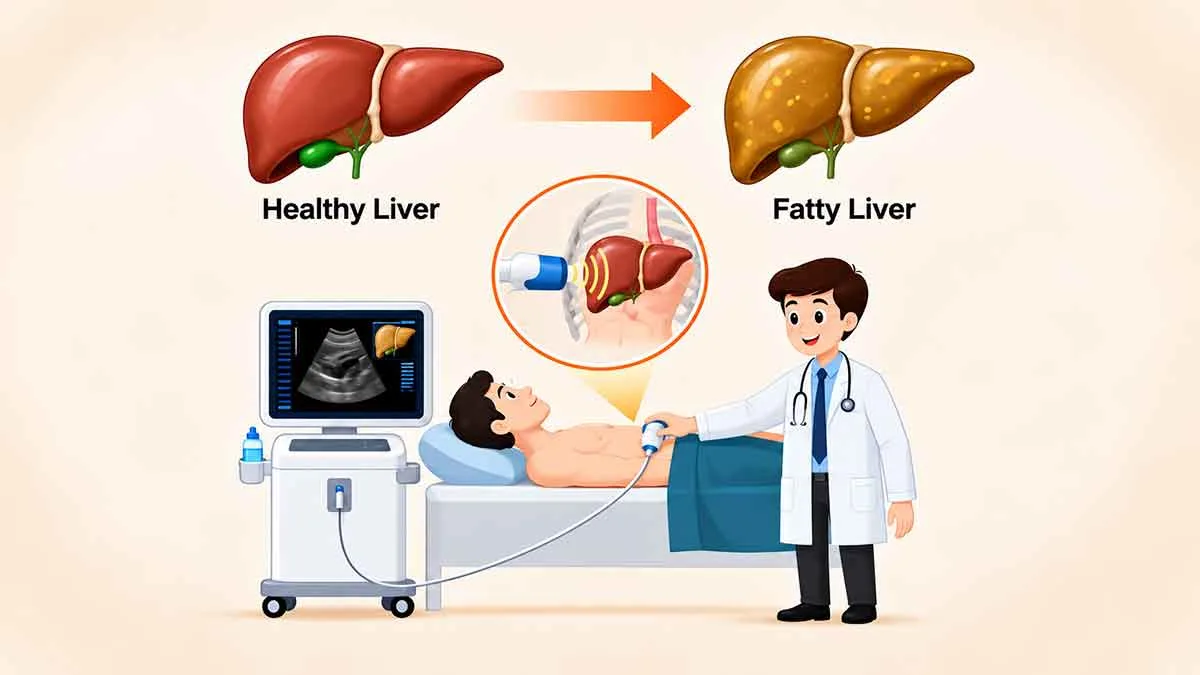
A FibroScan is a quick, non-invasive diagnostic device that uses ultrasound to assess liver stiffness and fat in the liver. It's a painless, non-surgical, and easy alternative to the liver biopsy. FibroScan uses VCTE (vibration-controlled transient elastography) technology, where a doctor places a small probe on the skin over the rib cage, and the device sends sound waves or vibrations into the liver. It assesses the speed of the waves to calculate liver stiffness, which is a signal of liver scarring or liver fibrosis.
What The Result/Test Means
FibroScan provides diagnostic results of two stages of liver condition: one is the CAP score, and the other is the fibrosis score.
CAP score, or controlled attenuation parameter, measures the amount of fat stored in the liver, and it is reported in decibels per meter; a normal CAP score of mild fat accumulation falls under 275 dB/m, and severe stages of fat accumulation fall above 275 dB/m. Fibrosis score, or liver stiffness score, measures the scarring and the hardening of the liver tissues, and it is reported in kilopascals (kPa). A normal fibrosis score lies between 2 -7 kPa, moderated fibrosis score lies between 7.5 -10 kPa, and severe cases lie above 10 kPa.
Advanced scarring or more fat accumulation is identified with higher numbers. However, test results can vary; if you eat before the test, it may show a rise in scores. You should seek proper guidance from a specialist before a diagnostic test.
What It Can And Cannot Prove
| What It Can Prove | What It Cannot Prove |
| The amount of fat accumulated in the liver; it is measured through the CAP score. | The exact underlying cause; it cannot distinguish between whether your liver is stiff or fatty. |
| The level of liver stiffness or scarring; it is measured through the fibrosis score. | It cannot diagnose the amount of inflammation and cell injury. |
| The overall progression or changes in the liver over time | It cannot replace the traditional liver biopsy and gives false results due to ongoing inflammation, high alcohol intake, and other metabolic factors. |
Common Reasons For The Finding
A doctor suggests a FibroScan when there is a risk of fat accumulation in the liver or to check liver stiffness or scarring. Fatty liver may be detected during a FibroScan for several reasons:
- Routine liver health check
- Abnormal liver tests
- Overweight or obesity
- Diabetes or insulin resistance
- High cholesterol or high triglycerides
- High blood pressure or metabolic syndrome
- Regular or heavy alcohol intake
- Fatty liver may be seen on the ultrasound
- Monitoring of existing liver condition
Patient Success Stories
How It Relates To The Disease
FibroScan helps show how much fat has accumulated in the liver, and it is related to severe liver disease by measuring liver fat and liver stiffness. It helps doctors to understand what is happening in the liver when fatty liver is found. Fatty liver is often seen in people with diabetes, obesity, high cholesterol, or other metabolic factors. In some cases, continued liver injury can lead to liver inflammation and fibrosis over time. However, having fatty liver does not mean that a person has liver damage or advanced scarring. The FibroScan test, along with other markers such as blood tests, can help in better understanding and treatment of the disease.
What To Review Next With A Doctor
If a FibroScan shows fatty liver, discuss the results with your doctor, along with your liver stiffness score and the CAP score. Your doctor may review blood tests, blood sugar, or HbA1c, triglycerides, cholesterol score, body weight, lifestyle, dietary habits, and other metabolic risk factors. If stiffness is raised, they may consider whether further tests are needed to diagnose fibrosis. It is also useful to discuss possible causes, medications, or when other tests or FibroScan should be repeated.
You should ask your doctor about what the underlying cause is, what the action plan is, the monitoring timeline, and the complications of the treatment.
Monitoring And Follow-Up
Follow-up after a FibroScan depends on the amount of liver fat, liver stiffness, and your overall health.
- The doctor may monitor liver enzymes, blood sugar, cholesterol, triglycerides, weight, dietary habits, and other risk factors over time.
- If fibrosis is suspected, the doctor may advise additional tests and repeat FibroScan.
- Lifestyle changes such as a healthy and balanced diet, regular physical activity, and maintaining a healthy body weight are also advised.
- The timeline of the monitoring process may vary from person to person; it is based on individual risk and test results.
Red Flags
You need immediate professional help if you notice these signs because they can get worse over time:
- Swelling in the abdomen or legs
- Yellowing of the skin or eyes
- Severe abdominal pain
- Repeated vomiting or inability to keep food in the body
- Extreme sleepiness
- Brain fog or constant confusion
- Vomiting blood or dark stool
- Unexplained weight loss or complete appetite loss
- Severe weakness even with a healthy lifestyle
Reference
Limitations of non-invasive tests for assessment of liver fibrosis - PMC
FibroScan (Transient Elastography) for the Measurement of Liver Fibrosis - PMC
FAQs
It gives an idea of how stiff the liver is and can help assess the possibility of fibrosis.
The CAP score estimates the amount of fat in the liver.
Yes, the FibroScan can detect fibrosis, but the results are not always the same; sometimes it needs other tests as well with a FibroScan.
It refers to the degree of liver fibrosis, where F0 indicates no fibrosis, and F4 indicates advanced fibrosis or cirrhosis.
No, it is usually quick and painless and does not require needles.
No. It does not automatically confirm a diagnosis of cirrhosis; it needs medical interpretation to check other factors as well.
Find Jiva Ayurveda Clinics for Fatty-liver Treatment Near You
Consult Experienced Ayurveda Doctors for Fatty-liver








Our Happy Patients
-
 Sunita Malik - Knee Pain
 -
 Abhishek Mal - Diabetes
 -
 Vidit Aggarwal - Psoriasis
 -
 Shanti - Sleeping Disorder
 -
 Ranjana - Arthritis
 -
 Jyoti - Migraine
 -
 Renu Lamba - Diabetes
 -
 Kamla Singh - Bulging Disc
 -
 Rajesh Kumar - Psoriasis
 -
 Dhruv Dutta - Diabetes
 -
 Atharva - Respiratory Disease
 -
 Amey - Skin Problem
 -
 Asha - Joint Problem
 -
 Sanjeeta - Joint Pain
 -
 A B Mukherjee - Acidity
 -
 Deepak Sharma - Lower Back Pain
 -
 Vyjayanti - Pcod
 -
 Sunil Singh - Thyroid
 -
 Sarla Gupta - Post Surgery Challenges
 -
 Syed Masood Ahmed - Osteoarthritis & Bp
Diagnostic Marker
Blogs
- Can Ayurveda Cure Fatty Liver Diseases?
- Lifestyle and Diet For Reducing a Fatty Liver
- Fatty Liver की वजह बन रही है आपकी 9-5 की नौकरी? आयुर्वेद से पाएं रामबाण इलाज
- फैटी लिवर बढ़ने से पहले पहचानिए संकेत और करें ये 5 आसान आयुर्वेदिक उपाय
- Maida, processed food और refined oil कैसे लिवर में जहर की तरह काम कर रहे हैं?
- Cold drinks, junk food, और packaged snacks कैसे लिवर में धीरे-धीरे फैट जमा कर रहे हैं?
- Liver में Fat जमा होने के पहले संकेत क्या हैं?
- Fatty Liver Grade 1 — दवा बिना Reverse हो सकता है? आयुर्वेद का जवाब
- Fatty Liver में Ghee खाएँ या नहीं? आयुर्वेद और Modern Science
- USG में Fatty Liver पर LFT Normal — कितनी चिंता करनी चाहिए?
Related Disease
- Ayurvedic Treatment for Gallstones: Symptoms, Causes, Diet & Care
- Ayurvedic Treatment for Jaundice: Symptoms, Causes, Diet & Care
- Ayurvedic Treatment for Liver Cirrhosis: Symptoms, Causes, Diet & Care
- Ayurvedic Treatment for Fatty Liver: Diet, Lifestyle & Liver Health
- Ayurvedic Treatment for hepatomegaly: Symptoms, Causes & Management
- Ayurvedic Treatment for Hepatitis A: Symptoms, Causes & Care Options
- Ayurvedic Treatment for Hepatitis B: Symptoms, Causes & Care Options
Latest Blogs
- Late Dinner Plus Poor Sleep: Why Ayurveda Looks At The Pattern, Not One Habit
- परिवार के साथ बैठकर खाना खाने से Portion और Eating Speed पर क्या फर्क पड़ सकता है?
- कब्ज़ में इंडियन-स्टाइल टॉयलेट बेहतर है? टॉयलेट पोस्चर के बारे में क्या पता है
- दूध, दही और लस्सी से IBS के लक्षण कब बढ़ सकते हैं?
- कभी कब्ज़, कभी दस्त? बार-बार बदलती पेट की आदतों को कैसे समझें
- क्या आयरन, कैल्शियम या कुछ दवाओं से कब्ज़ हो सकती है? डॉक्टर से कब बात करें
- पीरियड्स के दौरान IBS के लक्षण कुछ लोगों में क्यों बढ़ सकते हैं?
- व्रत या उपवास में कब्ज़ बढ़ जाती है? नवरात्रि में किन बातों का ध्यान रखें
- सफ़र में कब्ज़ क्यों हो जाती है? यात्रा से पहले क्या तैयारी करें
- खूब पानी पीने के बाद भी कब्ज़ क्यों बनी रह सकती है?
- बुज़ुर्ग माता-पिता को कब्ज़ रहती है? परिवार किन बातों का ध्यान रखे
- क्या खूनी बवासीर में ऑपरेशन ही एकमात्र विकल्प है? इलाज के विकल्प समझें
- शौच में खून देखकर घबरा गए? जानिए पहले क्या समझें और क्या करें
- रोटी, चावल और दही: कब्ज़ होने पर खाने में क्या बदलाव मदद कर सकते हैं?
- रोज़ बाइक से ऑफिस जाते हैं और बवासीर की सूजन परेशान करती है? जानिए सफ़र का असर
- IBS में दवा से राहत मिलने के बाद भी लक्षण दोबारा क्यों हो सकते हैं?
- IBS में कौन-सा खाना परेशानी बढ़ाता है? फ़ूड डायरी कैसे मदद कर सकती है
- मानसून में पेट की परेशानी बढ़ती लगती है? IBS और मौसम के संबंध को समझें
- बवासीर में सिट्ज़ बाथ कैसे करें? फायदे, सावधानियाँ और कब बचें
- बवासीर के मस्से बाहर निकलते हैं? ग्रेड 1 से 4 का मतलब समझें
Ayurvedic Doctor In Top Cities
- Ayurvedic Doctors in Bangalore
- Ayurvedic Doctors in Pune
- Ayurvedic Doctors in Delhi
- Ayurvedic Doctors in Hyderabad
- Ayurvedic Doctors in Indore
- Ayurvedic Doctors in Mumbai
- Ayurvedic Doctors in Lucknow
- Ayurvedic Doctors in Kolkata
- Ayurvedic Doctors in Patna
- Ayurvedic Doctors in Vadodara
- Ayurvedic Doctors in Ahmedabad
- Ayurvedic Doctors in Chandigarh
- Ayurvedic Doctors in Gurugaon
- Ayurvedic Doctors in Jaipur
- Ayurvedic Doctors in Kanpur
- Ayurvedic Doctors in Noida
- Ayurvedic Doctors in Ranchi
- Ayurvedic Doctors in Bhopal
- Ayurvedic Doctors in Ludhiana
- Ayurvedic Doctors in Dehradun