
Successful Treatments
Clinics
Doctors
Sciatica While Sitting: Desk Work, Posture and Driving
 Published on 22 Sep, 2026
 Updated on 15 Oct, 2026

Explore Sciatica While Sitting
- Home / Diseases & Ayurveda / Joint & Muscle Pain / Ayurvedic Treatment for Sciatica / Sciatica While Sitting: Desk Work, Posture and Driving
Living with sciatica nerve discomfort makes the simple, everyday act of sitting down feel like a heavy burden. For most people, sitting is a way to rest and recover. However, when you are managing deep nerve irritation, a chair quickly becomes a source of intense pain. Whether you are working long hours at an office desk, eating a meal at the dining table, or driving your car for a daily commute, staying seated for too long can rapidly turn a mild, quiet ache into sharp, shooting pain.
Managing this pain does not mean you have to sit all day. Instead, it requires carefully changing the way you sit, your physical environment, and creating a gentle routine. By understanding what is causing pain in your lower back, you can take practical steps to remove heavy pressure from the fragile nerve.
Why Sitting May Aggravate Symptoms
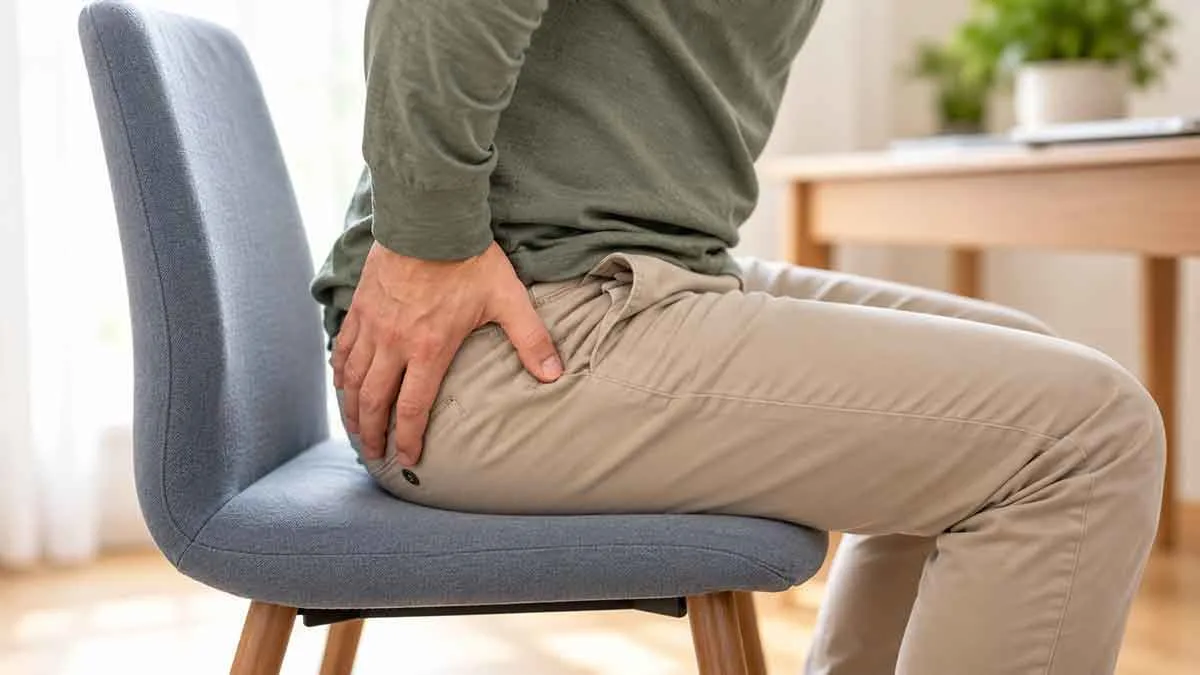
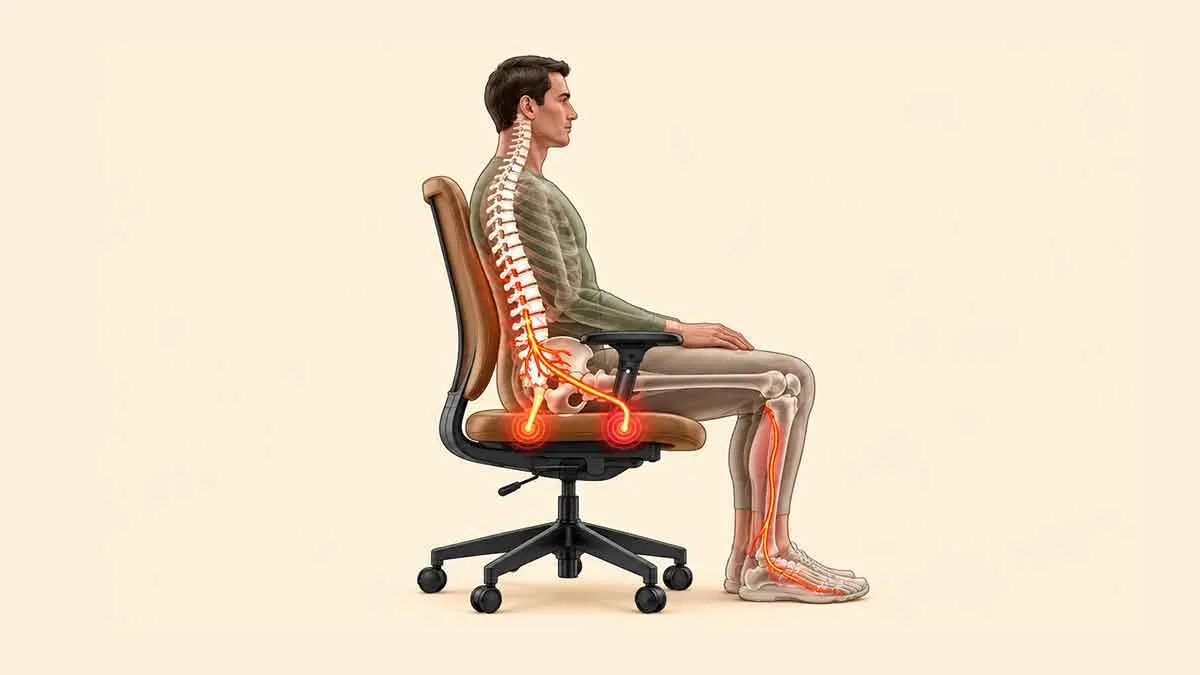
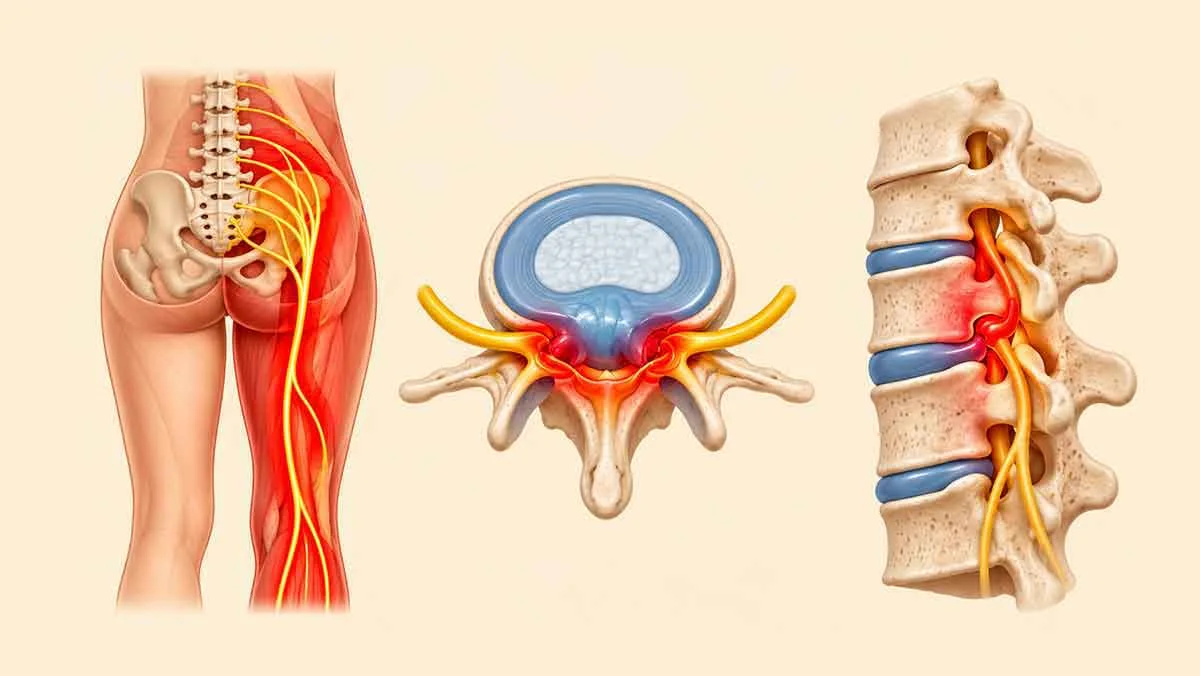
To understand why sitting causes so much deep discomfort, it is helpful to look at how your body handles physical weight. When you stand up straight, the heavy weight of your upper body is distributed evenly down through your hips, into your legs, and all the way down to your feet. The burden is shared across many large, strong joints. However, the moment you sit down, that entire system changes; all the heavy weight from your head, shoulders, and chest drops directly into the lower spine. It squeezes the soft disc present in your lower back; if your disc is already bulging or slipped, it affects the sciatic nerve a lot. Sitting in one place for hours makes your hips and muscles tight, which pulls on your pelvis and pinches the nerve even more. It also slows down your blood flow, which can increase the swelling and sharpen the pain. Check out our Sciatica Pain While Sitting page for more.
Desk-Job Routine And Ergonomics
Working at a desk all day puts heavy, direct pressure on your sciatic nerve. The secret to a comfortable workday is making your workspace fit your body. Keep your computer screen at your eye level because looking down pulls your upper body forward, which literally strains your lower spine.
Keep your keyboard close so your elbows rest naturally by your sides. Adjust your chair so your feet are flat on the solid floor, keeping your knees level with your hips. Most importantly, set a timer to stand up every thirty minutes to stop deep stiffness from locking your nerve.
Sitting Positions And Supports
Your desk is important, but how you actually sit in your chair is just as important. To properly protect your sciatic nerve you need to train your body how to sit in a way that actively supports the natural curve of your spine. Always push your hips all the way back to the very back edge of your seat so that the chair is holding your weight, rather than forcing your lower back muscles to do all the heavy lifting. Put a small firm cushion or a tightly rolled towel right behind your lower back to keep your spine from falling back. Never cross your legs as you work; this will totally twist your pelvis and pinch the delicate nerve sharply on one side. And finally, always empty your back pockets. Finally, always empty your back pockets before sitting down. Sitting on a thick wallet or heavy phone tilts your hips unevenly, which constantly grinds and irritates the sensitive nerve root all day long.
Movement-Break Plan
Staying in your chair without moving is what locks up your back and makes nerve pain flare up. You do not need a full workout during the workday. You simply need an easy routine to get out of your seat and take pressure off your spine. Follow this simple movement plan, and set a repeating timer on your phone for every thirty minutes. When it rings, stand up immediately, even if just for half a minute. Next, stand during phone calls; walking around slowly while talking gives your lower back an easy break. Also use a small water glass instead of a giant bottle so you are forced to get up and walk to refill it throughout the day. Every time you stand, stretch both arms high towards the ceiling to gently open your spine and breathe.
Driving modifications
Driving is often the most painful part of your day because you are stuck in a small, vibrating seat without any ability to move. To protect your pinched nerve during your daily commute, you must make a few changes before you start the engine. First, never drive with a wallet or phone in your back pocket. Sitting on anything uneven tilts your hips and constantly grinds the nerve with every single bump in the road. Next, fix your seating angle; pull your seat close enough to the steering wheel so you do not have to stretch forward, which puts heavy pressure on your lower back. If your car seat sinks deeply, place a small rolled towel behind your lower back to stop your spine from collapsing. Turn on your heated seats to keep your back muscles warm and always pull over every hour to walk around and stretch. Check out our Driving With Sciatica page for more.
Return-To-Work Guidance
Getting back to your desk after taking time off for a bad nerve can feel scary. The biggest mistake you can make is trying to sit for eight hours on your first day back. You must ease your routine slowly. Try to take standing breaks more frequently while your back heals. Before you even sit down on your first morning, set up your workspace completely. Bring your back cushion from home, get a small water glass, and fix your chair and screen height. If your normal job requires lifting heavy boxes, ask to do light desk tasks for the first few weeks.
Stop Signs And Medical Review
There are certain warning signs that our body gives which must not be ignored:
- If you suddenly lose all feeling in your inner thigh or groin area.
- If your pain gets steadily worse or does not improve after a few weeks of self-care.
- If you have unexplained weight loss, fever, night sweats, or chills, as it signals severe infection.
- If you cannot control your bladder or bowels.
- If your legs become so weak that you cannot lift them in front of your feet.
These symptoms must not be ignored, as they can be a sign of a serious problem.
References
Sciatica - StatPearls - NCBI Bookshelf
FAQs
No, a standing desk is helpful, but it is not a magic cure. If you stand frozen in one spot all day, your lower back muscles still get tight and tired. The real secret is switching between sitting and standing every 30 to 45 minutes to keep your spine moving smoothly.
Choose a firm, flat cushion that has a small cutout space at the very back (known as a tailbone cushion). This smart design lets your tailbone float in the air, removing the heavy, direct weight from your lower spine and taking pressure off the sciatic nerve.
By 5 PM, gravity has pushed down heavily on your spinal discs for hours. At the same time, your back muscles grow tired and weak, letting your posture collapse. This physical exhaustion directly squeezes your nerve, which is why your pain flares up before you clock out.
You can drive, but you must take regular breaks. Car engines send constant, small vibrations right into your seat, which deeply irritates an angry nerve. You must pull over every 45 to 60 minutes, get out, and walk around for five minutes to let your spine relax.
Keep both feet flat on the floor with your knees bent at a clean 90-degree angle. If your feet dangle, your lower back takes all the strain. Never cross your legs or sit on one foot, as this twists your hips and pinches the nerve immediately.
Yes, heat is wonderful for calming down tight back muscles. Turn on your heated seats during your commute. The gentle warmth keeps your tissues soft and stops cold air conditioning from locking up your lower back.
Never push through sharp or shooting pain. That sharp sensation is your body's alarm telling you the nerve is actively being crushed. If you feel pain building up, stand up, take a short walk, and stretch right away.
Yes, gentle walking is one of the easiest natural remedies. It pumps fresh blood to your lower spine, prevents deep stiffness, and gently stretches your tight hip muscles without putting harsh pressure on your lower back.
Consult Experienced Ayurveda Doctors for Sciatica While Sitting: Desk Work, Posture and Driving





















Our Happy Patients
-
 Sunita Malik - Knee Pain
 -
 Abhishek Mal - Diabetes
 -
 Vidit Aggarwal - Psoriasis
 -
 Shanti - Sleeping Disorder
 -
 Ranjana - Arthritis
 -
 Jyoti - Migraine
 -
 Renu Lamba - Diabetes
 -
 Kamla Singh - Bulging Disc
 -
 Rajesh Kumar - Psoriasis
 -
 Dhruv Dutta - Diabetes
 -
 Atharva - Respiratory Disease
 -
 Amey - Skin Problem
 -
 Asha - Joint Problem
 -
 Sanjeeta - Joint Pain
 -
 A B Mukherjee - Acidity
 -
 Deepak Sharma - Lower Back Pain
 -
 Vyjayanti - Pcod
 -
 Sunil Singh - Thyroid
 -
 Sarla Gupta - Post Surgery Challenges
 -
 Syed Masood Ahmed - Osteoarthritis & Bp
Diagnostic Marker
Blogs
- Ayurvedic Diet & Lifestyle Tips to deal with Sciatica
- 3 Yoga Asanas that Help Ease Sciatica Pain & Bring Relief
- Sciatica Pain? Try These 3 Home Remedies
- 5 Powerful Wonder Herbs to Relieve Sciatica Pain
- How to Sleep Peacefully With Sciatica Pain
- सायटिका का इलाज: जानिए कमर और पैरों की झनझनाहट से राहत पाने के आयुर्वेदिक तरीके
- Difference Between Sciatica and General Backache: What to Know
- क्या हीट थेरेपी या मसाज सायटिका में ठीक है? आयुर्वेद बताता है कब करना है और कब नहीं
- क्या स्लिप डिस्क और साइटिका एक जैसे हैं? दोनों में फर्क और आयुर्वेदिक उपचार समझिए
- लंबे समय तक ड्राइविंग या गलत बैठने से साइटिका क्यों ट्रिगर होता है? आयुर्वेद बताता है उपचार का सही मार्ग
Home Remedies
Related Disease
- Ayurvedic Treatment for Ankylosing Spondylitis
- Ayurvedic Treatment For Cervical Spondylosis
- Ayurvedic Treatment For Arthritis
- Ayurvedic Treatment for Osteoarthritis
- Ayurvedic treatment for Gout
- Ayurvedic Treatment for Sciatica
- Ayurvedic Treatment for Rheumatoid Arthritis
- Ayurvedic Treatment for Frozen Shoulder
- Ayurvedic Treatment for Deep Vein Thrombosis (DVT)
- Ayurvedic Treatment for Achilles Tendon Disorders
- Ayurvedic Treatment for Rickets
- Ayurvedic Treatment for Ganglion Cyst
- Ayurvedic Treatment for Osteoporosis
- Get Ayurvedic Treatment for AVN Avascular Necrosis
- Get Ayurvedic Treatment For Osteomyelitis
- Cerebral Palsy Treatment in Ayurveda
Latest Blogs
- Mindful Eating Is Trending—But Ayurveda Has Long Focused on How You Eat
- घर में बार-बार Snacks सामने दिखना बच्चों और Adults दोनों की Eating को कैसे बदलता है?
- गीले बाल बांधकर सोना कितना Harmless है?
- Why Dust Builds Up Faster Around Electronics and Workstations
- The ‘Clean Home’ Myth: When Fragrance Is Mistaken for Fresh Air
- बुजुर्गों का dinner बहुत जल्दी और breakfast बहुत देर से हो तो energy पर क्या असर पड़ सकता है?
- पीरियड्स से पहले Salty Food की Craving क्यों बढ़ सकती है?
- Can Ancient Dinacharya Be Practical For A Desk-Job Lifestyle?
- Why One ‘Perfect Breakfast’ Cannot Work For Every Body
- Mindful Eating नया Wellness Trend है या Ayurveda में यह Idea पहले से मौजूद था?
- Can Too Little Sleep Make Sugar Cravings Feel Stronger
- Seasonal Eating: Where Modern Nutrition And Ayurveda Meet
- हर चीज़ का health data track करना कब useful से obsessive बन सकता है
- Can Sleeping In An Overcooled Room Leave You Feeling Stiff In The Morning?
- Why Hair, Skin and Energy Often React to Aggressive Dieting
- बच्चों में weekend sleep timing बदलना Monday mood को कैसे प्रभावित कर सकता है
- Is Fasted Intense Exercise a Good Idea for Every Woman
- Health Tracking Every Hour: Helpful Awareness Or Another Source Of Stress?
- फोन देखते हुए चलना सिर्फ accident risk नहीं—posture और breathing पर क्या असर पड़ता है
- Bloating Before a Period: Why Lifestyle Can Change How It Feels
Ayurvedic Doctor In Top Cities
- Ayurvedic Doctors in Bangalore
- Ayurvedic Doctors in Pune
- Ayurvedic Doctors in Delhi
- Ayurvedic Doctors in Hyderabad
- Ayurvedic Doctors in Indore
- Ayurvedic Doctors in Mumbai
- Ayurvedic Doctors in Lucknow
- Ayurvedic Doctors in Kolkata
- Ayurvedic Doctors in Patna
- Ayurvedic Doctors in Vadodara
- Ayurvedic Doctors in Ahmedabad
- Ayurvedic Doctors in Chandigarh
- Ayurvedic Doctors in Gurugaon
- Ayurvedic Doctors in Jaipur
- Ayurvedic Doctors in Kanpur
- Ayurvedic Doctors in Noida
- Ayurvedic Doctors in Ranchi
- Ayurvedic Doctors in Bhopal
- Ayurvedic Doctors in Ludhiana
- Ayurvedic Doctors in Dehradun