Diabetes, arthritis, skin disorders & more! Get a free consultation with Top Ayurveda doctors - +91 9266714040 | No travel, No waiting – Consult Jiva’s doctors from home via video call! | Get up to 10% OFF! On Authentic Ayurveda Products! Best Prices only on the brand store. Visit : www.store.jiva.com
Dealing with nerve pain in your back and leg feels like a never-ending struggle. You might spend time doing gentle stretches, using heating pads, and watching your posture, wondering if you are actually healing or not. Most of the time, this quiet, patient home care is what your body needs to unpinch the trapped nerve. However, natural healing is not always enough, and wholly depending on it without consulting a doctor can make the problem worse. Sometimes the nerve is pinched so badly that you need medical care instead of just home care. This section explains how doctors diagnose sciatica and the major red flags you must never ignore.
How Sciatica Is Assessed
Both modern medicine and Ayurvedic treatment diagnose Sciatica accordingly, which includes the following:
How Does Modern Medicine Diagnose Sciatica?
Modern medicine includes the following tests to diagnose the problem in an individual:
Medical History: The doctor will do this to learn about your symptoms, when they started, what activity or movement makes them worse, and their location or type of pain (burning or sensation).
Straight Leg Raise (SLR) Test: In this test, you will lie down on a flat surface, and the doctor will raise the affected leg to check if the pain is shooting down below or not.
MRI: An MRI scan can show whether a disc in the spine is herniated or ruptured, which can cause pressure on the sciatic nerve and lead to sciatica pain.
CT scan: It provides cross-sectional views of spinal nerves and bone structure.
X-rays: This is done to check bone spurs or spinal alignment issues.
Electromyogram (EMG) and nerve conduction studies (NCS): They measure the electrical activity in the nerve and muscles to confirm the exact site and severity of nerve compression.
How Does Ayurveda Diagnose the Problem?
Along with the doctor's diagnosis, an Ayurvedic check-up depends on certain tests. It also looks at your whole life, not just your symptoms:
Nadi & Jiva Pariksha ( Pulse & Tongue Examination): The practitioner checks the nadi and tongue of the patient to see if the Vata dosha (governs air and movement in the body) is aggravated or not.
Rupa (Clinical Evaluation): The Ayurveda doctor will check your specific symptoms such as Stambha (stiffness), Ruka (sharp pain), and Toda (pricking sensations) in your body.
Physical Movement Test: The Ayurvedic practitioner also does physical checks such as Sakthi Utkshepa Nigrah, meaning the inability or restricted movement in lifting the leg, similar to the straight leg raise test.
Assessing Srotas (Pathways): They evaluate how energy and circulation flow through your lower body to check which srotas are exactly blocked.
Apart from these, an Ayurvedic practitioner may also check your X-rays, MRI, CT scan, or other related tests to know the big picture and treat the problem accordingly.
I was suffering from sciatica since 2025 and Doctors prescribed me for surgery but I believe in ayurveda and came here to consult with Dr Bhawna , she advised me 14 days panchakarma treatment. After 14 days panchakarma. I stayed here for 14 days and got 90% relief in my symptoms. I thankful to Dr Bhawna and team to cure me.
Thank you Lalita, Preeti, Naina and Tanuja who give me thefalies and personal care.
Reception staff was also very coperative.
When Imaging May Be Discussed
In the acute stage of sciatica, the diagnosis is usually based on physical examination and the patient's history, and if the patient starts seeing improvement, then no further tests are considered. Imaging testing may be discussed:
If there are indications of any red flags or there is a high chance of infection, due to spinal instability, misalignment, and advancing sepsis.
When the patient does not have any relief from conservative care and treatment for six to eight weeks, because of structural failure or progressive nerve compression.
If the patient has severe symptoms and does not improve within days, it can be due to acute neurological decline, unstable structural trauma, or rapidly evolving infectious states.
In such cases, blood tests (to check CBC, CRP, or ESR levels) and advanced imaging tests such as MRI, X-ray, or CT scan are recommended to get the big picture and make the treatment plan accordingly.
Emergency Red Flags
While mild sciatica pain can improve with proper care and time, serious cases have symptoms you shouldn't ignore and that require urgent medical care.
If you have partial or total loss of bladder control, have difficulty passing urine or having a bowel movement, and find blood in the stool.
If you experience severe weakness and loss of sensation in the groin, legs, and genital area.
If you have swelling in any part of the back, thigh, or leg.
If you see a change in the color of the skin, commonly blue, in the legs or feet.
If you have sexual dysfunction because of the pain.
If you experience itchiness in the painful region of the leg.
If you have a leg infection that does not heal with proper care.
These signs are serious and can signify a serious issue in the nerve, so ignoring them might result in something serious.
Progressive Weakness And Numbness
Sciatica is basically a symptom of nerve root compression or injury. The symptoms of sciatica usually come early, such as leg weakness or mild numbness, which can improve over time. But in some cases, sciatica can be progressive (meaning that the leg weakness and numbness will get worse every single day without any improvement), which can also make the symptoms progressive.
More sciatica pain, leg weakness and numbness, or more nerve damage can be the starting signs. It starts affecting your daily walking if not treated on time. Sciatica symptoms may become more acute, with sudden back pain or difficulty in standing because of leg pain, which might signal an acute process, like disc herniation and critical nerve compression.
Bladder/Bowel Or Saddle-Area Symptoms
This is the most critical warning sign that you should never ignore. The pain of sciatica is so severe that it can make it difficult to push when you have bowel movements, leading to constipation. We have sacral nerves, pelvic floor, anal sphincter, and bladder muscles that control our bowel movements; if you have sciatica, it can cause problems with them, causing diarrhea or incontinence.
If you have constipation because of sciatica, then it can lead to other problems such as hemorrhoidal infections, anal fissures, and even toxic megacolon, which requires severe medical treatment. So if you have difficulty with bowel movements, then it should not be ignored, and you should discuss this with your doctor urgently.
Routine vs Urgent Appointment
If you know when you need to rush to the doctor and when you can just go for a routine appointment, it can help in understanding that stress usually comes when the symptoms become severe:
When To Go For A Routine Treatment
Well, if you are suffering from sciatica, then taking routine treatment becomes necessary. Even if you have mild pain and have noticeable improvement, do not skip your visits to the doctor. Because skipping them can lead to severe issues that may require urgent medical attention later.
When To Take An Urgent Appointment
If you are going for routine treatment and taking care of yourself, then you may not need to have an urgent appointment with the doctor. But if your symptoms have become severe and you have emergency warning signs, then ignoring them and treating them at home may be harmful.
What To Tell The Doctor
When you visit a doctor, you just need to be completely honest so that he can give you the proper and exact solution for the problem.
Your pain location: Tell the doctor about your pain location, where it starts and where it goes.
Trigger activities: If there is any activity such as sitting, standing, bending, or kneeling that triggers the pain.
Pain type: Describe the feeling of the pain: sharp, mild, intense, electric, or shooting pain.
Timeline: Also share the timeline of how long you have had the pain and, if it triggers, how long it stays.
Numbness or weakness: If you have any sort of weakness or numbness in the legs, back, or any other specific part of the body.
Red flag signs: If you have severe symptoms such as loss of bladder control, swelling, or loss of sensation in the groin area, then do tell about this to the doctor.
Many tests are done to confirm whether you have sciatica, but the most common test which is done is the SLR (Straight leg raise) test, and a medical examination is done.
The worst thing is bending forward with a rounded lower back while twisting or lifting heavy objects, as this increases the pressure on the spinal discs and directly irritates the nerve.
Sciatica is serious when you have leg weakness, loss of bladder or bowel control, and a sharp pain that does not improve within a few weeks.
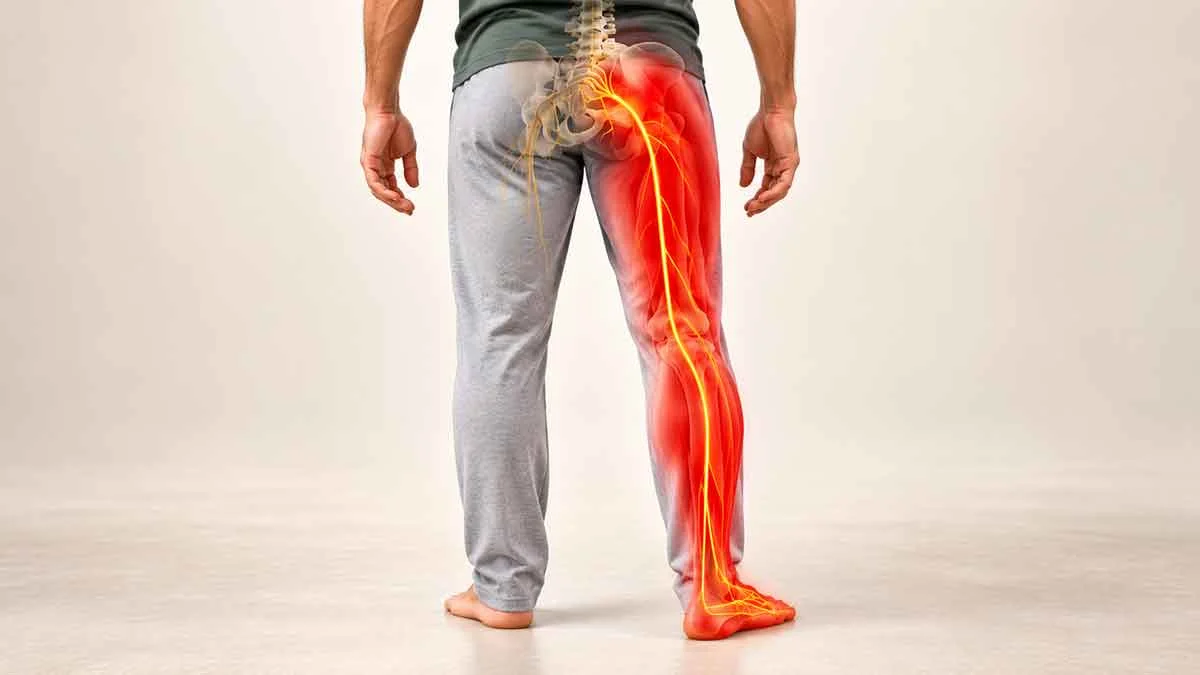
Sciatica usually starts from your lower back or buttock and radiates down to your leg, causing electric pain in the nerve.
If your sciatica pain is so bad, then you should see a doctor immediately or seek urgent medical evaluation to find out if you have serious nerve compression or something else.
Find Jiva Ayurveda Clinics for Sciatica Treatment Near You

 Published on 01 Oct, 2026
 Updated on 21 Oct, 2026