
Successful Treatments
Clinics
Doctors
Colonoscopy For IBD: Preparation, Procedure and Results
 Published on 01 Oct, 2026
 Updated on 12 Oct, 2026

Explore Diagnosis & Tests
- Home / Diseases & Ayurveda / Digestive Disorders / Ayurvedic Treatment For Inflammatory Bowel Disease (IBD) / IBD Diagnosis And Tests / Colonoscopy For IBD: Preparation, Procedure and Results
Colonoscopy is an important test used to diagnose and monitor IBD. It allows doctors to examine the inner lining of the large intestine and the end of the small intestine for signs of inflammation, ulcers, bleeding, or other changes. During the procedure, small tissue samples may also be taken for a biopsy.
.webp)
Why Colonoscopy Is Used In IBD
Colonoscopy helps doctors look directly at the bowel lining to check for inflammation and other changes linked with IBD. It can help:
- Confirm whether inflammation is present.
- Identify areas affected by Crohn’s disease or Ulcerative colitis.
- Assess how severe the inflammation is.
- Help distinguish IBD from other diseases with similar symptoms.
- Monitor how the disease is responding to the treatment.
- Check for complications in the digestive tract.
- Take a biopsy to examine the tissue under a microscope.
How To Prepare: Follow The Clinic Plan
Good preparation helps the doctor get a clear view of the bowel lining. Your doctor may give you specific instructions, but preparation usually includes:
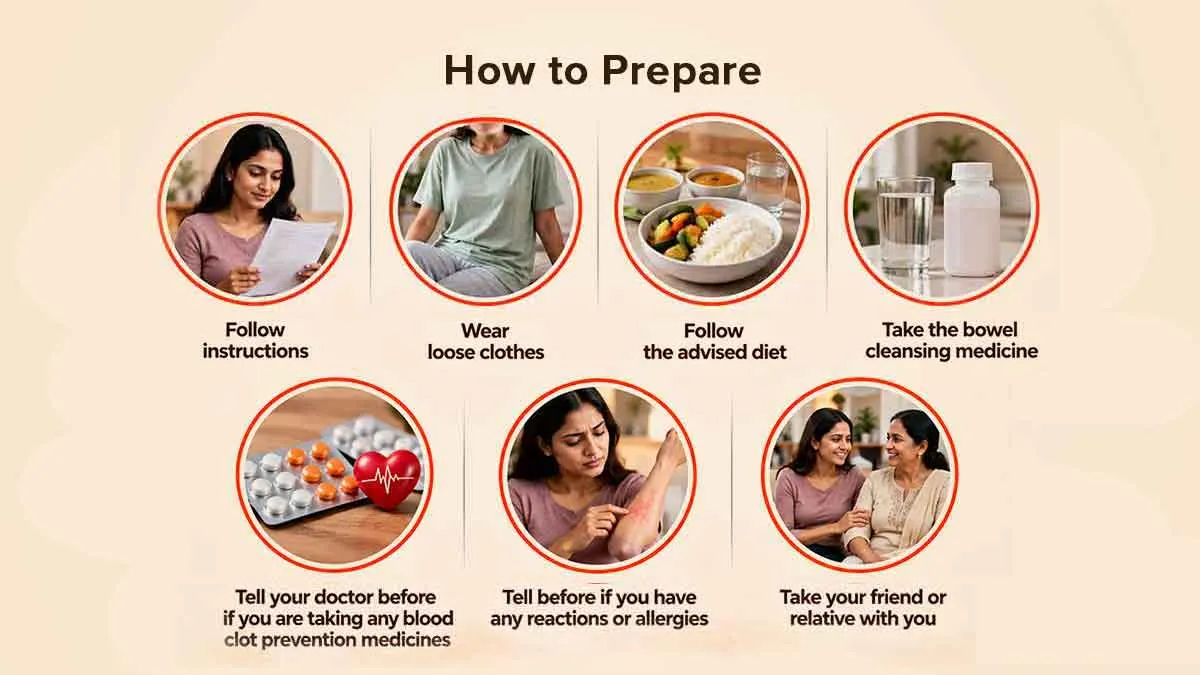
- Follow the bowel preparation instructions given by your doctor.
- Wear loose clothes on the test day.
- Take the bowel cleansing medicine at the recommended time and dose.
- Follow the advised diet and clear liquid instructions.
- Stop eating and drinking at the time your doctor tells you.
- Tell your doctor before if you are taking any blood clot prevention medicines.
- Tell before if you have any reactions or allergies.
- Take your friend or relative with you if your doctor advises you to take a sedative.
What Happens During The Procedure
During a colonoscopy, you will usually lie on your left side while the doctor gently passes a thin camera through the rectum to examine the colon. You may be given a sedative using Entonox or an injection of painkillers to help you relax and stay comfortable. The doctor looks for signs of inflammation, ulcers, bleeding, or other changes of IBD. A small tissue sample may also be taken for a biopsy. After the procedure, some people have mild bloating or abdominal discomfort for a short time. The colonoscopy procedure includes:
Bowel Preparation
Bowel preparation is the process of cleansing stool from the colon before a colonoscopy. You are usually given a Laxative to empty the bowel, along with instructions about what to eat and drink before the procedure. Follow the doctor’s instructions carefully, as an incomplete bowel preparation makes it harder to see the bowel lining clearly.
Sedation
Sedation is basically a medical drug used during a colonoscopy or biopsy to calm and relax you. It can make you sleepy and may reduce awareness of the procedure. If you receive sedition, it is advised to take someone with you to drive you back home safely because you may feel dizzy for a while. You must follow the instructions given by your doctor after taking a sedative.
Why Biopsies Are Taken
Biopsy
A biopsy is a procedure that examines the cells, tissue, or fluid samples under a microscope. It helps detect infections, ulcers, inflammation, and cancer present in the samples. It helps track the progress of medical therapy. In this process, a thin needle is used to extract cells or tissue samples, and then the samples are sent for analysis.
Why Are Biopsies Taken?
Biopsies are taken during a colonoscopy to examine small pieces of bowel tissue under a microscope. They can help doctors look for signs of inflammation, confirm the pattern of IBD, assess changes in the bowel lining, and rule out other conditions that may cause similar symptoms. Colon biopsy helps diagnose diarrhoea and different forms of colitis. IBD is a long- standing disease which increases the risk of colorectal cancer, and routine surveillance with biopsies helps find early dysplasia (precancerous changes).
Possible Findings
A colonoscopy may show different changes depending on the type and activity of IBD. Possible findings include:
- Redness and swelling in the bowel lining
- Ulcers or sores in the bowel
- Bleeding from the lining
- Loss of blood vessels
- Patchy areas of inflammation
- Narrowed areas or strictures
- Continuous inflammation, spreading from the rectum upward into the colon
- Normal-looking bowel, especially when IBD is in remission.
Aftercare And Common Temporary Effects
After a colonoscopy, you can return to your daily activities as advised by your doctors. If sedition was used, you may feel sleepy for a while, so you should avoid driving until its effects have worn off. Mild bloating, gas, abdominal discomfort, and other changes in bowel movements can happen for a short time after the procedure. Drink fluids and eat as advised by your doctor. Contact your doctor if you develop severe abdominal cramps, heavy bleeding, fever, vomiting, or other symptoms that concern you.
Risks And Warning Signs
Colonoscopy is generally safe, but some people may develop:
- Mild bloating, gas, or abdominal discomfort.
- A small amount of bleeding, especially after biopsy.
- Fever or vomiting
- Breathing changes or low blood pressure
- Dizziness, weakness, or fainting
- Rarely, a tear or infection in the bowel.
Get immediate medical care if you notice:
- Severe belly pain
- Heavy bleeding
- High fever
- Repeated digestive distress
- Extreme weakness
How Results Guide Treatment And Surveillance
Colonoscopy and biopsy results help doctors understand how active the IBD is and how much of the bowel is affected. If inflammation has improved or the bowel lining has healed, it may suggest that the treatment is working. If inflammation continues, the doctor may consider changing the treatment or monitoring more closely. The test results also help plan future colonoscopy or biopsy. Surveillance is clearly based on the person’s condition and risk factors. Results usually take one to four weeks, depending on the tissue sample.
Disease Extent
Colonoscopy helps doctors see where inflammation is present and how much of the bowel is affected. In ulcerative colitis, inflammation usually starts in the rectum and may extend continuously through part of the colon; in crohn’s disease, affected areas can be patchy and may involve different parts of the digestive tract. Knowing the extent helps doctors assess the disease and plan further treatment.
Cancer Surveillance
Cancer surveillance is the follow-up exam used to monitor individuals with high risk of colorectal cancer or those who have already been treated for it. People with long-standing IBD, when the colon is affected, may need regular colonoscopies to check for precancerous changes or colorectal cancer. During surveillance, doctors carefully examine the bowel lining and may take a biopsy from suspicious or selected areas. The timing depends on factors such as disease duration, extent of chronic involvement, inflammation, and other risk factors.
Reference
The Role of Colonoscopy in Inflammatory Bowel Disease - PMC
Endoscopic Diagnosis and Differentiation of Inflammatory Bowel Disease - PMC
The Role of Colonoscopy in Inflammatory Bowel Disease - PMC
Colonoscopy plus biopsy in the inflammatory bowel diseases - PubMed
FAQs
Not always. Your doctor decides based on your symptoms, disease history, treatment, and need for monitoring.
No, only small samples are taken during the procedure without you feeling them.
A colonoscopy procedure usually takes 30 to 60 minutes. But check-in, preparation, and post-test recovery may take a few hours. So you should prepare for at least 3 to 4 hours.
Yes, you can resume your normal diet, but in some cases your doctor’s advice is needed.
Consult Experienced Ayurveda Doctors for Colonoscopy For IBD: Preparation, Procedure and Results










Our Happy Patients
-
 Sunita Malik - Knee Pain
 -
 Abhishek Mal - Diabetes
 -
 Vidit Aggarwal - Psoriasis
 -
 Shanti - Sleeping Disorder
 -
 Ranjana - Arthritis
 -
 Jyoti - Migraine
 -
 Renu Lamba - Diabetes
 -
 Kamla Singh - Bulging Disc
 -
 Rajesh Kumar - Psoriasis
 -
 Dhruv Dutta - Diabetes
 -
 Atharva - Respiratory Disease
 -
 Amey - Skin Problem
 -
 Asha - Joint Problem
 -
 Sanjeeta - Joint Pain
 -
 A B Mukherjee - Acidity
 -
 Deepak Sharma - Lower Back Pain
 -
 Vyjayanti - Pcod
 -
 Sunil Singh - Thyroid
 -
 Sarla Gupta - Post Surgery Challenges
 -
 Syed Masood Ahmed - Osteoarthritis & Bp
Home Remedies
- पेट में गैस, जलन या संक्रमण? इन घरेलू उपायों से पाएं राहत
- पेट में गैस, अपच और फुलाव का आयुर्वेदिक इलाज - मुफ़्त परामर्श
- एनल फिशर से परेशान हैं? ये आयुर्वेदिक नुस्खे देंगे राहत और आराम
- कब्ज़ का आयुर्वेदिक इलाज - मुफ़्त परामर्श
- एसिड रिफ्लक्स का घरेलू इलाज - मुफ़्त आयुर्वेदिक परामर्श
- Food Poisoning का आयुर्वेदिक इलाज - मुफ़्त परामर्श
- क्या बार-बार उल्टी हो रही है? इन घरेलू उपायों से पाएं तुरंत आराम
- क्या आप जानते हैं? इन नुस्खों से पेट दर्द जड़ से खत्म होता है!
- बार-बार एसिडिटी? ये देसी नुस्खे तुरंत देंगे आराम!
- दवा की ज़रूरत नहीं! लूज़ मोशन का रामबाण इलाज घर पर ही
- Home Remedies for Vomiting
- Home Remedies for Piles
- Home Remedies for Food Poisoning
- Home Remedies for Stomach Infection
- Home Remedies for Bloating
- Home Remedies for Anal Fissure
- Home Remedies for Constipation
- Home Remedies for Acid Reflux
- Home Remedies for Acidity
- Home Remedies for Stomach Pain
Related Disease
- Ayurvedic Treatment for Acid Reflux
- Ayurvedic Treatment for Anemia
- Ayurvedic Treatment For Anorexia
- Ayurvedic Treatment for Chronic Fatigue Syndrome
- Ayurvedic Treatment For Gastritis
- Ayurvedic Treatment For Colitis
- Ayurvedic Treatment For Crohn’s Disease
- Ayurvedic Treatment for Weakness and Fatigue
- Ayurvedic Treatment For Flatulence
- Ayurvedic Treatment for Gallstones
- Ayurvedic Treatment for Jaundice
- Ayurvedic Treatment for Liver Cirrhosis
- Ayurvedic Treatment for Sickle Cell Anaemia
- Ayurvedic Treatment For Piles And Fissure
- Ayurvedic Treatment for Irritable Bowel Syndrome (IBS)
- Ayurvedic Treatment For Hyperacidity
- Ayurvedic Treatment for Constipation
- Ayurvedic treatment for Coeliac Disease
- Ayurvedic Treatment for Peptic Ulcer
- Ayurvedic Treatment for Tapeworm
- Ayurvedic Treatment for Typhoid
- Ayurvedic Treatment for Diarrhea
- Ayurvedic Treatment for Diverticulitis
- Ayurvedic Treatment for Pinworms
- Ayurvedic Treatment for Cholera
- Ayurvedic Treatment for Emphysema
- Ayurvedic Treatment for Food Poisoning
- Ayurvedic Treatment for Atherosclerosis
- Ayurvedic Treatment for Thalassemia
- Ayurvedic Treatment for High Triglycerides
- Get Ayurvedic Treatment for Gastroenteritis
- Ayurvedic Treatment For Inflammatory Bowel Disease (IBD)
Latest Blogs
- बुजुर्गों का dinner बहुत जल्दी और breakfast बहुत देर से हो तो energy पर क्या असर पड़ सकता है?
- पीरियड्स से पहले Salty Food की Craving क्यों बढ़ सकती है?
- Can Ancient Dinacharya Be Practical For A Desk-Job Lifestyle?
- Why One ‘Perfect Breakfast’ Cannot Work For Every Body
- Mindful Eating नया Wellness Trend है या Ayurveda में यह Idea पहले से मौजूद था?
- Can Too Little Sleep Make Sugar Cravings Feel Stronger
- Seasonal Eating: Where Modern Nutrition And Ayurveda Meet
- हर चीज़ का health data track करना कब useful से obsessive बन सकता है
- Can Sleeping In An Overcooled Room Leave You Feeling Stiff In The Morning?
- Why Hair, Skin and Energy Often React to Aggressive Dieting
- बच्चों में weekend sleep timing बदलना Monday mood को कैसे प्रभावित कर सकता है
- Is Fasted Intense Exercise a Good Idea for Every Woman
- Health Tracking Every Hour: Helpful Awareness Or Another Source Of Stress?
- फोन देखते हुए चलना सिर्फ accident risk नहीं—posture और breathing पर क्या असर पड़ता है
- Bloating Before a Period: Why Lifestyle Can Change How It Feels
- बहुत जल्दी खाना खाने से पेट भरने का signal देर से क्यों मिलता है
- ‘No Added Sugar’ Doesn’t Automatically Mean Low Sugar—Here’s Why
- Online meetings के बीच zero movement दिन के अंत में stiffness क्यों बढ़ाता है?
- Screen brightness और late-night work sleep readiness को कैसे बदलते हैं
- Warm Vs Cold Foods: How To Discuss The Ayurvedic Idea Without Turning It Into A Myth
Ayurvedic Doctor In Top Cities
- Ayurvedic Doctors in Bangalore
- Ayurvedic Doctors in Pune
- Ayurvedic Doctors in Delhi
- Ayurvedic Doctors in Hyderabad
- Ayurvedic Doctors in Indore
- Ayurvedic Doctors in Mumbai
- Ayurvedic Doctors in Lucknow
- Ayurvedic Doctors in Kolkata
- Ayurvedic Doctors in Patna
- Ayurvedic Doctors in Vadodara
- Ayurvedic Doctors in Ahmedabad
- Ayurvedic Doctors in Chandigarh
- Ayurvedic Doctors in Gurugaon
- Ayurvedic Doctors in Jaipur
- Ayurvedic Doctors in Kanpur
- Ayurvedic Doctors in Noida
- Ayurvedic Doctors in Ranchi
- Ayurvedic Doctors in Bhopal
- Ayurvedic Doctors in Ludhiana
- Ayurvedic Doctors in Dehradun